English
 Español
 Français
 Deutsch
 Italiano
 Português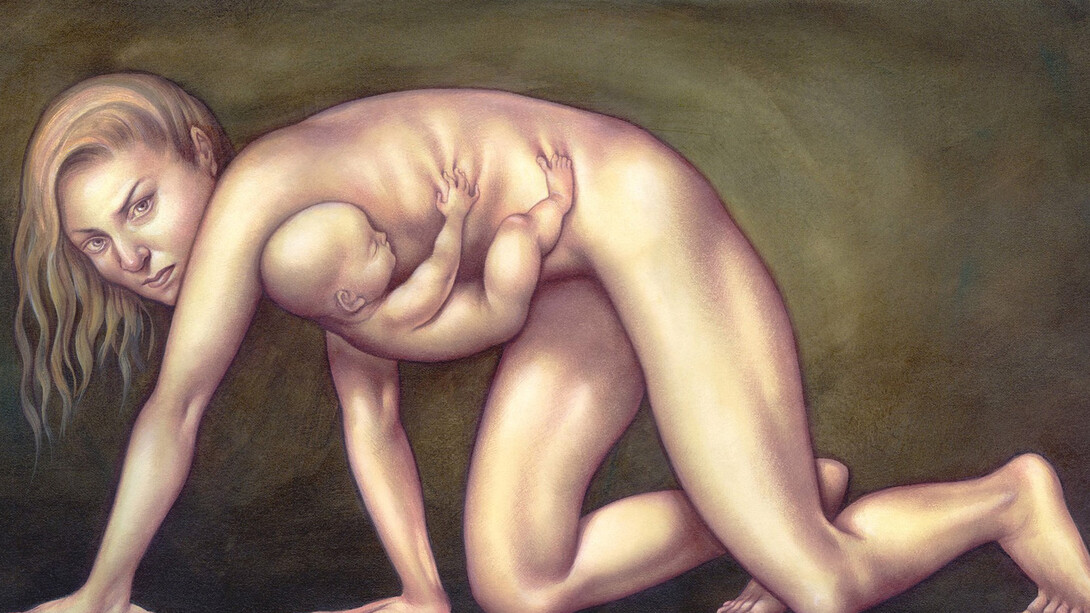
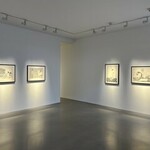
Philippe Labaune Gallery is pleased to present Evolution, a solo exhibition by Canadian artist, Anita Kunz. Bringing together decades of work, the exhibition explores evolution as a living system, one shaped by continual change, expansion, and recalibration. Born in 1956 and based in Toronto, Kunz is internationally recognized for her editorial illustrations for such magazines as: The New Yorker, Rolling stone, and Time, alongside a deeply personal studio practice. A graduate of the Ontario College of Art in 1978, her meticulous technique reflects the influence of Flemish painting and European Expressionism. The exhibition unfolds across two interconnected sections: a survey of her iconic editorial imagery and a selection of personal paintings in which mammals and humans meet in surreal, often intimate encounters. Together, these works frame evolution not as a linear progression, but as an ongoing biological, emotional, and conceptual process.
In her personal work, Kunz approaches evolution by dissolving the perceived divide between human and animal. Figures appear suspended in states of metamorphosis, inhabiting a shared space between instinct and intellect, physicality and emotion. Evolution extends beyond biology into emotional awareness. Themes of nurturing, vulnerability, and survival recur throughout the paintings, presented not as uniquely human conditions but as shared realities across species. Kunz’s attention to biological truth is matched by a sensitivity to interior states, suggesting that empathy, connection, and care are as crucial to evolution as physical adaptation.
This understanding is powerfully articulated in The chosen one, where a monkey cradles her own offspring alongside a human infant. The image proposes compassion as a universal instinct, untethered from species or genetic lineage. By depicting an animal caring for a child not her own, Kunz emphasizes a shared language of protection and nurture. Evolution, in this context, is defined not by difference, but by the behaviors and emotional bonds that sustain life.
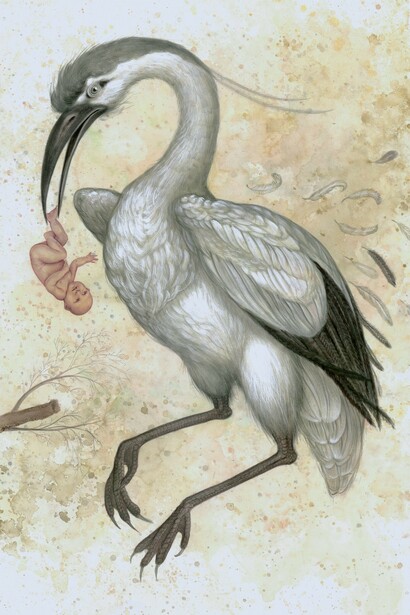
Other works extend this exploration of evolution as both physical and emotional. In The panther, a human figure assumes the crouched stance of a predatory animal while fused with an infant, merging strength and vulnerability into a single form. The posture signals instinct and survival, while its symbolic weight evokes motherhood and care. Physicality and emotion become inseparable, suggesting that protection, attachment, and endurance are foundational impulses embedded across species.
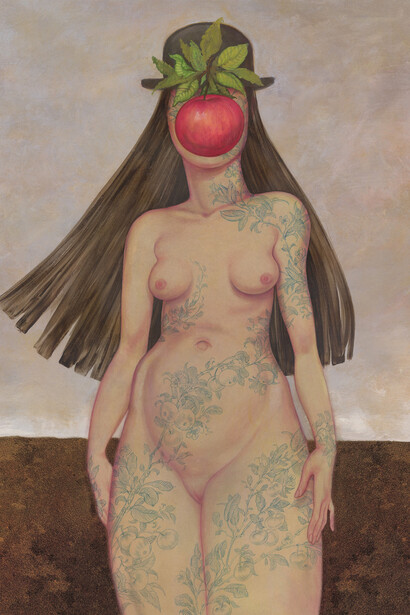
Beyond the physical, Kunz presents evolution as a symbolic and metaphorical process shaped by memory, history, and myth. In works such as The beauty, The puncture, Painted pony, and Marked Cat and Dog, antlers, markings, and mythic references operate as visual metaphors for adaptation and transformation. These elements suggest that change is cumulative rather than abrupt, and formed through experience, environment, and inherited narratives. Evolution emerges as a dialogue between what is remembered and what is becoming, negotiated across both collective and personal histories.
This view of evolution extends into Kunz’s editorial and commercial work, where adaptation takes the form of stylistic reinvention. Drawing from art history and cultural memory, Kunz recontextualizes public figures to comment on human behavior and societal change. Her portrayal of Charles Darwin serves as a conceptual bridge between her personal and published work. Rendered with humor and insight, Darwin appears not as a distant historical figure, but as an active participant in the theory he proposed, reflecting Kunz’s ongoing process of observation, critique, and refinement.
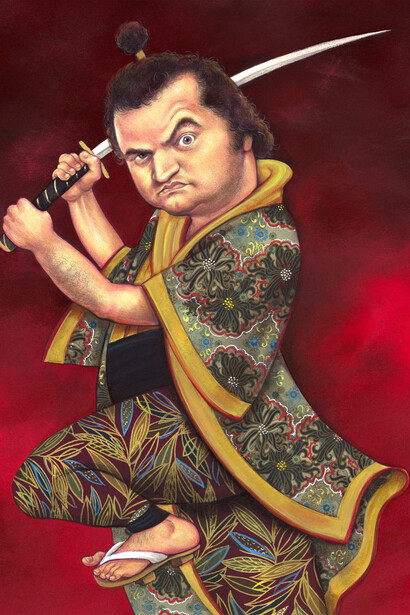
Characterized by distorted hyperrealism, Kunz’s distinctive editorial illustrations fuse Old Master techniques with sharp satire. In her Rolling Stone portrait of John Belushi, exaggerated form and vivid color capture both the performer’s manic energy and the cultural moment he embodied. For The New Yorker’s 100th anniversary, Eustace Froggy transforms the magazine’s iconic Eustace Tilly into an animal alter ego, using wit and metaphor to reflect the publication’s enduring voice and its observations of human nature. Across these works, evolution appears as a cultural phenomenon shaped by shifting identities, social norms, and collective memory.
Evolution reveals Anita Kunz’s work as an ever-adapting organism: responsive, expansive, and driven by continual reinvention. The exhibition invites viewers to consider the pace of human evolution while reminding us of our enduring connection to the mammalian world. In Kunz’s vision, progress does not erase instinct or emotion, but exposes how deeply they remain intertwined with who we are becoming.