English
 Español
 Français
 Deutsch
 Italiano
 Português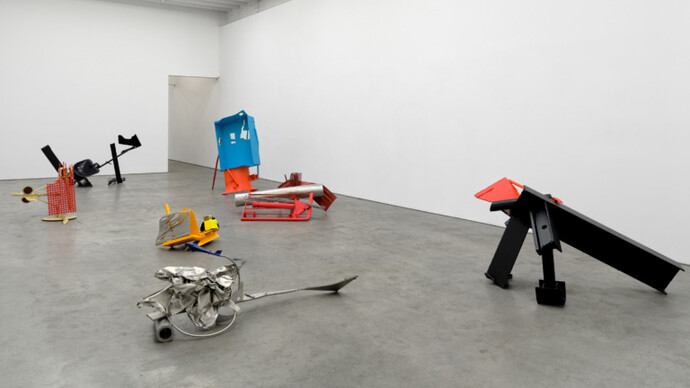
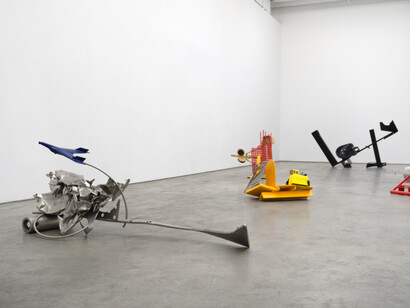
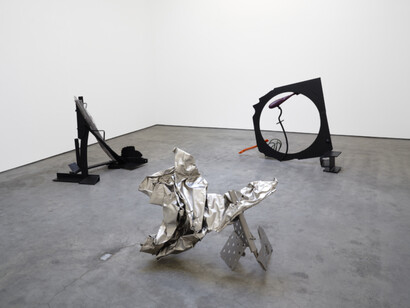
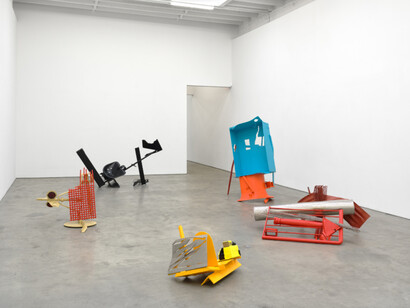
Since the 1970s, Peter Bradley has made expressive, abstract sculptures alongside the Color Field paintings for which he is best known. For Ten sculptures, Bradley welded together salvaged industrial fragments such as grates, pipes, and perforated sheets to create hybrid forms that fuse geometrical abstraction with assemblage’s connection to the everyday. As in his paintings, color, which in Bradley’s words “dictates sound, feelings . . . It’s all color,” is essential here. The artist used a focused palette for select elements, setting off the burnished silver of untreated steel. This evocative combination of found and altered forms synthesizes Bradley’s over fifty years of improvisational abstractions across media.
Bradley began making sculptures with reclaimed wood around the time he started using a spray gun to project acrylic onto canvas, which would become his signature technique throughout the 1970s. The artist learned to weld metal at the end of the decade, and, during a 1985 residency at the Thupelo Workshop in Johannesburg, South Africa, he exclusively worked in sculpture. There, he made the large-scale, milled-steel Silver dawn—later dedicated to the people of the city by anti-apartheid activist Desmond Tutu. “One of the things that South Africa taught me,” Bradley said in 2017, “was that abstraction was the greatest expression of freedom.”
The nonrepresentational works in Ten sculptures, made in Bradley’s open-air studio in upstate New York, communicate this freedom through connections to flight. The swath of steel at the center of Albatross (2022) is furrowed as fluidly as textile, lending the work a lightness that is tempered by its titular bird’s associations with psychic burden. In Fly away (2022), an ultramarine model airplane is supported by a curling piece of pipe that traces the jet’s arc through space while also arresting its movement—a vapor trail made solid. In its tented structure and cadmium-red gloss, Orange right of way (2023) evokes the “stabiles” of Alexander Calder, with whom Bradley became close while working in the Guggenheim’s conservation department on the installation of Calder’s 1964 retrospective. But unlike the Modernist sculptor, who transfigured his materials such that their origins are untraceable, Bradley allows his H-beams and piece of signage to retain evidence of their history in the built environment. As in his recent paintings, which he places outdoors to be transformed by the elements, Bradley’s sculptures invite the outside world into abstraction.