English
 Español
 Français
 Deutsch
 Italiano
 Português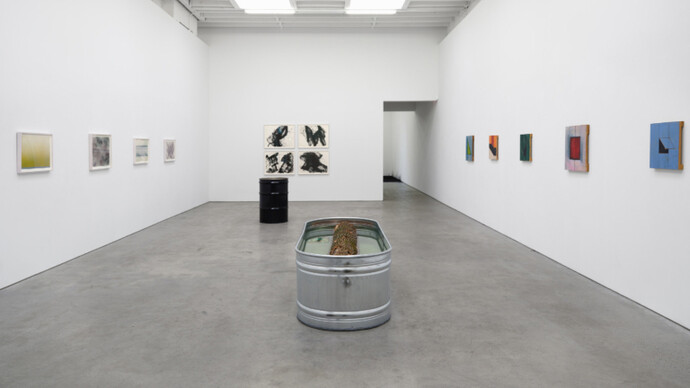
To construct something with the intention that it have meaning is a mistake.
(Bill Bollinger)
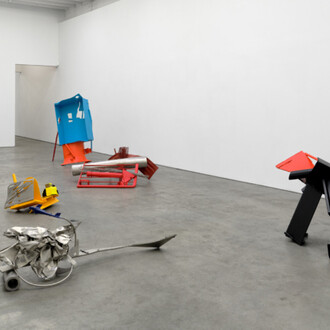
Bill Bollinger was a central figure in the Postminimalist and anti-form movements of the late 1960s and early 1970s. Karma’s first exhibition with the Bollinger estate, I am gravity features an installation, drawings, paintings, and sculptures in line with William Carlos Williams’s call for “no ideas but in things.” Included in era-defining exhibitions like Anti-illusion: procedures/materials (Whitney Museum of American Art) and Live in your head: when attitudes become form (Kunsthalle Bern, both 1969) alongside artists such as Richard Serra, Eva Hesse, and Richard Tuttle, Bollinger developed a form of inverse Conceptual art: rather than presenting ideas as things, he presented things as ideas. For the artist, common objects—rope, plastic hose, aluminum pipe, wire mesh, a trough—were “simple, physical expression[s] of an idea, a way of conveying information.”
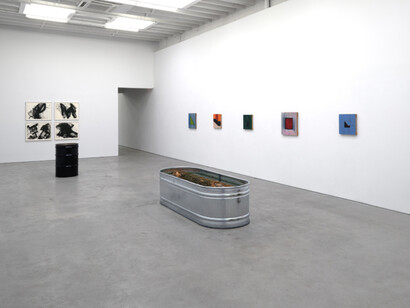
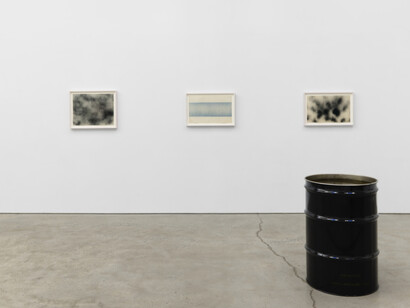
The relationship between these ordinary materials and the forces of nature was the primary subject of Bollinger’s art. A work on paper from around 1968 makes this explicit; stenciled in black inside a square, the words “I am gravity” lend the exhibition its title. This focus reflects his undergraduate study of aeronautical engineering—at his first solo show in 1966, he displayed wall-mounted aluminum channels whose sleek forms alluded to aircraft design. Over the next three years, the artist would have four solo exhibitions at Klaus Kertess’s Bykert Gallery. At Karma, a reconstruction of a 1969 graphite scatter piece originally presented at Bykert exemplifies Bollinger’s use of manufacturing materials to artistic ends—in addition to its use as a drawing medium, the powdered carbon is a commercial lubricant. His final Bykert exhibition, in 1970, was a sprawling installation sited in a vacant industrial space on the top floor of the Starrett-Lehigh Building in a pre-gentrified Chelsea. The sculptures, as with most of the artist’s work at this time, were dismantled when the show was over. In the New York times, Peter Schjeldahl described Bollinger’s installation as “a species of ‘Conceptual’ art . . . it sets itself problems—quite arbitrary problems, usually, like how to relate a log to a steel trough—that challenge the artist to come up with simple, ‘rational’ solutions: in this case, fill the trough with water and float the log in it.” In this way, Bollinger adduces containment, gravity, and Archimedes’s Principle (put simply, buoyancy) in an adroitly straightforward piece of sculpture. A new permutation of Trough with floating log (1970) is included here.
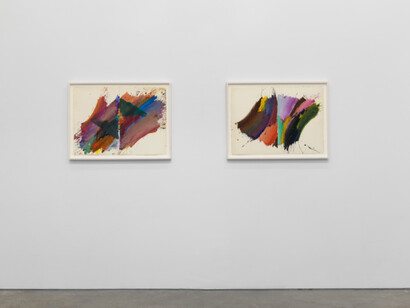
While Bollinger’s sculptures were ephemeral, works on paper from the 1960s and 1970s provide a record of his work from that time. Alongside an array of spray paint drawings with strong horizons, I am gravity features Bollinger’s renderings of abstract maps. These are bisected by equatorial baselines illustrating the Coriolis Effect, the pseudo-force that makes the paths of water, wind, and objects appear to curve as they move relative to the Earth’s rotation. The exhibition also presents Bollinger’s final body of work: never-before-shown paintings on wood from the late 1970s and 1980s through which the artist once again found ways to integrate his complex engineering ideas into uncomplicated objects. Here, the wood grounds recall the ramp sculptures in the same material he showed at OK Harris Gallery in 1972. Ramps are the simplest of simple machines: just inclined planes, they reduce the force required to move objects vertically against gravity’s pull. In these untitled paintings, Bollinger creates a concise visual analog, turning both the object—the deconstructed ramp—and the forces, both applied and gravitational, that act upon it, into works of art.
(Text by Mitchell Algus)