English
 Español
 Français
 Deutsch
 Italiano
 Português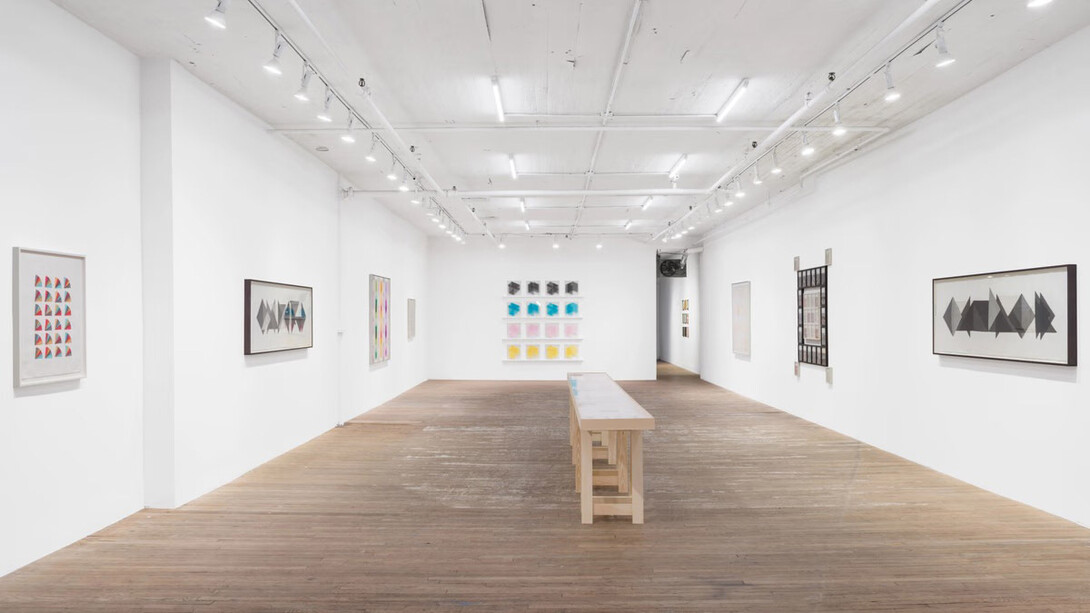
Perhaps the most basic technique in both sewing and embroidery is a running stitch, a simple line of stitches equal in length, consistently spaced — like a dotted line. One method of strengthening or reinforcing this line is a back stitch, which loops backward to fill in the spaces left open between the “running” stitches.
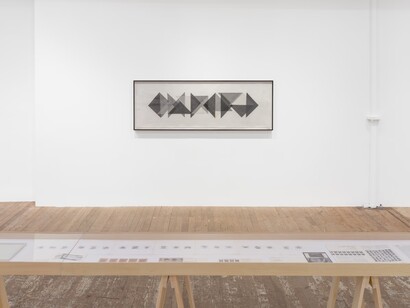
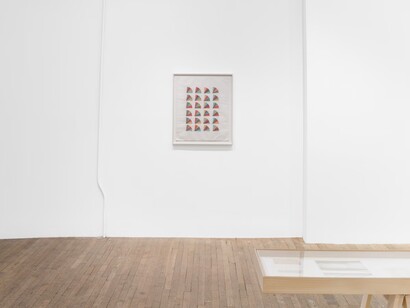
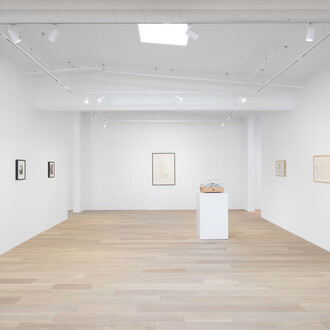
As an exhibition title, Back stitch is meant both literally, as a technique evidenced in many of the works here, and metaphorically, as a way for Elaine Reichek to revisit her earliest mature work from 1971 to 1979 — and in some cases to remake that work, as though returning to a train of thought where it left off. In much the same spirit, the exhibition includes a 16-foot-long table case with archival material dating from 1962 to 1980.
Reichek trained as a painter at Brooklyn College with Ad Reinhardt, and then at Yale for a year of graduate studies. The paintings for her first New York solo show, in 1975, employed a limited vocabulary of lines and grids drawn with pencil and thread, or masked out with tape, on canvases prepared with gesso or silver paint. In the exhibition catalogue and reviews, the critics mainly parsed formalist procedures and perceptual shifts, though each also noted the use of thread and pondered its meaning. For Reichek, however, the most significant takeaway was that her threads had pierced the “hieratic” surface of the Greenbergian picture plane, and now she was much more interested in the process of sewing than in applying paint.
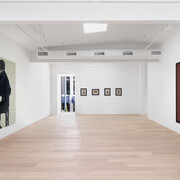
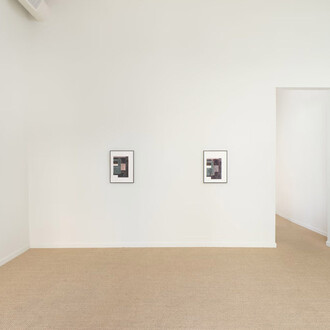
In the gallery’s front space facing the Bowery are 4 smaller examples of these early “thread paintings” from 1972–73, each with segments of vertical lines made with pencil, paint, tape, thread, or string. On the opposite wall is Untitled #1 — a gridded 5-by-4-foot painting that in its original 1971 version only included gesso and graphite — which Reichek has newly emended with lines of golden thread, as if to emphasize the act of drawing with a needle.
Subsequent works in the main space show the gradual expansion of this basic formal vocabulary of the grid, modularity, repetition, and variation. But even as the work maintains a pointed dialogue with conventions of post-minimal painting, structures and optical effects are generated with the haptic materials of fabric and thread.
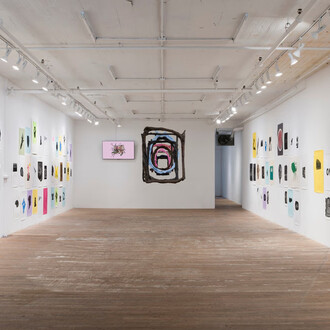
One possible path forward for Reichek was to lean into the overtly feminist implications of handicraft and to embrace domestically associative imagery. In the present exhibition this track is clearly represented in 2 works: Black and white beds (1978) consists of 34 units — 18 framed in black, 16 in white, arranged in a wall-scaled, 4-corner framed grid — each depicting a miniature double bed complete with doll-sized pillows and a unique patchwork quilt-block coverlet. By presenting these quilt patterns as an open-ended compositional multiplicity, Black & White Beds offers a direct rejoinder to the overpainted quilt in Rauschenberg’s well-known 1955 Bed. In the gallery’s office, The life and times of art (1979) takes this associative and literalist approach a step further, with each of 9 small units framing a unique pictorial riff on the merging of quotidian and artistic spaces.
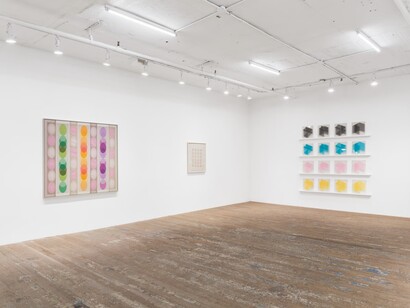
The other works in Back stitch, however, are more abstractly systems-based. White mesh (1976), for example, consists of 9 units of spray-painted needlepoint mesh, with rectangular shapes and framing structures either extracted from the weave or added with thread. Several other works, including the newest, are made with cotton organdy — a crisp, semi-sheer fabric often used for party dresses and bridal gowns. Originally these organdy works were intended to be sandwiched between sheets of Plexiglass, allowing light to pass through and reflect from the wall behind. Parallelograms (Gray, turquoise, pink, yellow) updates this idea, with 16 units displayed on 4 white shelves and leaned against the wall at a slight angle. The work is double-dated 1977/2024 because it reclaims 4 original gray Parallelograms and reprises these isomorphic shape configurations in 3 new colors.
Fan factorial #1 and #2 offer a hint of representational imagery while cycling through alternating sequences of shades and tints that are generated simply by variously overlapping 4 colors of organdy. Likewise, Triangles #1 and #3 repeatedly flip or rotate the same basic shape in black-towhite shades of organdy to create complex horizontal compositions. Both the Fan factorial and Triangles series invoke drawing conventions, with the organdy cutouts sewn onto translucent KozoShi or mulberry paper, respectively.
Two final organdy works return to the object-language of painting and stretcher bars. With Pink piece (1977/2025), Reichek rescues a nearly lost original work by reconfiguring its delicate grids and cruciform arrangements into a new composition of 16 units, which she has sewn to a single length of white organdy. Ovals (2025) likewise returns to a patchwork process, partly as a way to revisit a pair of long-lost Useless quilt organdy works from 1979, which were also pulled around stretcher bars. Here, columns of pale-pink ovals nestled on light-gray strips alternate with descending overlapped ovals in Josef-Albers-like colorways of green, orange, and purple.