English
 Español
 Français
 Deutsch
 Italiano
 Português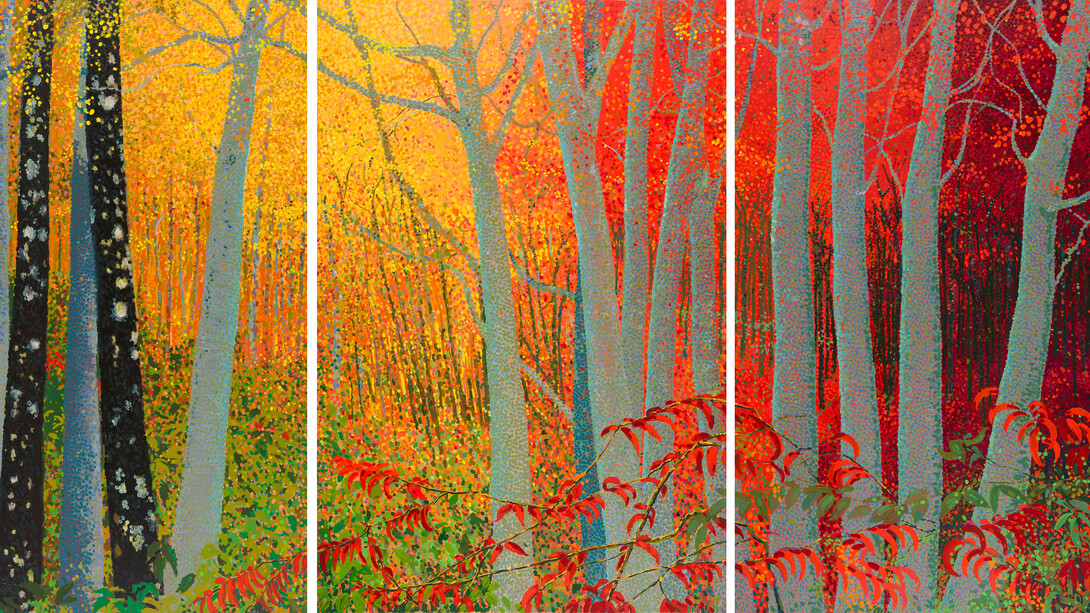
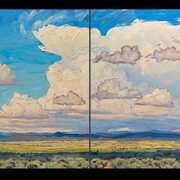
New American lyrical landscapes, an exhibition of oil canvases and works on paper by Joseph DiGiorgio (1931-2000), that feature a radical reinterpretation of American wilderness through a meticulous, atomized technique, opens at LewAllen Galleries on Friday, March 27, 2026 and will remain on view through May 9.
The exhibition focuses on DiGiorgio’s profound assertion that nature remains a site for psychological and spiritual inquiry, transforming the vast landscape into a visual and intellectual sanctuary.
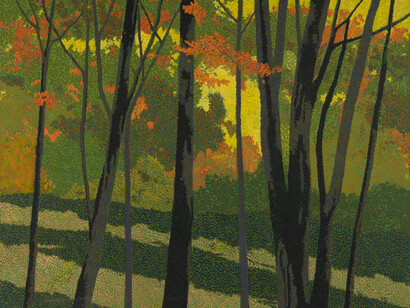
DiGiorgio was a pivotal American painter whose expansive body of work reconceives the natural world through a synthesis of abstracted landscape structure, fauvist color, and the use of dot-like marks. Working, primarily from his industrial loft in New York’s Bowery, DiGiorgio created art that reflected a melding of the “push-pull” dynamics of the New York School, the aesthetic principles of Color Field painting, the romanticized naturalism of the Hudson River School, and the over-all lighting of Luminism. This synthesis infuses his paintings with an engaging light as well as aligning the work with certain ideas of the Transcendentalists who privileged Nature as a connection to the spiritual.
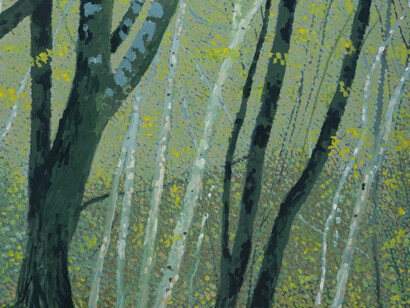
His artistic lineage is rooted in formal training at Cooper Union in New York under the painter Morris Kantor and the transformative influence of Abstract Expressionist titan Hans Hofmann’s classes in Provincetown. The artist’s practice utilizes a labor-intensive method of achieving complex and subtle coloration, which evolved into a signature modular dash mark-making system in the early 1970s. While composed of countless rhythmic dots, the resultant imagery moves beyond Neo-Pointillism—a descriptive term often applied to his work but which ultimately is imprecise.
The creation of his works was driven by what DiGiorgio described as an ethical imperative and a monastic discipline. In his many works in which dots served as surrogates for brushstrokes, he noted that their density creates a visual vibration that layers atop and serves to illuminate the underlying abstracted image of landscape features such as tree trunks and limbs.
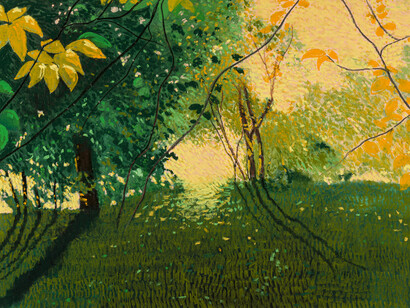
A central element of the work is the masterful manipulation of perspective, frequently positioning the viewer in an indeterminate zone that is neither on the ground nor in the sky. This floating vantage point resonates the artist’s devotion to environmental conservation reflecting in his work a subtle protective distance between the viewer and his landscape subject. The spectator metaphorically hovers as a witness but has no physical contact or effect on the environment. Within the artist’s singular aesthetic cosmology, the eye is forced to move constantly across myriad dots, demanding an active visual engagement and transcending merely a momentary glance.
Joseph DiGiorgio’s enduring legacy is assured by inclusion in the permanent collections of over forty major institutions. The artist is further distinguished as a pioneer of New York’s Artist in Residence (A.I.R.) Regulations, which enabled artists to reside in commercial spaces and fostered the city’s permanent creative life.