English
 Español
 Français
 Deutsch
 Italiano
 Português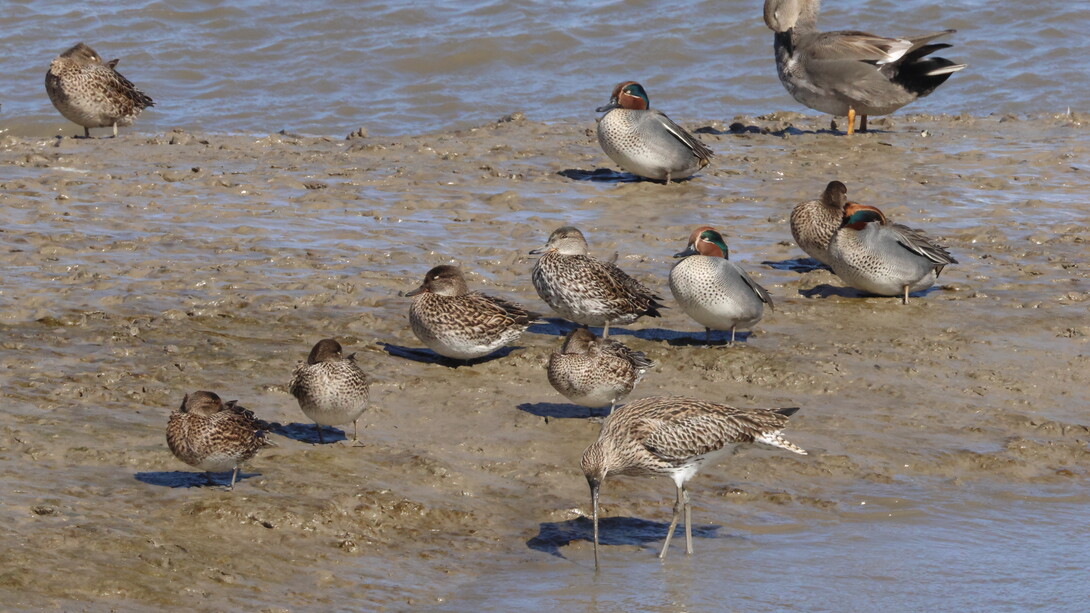
The River Thames, dark and muddy as it approached the sea, had receded on a low tide, exposing a transient patchwork of sandbanks. I peered over the low embankment wall on the River Thames Path at Crossness. I expected to see some ducks, but I was treated to a bigger spectacle. There were several hundred ducks perched on the mud, but also together with them were various species of waders and gulls. It was one of the best waterfowl and wader aggregations I had seen in the recording area of the London Natural History Society, defined as being 20 miles from St. Paul's Cathedral.
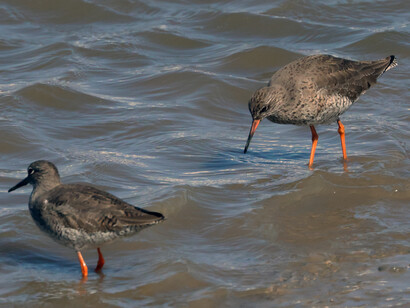
Nearest to us was a common sandpiper, characteristically bobbing its body as it picked its way through a shallow channel of water. This bird breeds in upland areas of Britain and is seen in the London area on passage. A few common redshanks were also present. Their loud calls mark their presence. In flight their white wing bars showed prominently. The Redshanks we were seeing today may have been on passage, although it is also present as a wintering bird. The star wader species on the day was a curlew. A group of us were on a London Bird Club walk led by George Kalli in March. We could make out at least two curlews. This tall, elegant wader with its long, down-curved bill was distinctive and towered over the other waders. It has a beautiful bubbling call, which sadly is heard less and less as breeding curlew populations in the UK have fallen dramatically in recent decades.
In the London area, they are seen on passage in spring and autumn. In winter, a small number of wintering birds arrive from continental Europe. Another large wader that was present was a black-tailed godwit. On previous London Bird Club walks to Crossness we have encountered over 30 birds. Today there was just one individual. A hint of rust on its plumage hinted that it may be shedding its winter plumage and acquiring summer plumage. Again, as with other waders, it is mainly a passage migrant in the London area, although continental birds arrive here to winter.
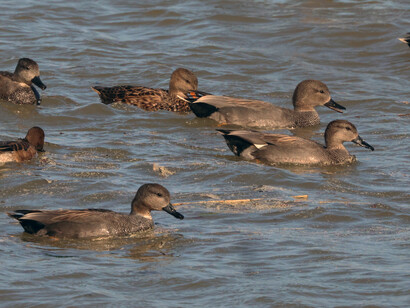
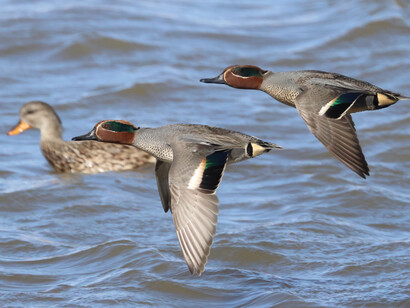
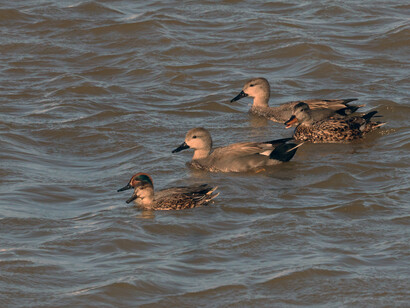
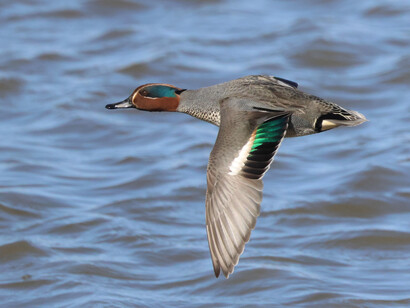
What particularly struck me was the number of ducks. I loosely estimated that there could be around 300-plus Common Teal scattered about. There were large numbers of swimming on the water as well as standing on the sandbanks. There were also a large number of Gadwall, perhaps up to a hundred. Just two or three individuals of the much larger shoveler were also present. I made out a female wigeon in flight. This is a grazing duck and not a duck I would expect here. Occasionally, a Great Cormorant would arrive but never linger for long.
One of the reasons for the concentration of ducks here was that there was a Thames Water treatment facility here with an outfall. There would be periodic discharges of treated water, which would spread out in a fan into the river from the outfall. Despite being treated, the discharge would be nutrient-rich and be a source of food for aquatic invertebrates, which would explain the presence of surface-feeding ducks. The common teal is a winter visitor to London, and the largest winter counts are in Barking, Rainham, and Crossness, which are all in close proximity to each other. By summer the Teal have almost all gone, with just around 2,800 pairs remaining to breed in the UK. Compare this with an estimated 200,000 birds, around 30%-40% of the European population, which winter in the UK.
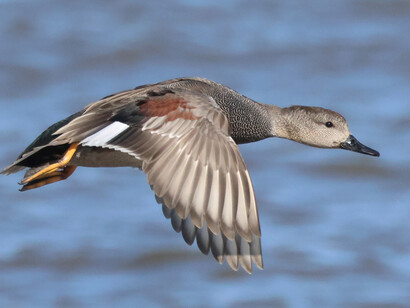
The Gadwall is a breeding resident in the UK. The male has a beautiful vermiculated pattern on its neck and belly. Gadwall numbers too are swelled by winter arrivals. In winter there is a large influx of birds, with an estimated 17,000 individuals wintering in Britain and Ireland. The breeding population is only around 10% of that. I had no doubt that many of the birds on the water were wintering birds. When you watch Gadwall, you often see little fights breaking out between the males to establish a pecking order. From time to time small flocks of 3 to 7 birds would take off.
Sometimes they would just change position by moving a hundred meters or so. Sometimes they would wheel around and climb steeply into the sky and disappear from view. I spent a lot of time photographing them on the wing. In flight, a small white wing bar shows in both sexes. The male is readily identified by its black bill, overall greyish look, and black vent. Close up, the body is finely vermiculated. The female looks similar to a mallard but has an orange-sided bill and has the white wing bar.
In March it can still be cold by the waterfront, and after an hour George decided the group should move on to the grassland interspersed with pockets of blackthorn and hawthorn. Being a warm sunny day, we had some early butterflies on the wing, including an obliging small tortoiseshell, which had emerged from hibernation.