English
 Español
 Français
 Deutsch
 Italiano
 Português
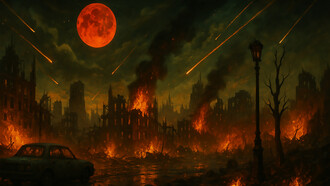
Here is the bottom: the back of an ambulance, with bodies piled. The missiles have come whistling down like skinned knees onto the water-truck—not this water-truck, a different water-truck, in a different neighborhood, a little down the way. You can hear the booms, one, two, three, much louder than a sniper-round cracking. Back of an ambulance, bodies piled. The men, here, in orange vests, they’re all shouting, they’re all running.
They all knew people at the other truck, all of them, they’d all been planning to die together, tonight, when the firebomb came. What’s going on, now? What’s all this mess? Nobody planned for this.
These ones, they are different from the other dead. Maybe it’s something about the light in the back of this ambulance, in the other neighborhood; have you ever seen bodies piled? Not in a movie, have you seen? Do you know what they look like, bodies piled? You probably think you know. Like piled lumber. Or sure, like piles of flour sacks, the body has a little bend to it, no?
Imagine yourself in a pile.
You don’t know anything about your body, really. You only know yourself. Your empty body can do things that your beating heart can’t—different shapes. Empty bodies can flop their arms and legs in ways that living bodies would never let themselves. It would be painful or crushing or it would just be the wrong sort of stretch. Living bodies are always keeping their balance, even when they’re laying down.
They’re always shifting their parts around, a little bit this way, a little bit that way, to make sure that they don’t go tumbling, tumbling. Take off all your clothes and go out in the night to a hill near where you live and lay on your side, halfway to the top, and let your whole body go limp, if you can? Can you? Will your brain let you? Just try. Feel yourself tumbling, tumbling. Empty bodies are just bags of water, look at this pile.
Arms and legs and heads in every direction, twisted into all the wrong angles. Spines bent backwards so much farther than a brain would ever let them. If any of these people come back to life, they will be sorer than sore—miserable—oh, misery!
Esraa sits down on the dusty ruined floor of the ruined building, next to the rifle. Look at this rifle—look at this thing! Look at the side of it. Look at the weight of it—you can just feel its weight, just by looking at it—look at it! Feel the Power Of it. Look through the scope, see everything that you can see. Look at the water-truck. Look at all the people. There are people like flies around the water truck, that’s the right imagery.
There are flies around all the people, like they’re all horses that have been shot, that are bleeding out into the dust. Look at how small they are. It is amazing, what Esraa can see with this. She is a little bird, little bird, circling above everything, or maybe she is more like a hawk. She is death, she realizes. This man on the ground next to her was going to kill all these people, she realizes.
She can kill a person, she realizes. She’s just had practice, she realizes.
The man who’d been looking after Rocinante and the boy goes running. He lets go of the little boy’s hand, and he goes running. The water-truck closes off the tap. The engine starts. The crowd clears, to let it through. Even if Esraa could somehow find another water-jug to fill again, where would she go and fill it again?
The whole cloud of people waiting for water, they start to disperse as soon as the center of gravity is gone. In this direction, in that direction, little particles. Boyle’s Law. Some of them are going West, and East, and North, and to the South, Esraa can see, she can see everything, all the parts, exactly how they work, Esraa can see a group of ten soldiers, moving towards where the water-truck was.
Because this is a story about choices instead of anything else, Esraa immediately understands how to use this weapon in her hands, and her body, weak with hunger, dizzy, dizzy, is naturally strong enough and experienced enough to make this weapon do whatever she might want it to. She swings the crosshairs onto the head of the soldier at the head of the group.
She calculates the bullet drop over this distance, and makes her adjustments. She estimates the wind-shear between here and there, and makes her adjustments. She considers the walking speed of the group and the travel-time of the first shot, and she makes her adjustments.
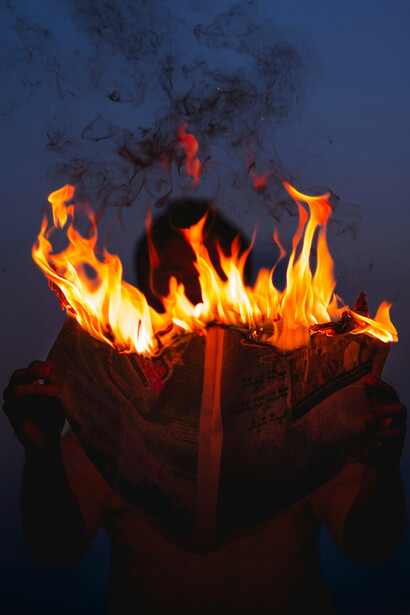
"I am not a violent person," she says to the empty room. Laughter, from the shadow, sitting on the floor beside her—the shape of a woman, burning, smoke and soot and laughing
“Ha!”
It is Beatriz, and it is Isabella. It is one and the other. It is Isabella, who has desperately smashed in a man’s head with a rock, and wasn’t that lovely? It is Beatriz, who has gone around impaling every Inquisition soldier she can find, and wasn’t that lovely? They are overlapping, they are mixing and blurring, and they are laughing.
They are cohabitating this howl, this shadow in the shape of a burning woman; she is Carcayona, unambiguously.
And here is Esraa, directly in the middle of them, between them, in front of them and behind them.
“It felt just fine,” says a shape that might be Isabella. “It will feel better than fine,” says a shape that might be Beatriz.
“It was not you,”
Says Carcayona.
“‘It was not a stream of water.
It was a wolf snarling underneath the rubble,
Wanting to
Rip the flesh
Of these tanks
With its teeth.’”
She can’t remember the Rabah verse about boredom, either, so instead she just tells Esraa that she knows she needs something to do, doesn’t she? She’s getting so bored, isn’t she? This is all so boring.
Esraa stands. She just stands, on her feet, on the ground. She doesn’t walk forwards or backwards. She doesn’t turn. The people around her think that she’s thinking—trying to come up with the best thing to do next now that someone has gone and put a bullet through her second water-jug.
Is she going to go off and walk into the sea, opposite of a beached whale? Is she going to curl up and die, right here where she is? Is she going to try to find another jug?—another truck, while she’s at it? She must be thinking, thinking, thinking, look at how she’s staring into the distance, imagine all the thoughts she must be reading on the paper past the edge of Creation.
She’s not thinking about anything at all, of course. She’s only just standing here, with her brain keeping her balance, legs and arms and head. The world isn’t working. There is no world—what’s to think about? Nothing’s making it into her head.
What’s to do? She doesn’t think anything and she doesn’t do anything until a man bumps into her as he moves past, not very hard, but it’s something, and she turns towards him, and she yells after him—“Hey!”
She gives him a rude gesture. She calls him a rude word. All her parts are working again.
Esraa stares at the soldiers, heading North. It won’t be very long, now, before they come across some of the people, heading South from where the water-truck was, and then?—and then, and then, and then.
Maybe a minute. Esraa’s got it all lined up. All it takes is a twitch of a finger, and then another two-hundred grains of nitrocellulose will be ignited, and then the expanding gasses will propel a heavy-metal slug down a twisting barrel and then—and then, and then. The chain of causality continues on and on and on, the process continues, up and up and up, until it interrupts. And then the next one. And then the next one.
Esraa tells herself a little story about how she would never do something like this.
Her finger tightens slightly, and then loosens. She remembers, suddenly, like a voice from an Angel, that she isn’t wearing any ear-protection, is she?—and she’s already gone a little more than half-deaf, hasn’t she? Does she really want to go and lose the other half?
How will she hear any voices from any Angels, then?
Rocinante is beginning to become agitated. It was fine to stop for water, but now the water is gone, and they are still standing here—just standing here—just standing here. The man with the orange vest is gone, but they are still just standing here.
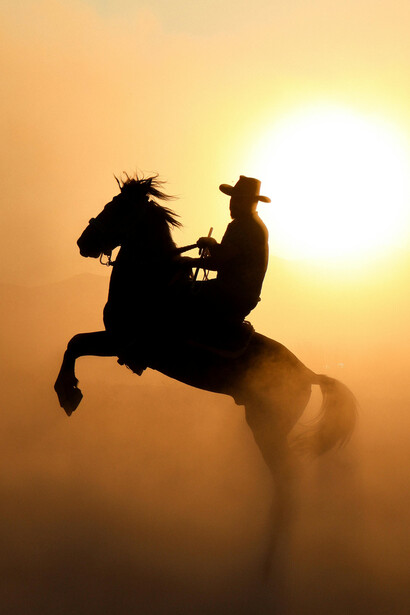
The world is crumbling; the world isn’t working. He lowers his head to his boy, and he gives him just the gentlest nudge with his nose—we have to go. We can’t stay here. There is a Knight to find. I can’t do this alone. You are Dulcinea’s son; you have been sent by your mother. You have to guide me. He tells himself a little story about what his Master will say when he recognizes the boy.
Of course he will recognize the boy, instantly, explosively. Maybe he won’t need help getting free from whatever ropes or else he’s been snared in. Maybe his first look at the boy’s face and he’ll up and tear himself loose, just like that. Of course he will recognize the son of the peerless Dulcinea, the Princess Dulcinea. He will be even more joyed to see this boy than he will about being rescued, and what a glorious horse he has, doesn’t he? Isn’t Rocinante such a glorious horse, bringing him such a boy? And obviously that has nothing at all to do with who the father of that boy might be, obviously.
That’s not a thing to be thought about, not a thing to be worried about. A noble Knight and a gentleman never speculates about such things. Anyone who might think that a noble Knight and a gentleman might have fathered a child with his Princess, to whom he has sworn complete dedication and chastity, anyone who might think that, they are only speculating.
Rocinante tells himself a little story about the shape of the boy’s eyes. Rocinante tells himself a little story about the color of the boy’s hair. Rocinante tells himself a little story about the way that the boy smiles, when the boy smiles, which he doesn’t, but if he did, think of how his smile might look. Rocinante tells himself a little story of how the boy might look in chainmail and armor, with a lance in his hand, or a rusty old sword.
Esraa straightens up from the rifle, for a moment. She glances behind her, where the soldier’s body is slumped out, across the floor. He’s still got his earphones on. Esraa starts—starts—to reach towards him. He’s still got his helmet on, over his earphones, thick polycarbonate something-something. Has she really managed to kill him, with just a jug of water?
For a moment, she thinks about, what does she think about? She is thinking about picking up the jug and smashing him again—and again and again—while he is just laying there. Or Carcayona’s sword, Carcayona’s lance, Esraa looks towards the Princess, but her hands are empty. Her hands are missing—or tucked away into the folds of her cloak. She has no lance, she has no sword—don’t be ridiculous! In this day and age? Who would ever bother with such stupid things?
Rocinante tells himself a little story about maybe not worrying so much about finding Don Quixote, actually.
Esraa thinks about, what? Taking the soldier’s knife out of its sheath on his waist, does he even have a knife? Isn’t he a soldier? Doesn’t he carry a knife? Doesn’t he have a sidearm? Can she take off his belt and wrap it around his neck, while he is just laying here? Before he wakes up? Before he wakes up?
And then she can take off his helmet, and then she take off his earphones and put them over her own ears, and then she can go back to the rifle, and take aim again, and then she can pull the trigger and blow up someone’s head and he’ll never even see it coming, he’ll just be standing there—he’ll just be standing there.
She would never do something like this.
“This isn’t right,” says Esraa, to the empty room, and that’s not quite what she means. “It’s not fair,” says Esraa, and that’s what she means, but not about this. She knows what she means about this, but she’s not sure how to say it.
Rocinante tells himself a little story about just moving on to a new adventure, here and now. Can the world really wait? Aren’t there dragons to kill? Aren’t there maidens to rescue? Look at those shapes, looming above, roaring above, fire and teeth. Look at that woman, there, standing, shouting. Who is going to rescue her? Right here? Right now?
“Where is…?” Esraa asks. “Where is the…?” she asks. She is rolling her hands in the air, searching. She is trying to ask how the world has become this way, how it has come to work in this way, or maybe she is trying to ask how she is supposed to work in a world like this. “Where is the”
“There is no honor,” says Carcayona, simple as a bullet.
Rocinante sniffs at his boy; does he smell like the rescuing sort?
“You are not Don Quixote. Don Quixote is dead, or else lost, or else chained up rotting in a room somewhere,” says Carcayona, simple as a bomb.
Rocinante, don’t tell him the truth, remember; don’t tell him what’s really happened—what I’ve done.
“The world doesn’t work in his way, anymore,” says Carcayona. “With honor, no. Sit around and die until you’re dead if that’s what you want. Put yourself in a pile in the back of an ambulance, sure; you need something to do. I’ll let you do what you want—but I won’t let you walk out of here right now thinking that the world still works in that way. I’ll kill you before you walk out of here thinking that. I’ll rip off your arm and pull out all your organs through your open shoulder.”
Aya says nothing to that. She goes back to the rifle; nevermind the earphones; let her go deaf; whatever. She puts her face back to the eyepiece; the soldiers are gone; they’ve kept walking in all this time; she swings to find them again, searching, searching. Is it too late? Has she already waited too long? She searches, searches.
She looks back to where the water-truck was, where there are still a few particles, drifting, drifting—the last of the air in the balloon. A few men and women and children who haven’t found their way out into the surrounding streets, yet.
“Ah.”
Esraa sees herself through the scope of the rifle.
“Ah,” she says. Look at that. Look at her. She can see everything.
Look at how thin she's become. Her cheeks. The paleness of her skin. Her arms like little wires. Look at the empty space next to her where her fiance should be standing. Look into her ear, that’s come untucked from her headscarf, it happens, in the heat, in the walk, in the scuffle of a fall and a catch, in the cloud of water-waiting.
Look in, through all the nooks and passages, until you can see her thoughts, look at her thoughts. See what you can see. See if you can find the name of her fiancé, what’s his name? Did he ever have a name?
Is his name anywhere in her head?
Esraa sees the horse staring at her. The horse and the boy, who is that boy? Where are his parents? Esraa catches herself asking what is going to happen to him. For fuck’s sake. What is she doing? Asking things like that. For fuck’s sake. He is going to turn to soot and smoke. The horse is going to turn to soot and smoke.
She is going to turn to soot and smoke, too. They’ll gather up wherever parts of her are large enough to carry in a bag, and they’ll bury them next to her fiancé’s parts, isn’t that fine?
Esraa tells herself a little story about going over to help that boy.
For fuck’s sake. Esraa tells herself a little story about her and her fiancé, going over to help that boy together. Bringing him home, a story about having a home. Taking care of him. She tells herself a story about things being hard, but they make it work; they make it through. They get a cart for the horse, to help carry water, maybe or to bring things back from the market, when there are things in the market and they can afford them. Esraa tells herself a little story about the crowdfunding campaigns they will create, “Help Save Our Adopted Son!”, and of course they will have to take lots of pictures as a family for the crowdfunding page.
Those crowdfunding pages always do the best when they have lots of good pictures, cute pictures. The three of them together in a tent. The three of them up on the horse, like pilgrims, journeying. Maybe a cute photo of them cooking together. Maybe a cute photo of them walking together.
Esraa tells herself a little story about a photo of her and her fiance standing side by side with this little boy in the middle, reaching up to hold each of their hands, or maybe even dangling, swinging from their arms like in an advertisement for medication, get your life back.
Here is what she does: she reaches down and she picks up the ruined water-jug from the spot where she’d dropped it. It’s empty, and there’s no way to fill it anymore, but the handle is still good, so she can pick it up and turn around and walk home with it. It’s a stupid thing to do, but she is speaking the Language of the Universe now.
She is replying to an Angel. “I have picked up the water-jug,” she says, which means “I will not go to the boy. I will turn around and go home. I will not be part of any more stories. I’m done.”
Esraa turns around, she turns away. She can turn away from anything. She starts to walk. She’ll take this jug home and she’ll fix it with tape, or with something. She’ll come back tomorrow, or she’ll go somewhere else.
In the distance, in a high window, she can see a sharp glint of sunlight off some glass. This time, she drops her eyes, instead of squinting. She watches the ground, nothing to trip over; no more stories.
Esraa keeps the weapon pointed at herself for a very long time, or for a time that couldn’t possibly be short, could it? She is not a violent person. I never gave her that. In my notes for this section, there’s that phrase, “she is not a violent person”.
What you need to understand is that it’s only filler, so that I don’t forget the sort of thing I want to say when I come back later to actually write it, but not like that; with good words, better words. I’ve gone and left myself a note for that next to the note: “She is not a violent person. (Artfully execute)”—give the idea an artful execution, instead of my usual crap. Artfully execute:
The Angel replies back.
Esraa pulls the trigger and the idea comes in right through the top of her head and comes out the base of her neck, it goes splattering everywhere. She turns back towards the horse, and his boy, and she drops the shattered water-jug that she’d picked up again for no reason, and she walks towards them. She reaches out and gives the bony old horse a gentle pat on his noble snout. “Hola, precioso cabello,” she tells him.
Rocinante’s cloudy old eye shifts down onto her, and even though it is like looking through the rainfall, he can see her clearly. It is amazing, all the things he can see. Horses are very sensitive creatures, after all. A horse knows a Princess when he sees one. Not Dulcinea, but a Princess, certainly, but not Dulcinea; she’s got a different air about her. She’s got a different scent about her. Rocinante knows a Killer when he meets one.
He feels a hot rush of shame. What had he been thinking, just now? And now here she is, a reply. If there’s anyone who’s going to know where to start looking next for Don Quixote, it will be her. Princesses know very nearly everything, and Killers know what’s left. He gives her a deep bow of his head. He dips his neck to her. She can kill him, if that’s what’s right.
“Mi nombre es Carcayona,” she says to the little boy, and then she crouches to get a little lower to him, and she repeats herself, she tells him again that her name is Carcayona, and she asks him what’s his name, and when he answers, she smiles before any other reaction can slip out. That name is very special to her, she tells the boy. She once knew someone with that same name as his, and he was very special to her, she tells the boy. She thanks him for having that name.
She puts her fingers through his dusty hair, and she counts the freckles on his nose, and she hoists him up in her arms. He’s lighter than any jug of water she’s ever carried.
Come, she tells him, as though he’s still down on the ground, walking for himself. “Voy a cuidarte hasta que encontremos a tu padre.”
She knows, already, without much trouble, that that’s the only person they’re going to be able to find for him. That’s who’s left.
“Venga conmigo,” she says to Rocinante. If he had a harness with a muzzle and reins, she’d take hold of him now and gently pull, but instead what she can do is walk forwards a few steps and then stop and wait and look back over her shoulder without moving until he finally starts to trot slowly after her on his poor splitting hooves, and with that, he understands. They are not going to search for a Great Knight, she tells him. The world no longer works in that way. They have to let go.
Let go of swords and shields and lances and chainmail. They were ridiculous tools for a ridiculous old man to be using, pretending to be a Knight. They are ridiculous tools for a Princess. Carcayona places up the boy onto Rocinante’s bony old back after a few more steps, and she leads the two of them Southwards, out of the clearing in the streets. They aren’t walking for long before they stop again.
She says that it will only be a moment or so, but of course it’s not. There are a whole seven bodies laid out here to strip for parts. On their fronts, on their sides, on their backs. Arms and legs and heads and spines at all the wrong angles, soft, boneless dolls. Holes in their skulls. Holes in their chests. You can put together a story about them.
This one, at the base of the neck, first to go down, and the others all turned towards the noise, rifles up, you can tell that their rifles were up because of how they dropped them, one by one. Between the ribs. In the front of the throat. You can tell who went down last, because their magazine is missing five rounds, shot off in a panic in random directions. What were their names? Did any of them have names? They’ve got dog-tags and patches. Carcayona—Esraa? She gathers them into the pockets of her dress, along with all of the spare magazines she can find.
She peels off bits of body-armor and fixes them to her shins and shoulders and forearms. She takes a helmet for herself, off of the soldier with the smallest head. She takes one, two, three combat-knives to tuck onto her new belt. She takes a few fragmentation grenades, like little fruits.
The people are watching. Some of them are turning their eyes as they walk past, or turning their children’s eyes away. Some of them are standing and staring, whispering to each other as the woman here does her work. They have heard stories about stories about this. Whispers about cousins of friends having friends who were out walking and saw things like this.
Murmurs from people who might have been dreaming, but they swear, they swear. Entire groups of soldiers found dead, throats cut, impaled, carved into bright red ribbons… or just gone. Disappeared from somewhere to nowhere. Is that real? Is that this? Has it really been happening? “Carcayona…” they breathe back and forth to each other, “...Carcayona…”
One by one, the woman shifts the bodies into a pile off to the side of the road, so that they won’t block anybody else who has to go anywhere. Look at how they pile, empty bodies, look at how they flop and fall over each other. Look at how they spill. From the last body, she takes the rifle and the sidearm, one to wear on her hip, one to sling over her shoulder. There you go, much better.
When she straightens up, away from the last body, the people watching all flinch backwards, before they can stop themselves. They’ve heard other stories. They can’t possibly know what’s true and what’s not. They’ve heard lots of stories. They’ve heard stories about giggling, in the shadows. They’ve heard stories about necklaces of tongues. They’ve heard stories and stories.
They all start to move off, back to wherever they were going, or just away. They don’t want to find out anything more than what they’ve already learned, here. They are going to tell this story to everyone, and then everyone is going to tell this story to everyone. This is a story about them, now; stories are always about storytellers.
The whole thing has taken maybe twenty minutes, and in that time the little boy has fallen asleep up on the back of the bony old horse. He’s slumped over to the side, like a body in a pile, and Rocinante has carefully shuffled himself to gently catch the boy’s shoulder against a bit of wall so he doesn’t fall.
Carcayona? Esraa? Beatriz? Isabella? Aya? Basma? Aldonza? She gives him a little shake. “Ey!” she says. “Ey!” she says. She tells him not to fall asleep yet; they’ve got things to do; they’ve got places to go; she’s going to need his help; she can’t handle all of this alone.
His eyelids are heavy, and his arms and his legs and his head—like a body in a pile, a body in a pile, maybe they were all just asleep. He blinks, he blinks, like he is trying to crush a peanut into powder, and that’ll be enough, for a minute or two. He yawns. Carcayona yawns back to him, on purpose. She whines at him not to yawn; if he yawns, she’ll yawn, and then she’ll get sleepy, and then she’ll fall asleep.
She yawns again, which makes the boy yawn again, which makes her pretend to yawn again.
“Basta!” she says. “Deja de bostezar!”
She tells him that she will cry if he yawns. Does he really want her to cry? She starts to pretend to cry, which makes the boy pretend to laugh—no, no, obviously he’s not pretending to laugh, he’s like what? Three? Obviously he’s actually laughing. He laughs and he laughs, up on the horse’s bony back, he laughs and he laughs.
Later, maybe, maybe, he will look back and wonder about laughing after his mother has just died, and he will be sure that this is either a story about strength or a story about weakness.