English
 Español
 Français
 Deutsch
 Italiano
 Português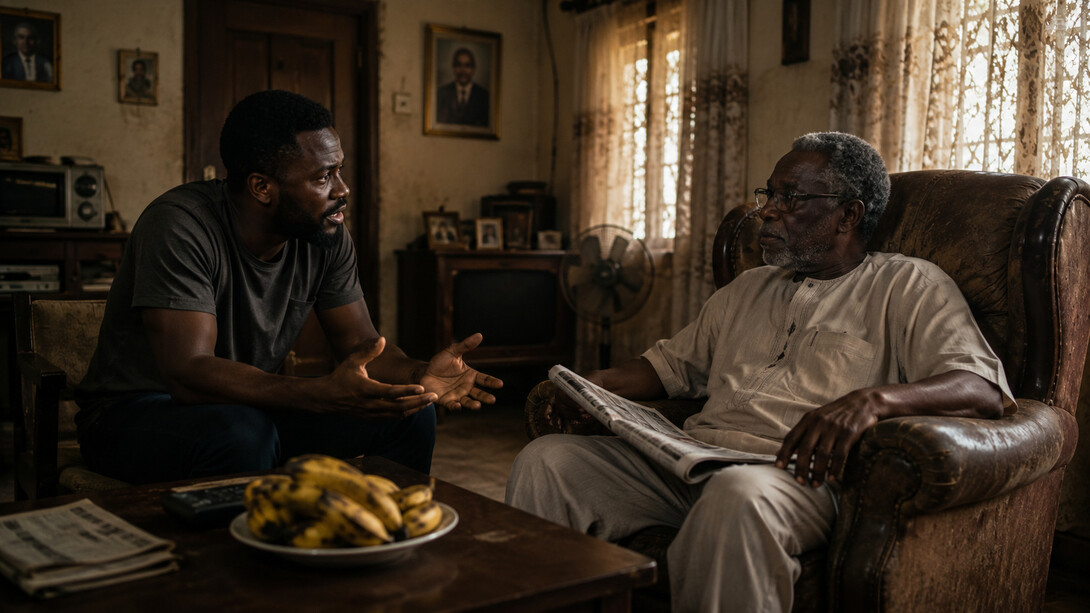
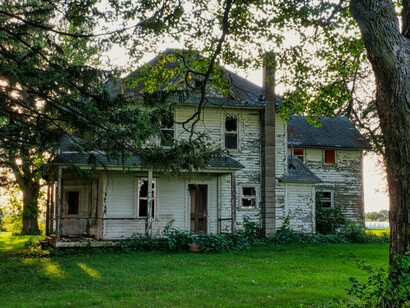
The air in the living room was thick with the scent of old paper and the faint, sweet musk of overripe plantains resting somewhere out of sight. It was the kind of house that carried time in its walls—a city relic from the late 70s, built when things were meant to last.
The ceilings were high enough to trap heat instead of release it. The walls, once bright, had settled into a tired shade of cream. Heavy lace curtains hung stubbornly over the windows, filtering sunlight but never quite muting the restless noise of the city outside—honking horns, distant engines, the constant hum of movement.
Independence Street had changed over the years. The house had not.
I pushed the door open with my shoulder and stepped in, the weight of the grocery bags cutting into my fingers. The familiar stillness of the living room greeted me—unchanged, almost defiant.
My father sat exactly where I expected him to be, in his wingback chair. The leather had cracked over time, forming lines like a dry riverbed, but it still held its shape. A newspaper rested open in his hands, its pages slightly trembling under the slow rhythm of the ceiling fan above.
I dropped the bags onto the mahogany side table with a dull thud.
“I’m sorry it’s not more, Dad,” I said, wiping sweat from my forehead with the back of my hand. “Things are getting worse. The price of rice has doubled since last month.”
He didn’t look up immediately.
“And the road here…” I continued, my voice tightening. “I almost turned back. Two kidnappings on the expressway this morning. Broad daylight.”
Still, nothing.
Only the slow turning of a newspaper page.
I let out a breath, half frustration, half exhaustion, and loosened my collar. “Sometimes I don’t understand how we are expected to live like this.”
My father finally lowered the paper, just enough to look at me over the rim of his glasses.
“Sit down, son,” he said quietly. “The world will not end today.”
I pulled a chair toward me, the legs scraping faintly against the tiled floor.
But before I could sit, the overhead fan gave a long, tired groan.
It sputtered once.
Then stopped.
The sudden silence was immediate and heavy—the kind that only comes when electricity disappears. The hum of modern life collapsed in an instant, leaving behind heat, stillness, and the distant, indifferent noise of the city.
“Again?” I threw my hands up, anger rising faster than I could control it. “We pay, we complain, we beg—and still we sit in darkness!”
The heat pressed in around us, thick and unforgiving.
“These leaders…” I continued, my voice sharpening. “They are a curse on this continent. Every single one of them. When will someone finally fix this place? When will someone save us?”
My father folded his newspaper slowly, deliberately, as if time itself had no authority over him.
In the dimming light, his face seemed carved out of memory—calm, steady, untouched by my agitation.
“We love to shout for change every election,” he began, his voice low and textured—like gravel softened by honey. “But our hearts remain the same.”
I frowned slightly, still pacing.
“We expect new results,” he continued, “from the same broken mindset. We remove one man and replace him with another moulded from the same soil—greed, impatience, and short memory.”
I stopped moving.
Something in his tone made it difficult not to listen.
He leaned forward slightly, the folds of his buba deepening in the shadows.
“You blame the leaders for the potholes,” he said, “but tell me—do we pick up the trash outside our own gates?”
I opened my mouth, then paused.
“You curse the government for fraud,” he went on, “yet we celebrate the thieves in our own families because they speak our language, because they share our name.”
The words landed harder than I expected.
“We treat politics like football,” he said. “We shout for our team to win, not for the nation to rise. We are loyal to tribes, not to truth.”
“But Dad,” I said, my voice softer now but still resisting, “the corruption—”
“Is a reflection,” he cut in gently. “Not an accident.”
The room felt smaller suddenly.
Hotter.
Quieter.
“Africa does not suffer from a lack of leaders,” he said. “It suffers from a lack of citizens who think.”
I sank slowly into the chair.
“We want success without discipline,” he continued. “We want mangoes while we plant oranges. We want change, but we do not want to change.”
Outside, a car horn blared. Somewhere in the distance, a generator coughed to life.
“The real prison is not the State House, son,” he said, his eyes steady on mine. “It is the mind of the voter who chooses revenge over progress every four years.”
I swallowed.
The anger I had carried into the room no longer felt sharp. It felt… unsettled. Complicated.
He gestured toward the window, toward the restless city beyond the curtains.
“The day we stop waiting for rescue,” he said, “is the day we begin to rise.”
The words lingered in the heat.
“Until then,” he added quietly, “we are not trapped by bad men. We are trapped by our own illusions.”
Silence settled between us again—but this time, it felt different.
Not empty.
Heavy.
Deliberate.
“The enemy is not at the top,” he said finally. “The enemy is within us.”
He picked up his newspaper again, unfolding it carefully, even though the room was now too dim to read.
For a moment, I just sat there.
Listening to the stillness.
To the heat.
To the echo of his words rearranging something I hadn’t realized was fragile.
The groceries sat untouched on the table. The city outside carried on, indifferent as ever.
I stood up slowly.
“Go and bring the kerosene lamp,” he said without looking up. “It’s in the kitchen. Where it has always been.”
I walked toward the kitchen, the familiar path suddenly feeling different under my feet.
Not new.
Just… seen.