English
 Español
 Français
 Deutsch
 Italiano
 Português
This study examines the U.S.-led war on drugs in Latin America as a form of militarized security policy that has expanded state capacity without weakening the underlying drug economy. Focusing on Colombia and Mexico, it argues that counter-narcotics strategies framed through the language of war and security have prioritized military assistance, intelligence cooperation, and coercive enforcement while leaving the political-economic foundations of drug production and trafficking largely intact. Despite decades of intervention, drug markets have shown a high degree of adaptability, shifting geographically and organizationally in response to pressure. Drawing on policy documents, official reports, and UNODC data, the analysis treats drug wars not simply as security failures but as hybrid conflicts shaped by market incentives, institutional vulnerabilities, and the securitization of crime.
On the basis of the intertwining of several modalities of conflict within a single space and their capacity to complement one another, the concept of a hybrid threat is constructed. Frank G. Hoffman emphasizes that hybrid threats can simultaneously encompass conventional capabilities, irregular tactics, terrorist acts, and a “criminal order”1. Read in this way, hybridity is less a “technical” detail than a form of organizing violence and governance together: cartels and smuggling networks are not merely “criminal organizations” but actors capable of establishing territorial control through repertoires of violence that at times approach paramilitary capacity, by forming relationships with local administrations and by controlling economic flows. An educational document from the United States is referred to as TC 7-100.32.
Army, a “hybrid threat,” is defined as the combined use of regular forces, irregular forces, terrorist elements, and/or criminal elements to create “mutually beneficial effects.” The text’s additional definition of “threat” as a combination of actors with the capability and intent to harm U.S. forces, national interests, or the “homeland” also explains why phenomena such as drug trafficking can be elevated to the status of “national security” issues in U.S. domestic politics: the drug market is read not merely as a form of transnational crime, but as a phenomenon with the potential to erode state capacity and legitimacy.
This hybrid picture is enhanced with a discursive layer that is added by Critical Security Studies. According to the securitization approach of the Copenhagen School, security is not a fixed category; rather, it is produced through the presentation of certain situations as "existential threats" by specific actors. This construction can legitimize extreme actions, as it is a construction that can be used to justify extraordinary measures. Within this paradigm, the metaphor of a "war on drugs" has the potential to normalize the development of military power, external security assistance, and intelligence-based targeting methods.
This is accomplished by shifting the realm of criminal justice to the center of the agenda for security. The language of "war" pushes the idea of addressing the problem through criminal justice tools into the background while facilitating the use of traditional security instruments. Furthermore, the failure of the United States' war on drugs to reduce supply in the Colombian case can be read as a warning that such a securitization move may fail to produce effective policy outcomes. Emmers emphasizes this point in his discussion of transnational crime to emphasize the importance of the language of "war."
Historical background
Nixon's "Drug Abuse Prevention and Control" statement, which was delivered to Congress on June 17, 1971, was one of the early turning points that provided the framework that brought the United States' war on drugs into Latin America3. Nixon referred to the drug problem as a "national emergency" in this speech, putting an emphasis on rehabilitation and treatment as a means of addressing the demand side of the issue, while also highlighting the importance of combating overseas manufacture and trafficking as a concern for the supply side. The narrative that he constructed around heroin as a "foreign import" that was not produced in the United States provided a strong justification for externalizing the problem. Even if the problem appeared to be "inside" the country, the solution was sought "outside."
As a consequence of this, foreign policy, security cooperation, and activities that involve law enforcement across borders became natural extensions of the drug agenda. In a short amount of time, the institutional equivalent of this discourse was constructed. In conjunction with the implementation of Reorganization Plan No. 2 of 1973, President Nixon issued Executive Order 11727 on July 6, 1973, which specifically referred to the establishment of the Drug Enforcement Administration (DEA) within the Department of Justice. Additionally, this order placed the responsibility of coordinating executive activities related to the enforcement of drug laws under the authority of the Attorney General.
Similarly, the narrative of the Drug Enforcement Administration (DEA) titled "DEA Celebrates 50 Years" portrays this time period as a search for "unity of command" with the objective of reducing the lack of coordination and rivalry among federal agencies. In particular, the emphasis placed on the inadequacy of fragmented institutions in the face of a "global enemy" suggests that the drug problem was framed from the beginning as a hybrid security problem4.
When the Cold War ended, drug policy became an even more important security issue in the relationship between the United States and Latin American countries. Andreas and Duran-Martinez highlight the fact that unlawful flows, such as migration and drug trafficking, have enlarged the scope of "policing" and monitoring in the United States' ties with the region, thereby replicating and repeating power imbalances. The same work, in explaining the dynamics of the “balloon effect,” demonstrates with concrete examples how intensified enforcement in one area can shift production and trafficking to other countries: pressure on Caribbean routes increasing the importance of Mexican routes, or pressure on production in Peru and Bolivia raising production levels in Colombia, suggests that what is often framed as a “security success” frequently returns as a mere “market displacement.”
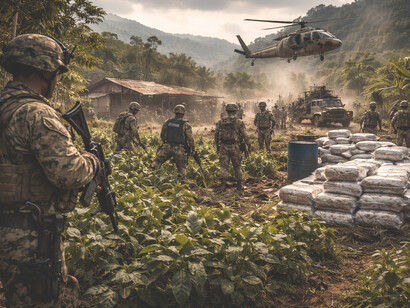
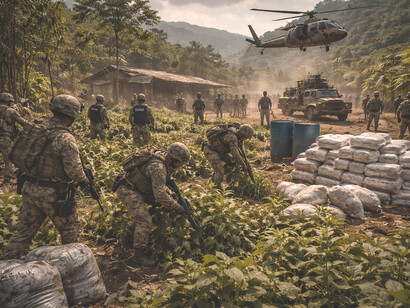
For the purpose of gaining an understanding of how the United States structured militarization as a deliberate policy choice, Plan Colombia is an especially interesting case study in the context of Colombia. In a congressional document from 2000, Colombia is described as the “primary source” of the cocaine and heroin sold in the United States, and this situation is said to create a “rare enforcement opportunity.” The same text interprets the security crisis in southern Colombia through the protection of drug operations by guerrilla fronts and paramilitary structures; for this reason, the involvement of the Colombian military alongside the police in counter-narcotics operations is presented as a “security necessity.”
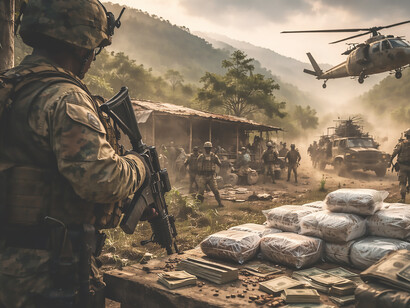
The document explicitly emphasizes that the training and equipping of three counter-narcotics battalions within the Colombian army, together with the procurement of helicopters, would increase tactical mobility and strengthen the state’s operational capacity on the ground. When it comes to testing the hypothesis, the tension that exists between the objectives and outcomes of Plan Colombia is the deciding factor. Despite the fact that poppy cultivation and heroin production decreased between the years 2000 and 2006, coca cultivation in 2006 remained higher than it was in 2000, according to the evaluation conducted by the GAO. The goal of Plan Colombia was to reduce narcotics cultivation, processing, and distribution by fifty percent within six years (by 2006). However, this goal was not fully achieved.
The report also notes that coca farmers reacted to the pressure of eradication by taking countermeasures like replanting and moving to locations that were more distant and difficult to access. At the same time, the same report states that the assistance provided by the United States had significantly increased the "air mobility" capacity of the Colombian military and police, and that improvements were observed in security indicators such as homicide, kidnapping, and pipeline attacks. The total amount of assistance provided by the United States since the year 2000 has been approximately 4.9 billion dollars. Accordingly, Plan Colombia resembles a hybrid warfare plan that delivered “security gains” while remaining constrained in its potential to permanently diminish the “drug political economy.”
When attempting to comprehend this resiliency, it is essential to engage in discussions concerning political economy and the ability of the state. It is argued in the research conducted by Dion and Russler, which models the period of Plan Colombia at the sub-national level, that aerial eradication was primarily responsible for the reduction of coca cultivation through the process of "displacement." Additionally, it is stated that coca cultivation remained more limited in regions where the presence of the state was stronger and that it was more prevalent in agricultural regions that were underdeveloped and experienced limited access to legal markets5. This paradigm argues that the drug economy becomes localized less as a “security target” but as a “livelihood strategy” and a problem of “market access”: in the absence of the state, not only violence but also economic incentives and local broking relationships support the drug industry.
This continuity is confirmed by recent statistics from the UNODC. In 2023, the cultivation of coca in Colombia climbed by 10 percent, reaching 253,000 hectares, as stated in a news release issued by the United Nations Office on Drugs and Crime (UNODC) in October 2024. Additionally, the potential production of cocaine reached 2,664 metric tons, which represents a 53 percent rise compared to the previous year. It is also mentioned in the statement that the problem of "productive enclaves," in which a significant portion of the potential leaf production is concentrated in small areas, continues to exist. Furthermore, it is mentioned that the movement of coca fields closer to settlements creates a dynamic that may increase the dependence of legal economies on illegal sources. According to these findings, the war on drugs is not simply an "armed" conflict but also an issue of economic and administrative spatial transformation. This is because the war on drugs is a problem6.
Mérida Initiative
Through the framework of security collaboration between the United States and Mexico, the hybrid nature of drug battles in Mexico becomes more apparent. The Mérida Initiative is a U.S. package of counter-drug and rule-of-law support that was launched in response to a request made by Calderón in 2007 for further assistance from the United States in the fight against cartels. This request was included in a CRS brief that summarizes this cooperation. According to the same source, Congress allotted 3.5 billion dollars to Mérida between the fiscal years 2008 and 2021, with the majority of the funding, particularly in the early phase, being focused toward the provision of equipment to security forces (both military and police). Not only does this kind of foreign help build operational capacity, but it also reshapes doctrine and the power balances amongst institutions inside the realm of domestic security. The unintended repercussions of this cooperation are specifically mentioned in the CRS brief.
The United States intelligence community supported Mexico's plan of capturing and extraditing prominent cartel leaders, which was referred to as the "kingpin" strategy. This tactic, in turn, unintentionally fueled violence inside the cartels themselves. It is emphasized in the same research that the homicide rate in Mexico increased by a factor of three between the years 2007 and 2023, and that this tendency continued despite the country's collaboration throughout the Mérida period. Moreover, the report recounts that the arrest of a former Mexican defense minister by the United States in the year 2020 on drug charges caused "institutional tensions." As a result, Mexico moved toward a legal framework that required the sharing of information collected by foreign law enforcement officers (and the majority of Mérida program approvals were suspended). This case is notable because it demonstrates the secondary consequences that efforts of law enforcement agencies that cross international borders have on local politics and institutions, regardless of the intentions of agencies such as the Drug Enforcement Administration (DEA).
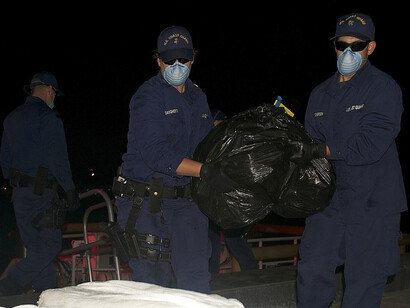
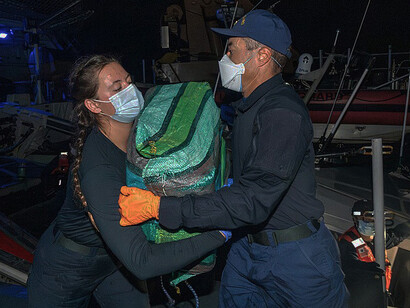
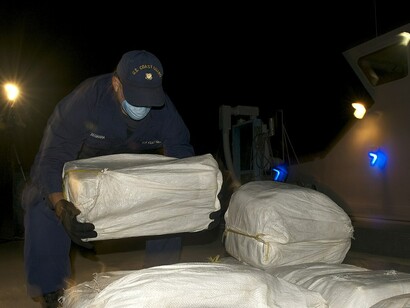
The political and economic basis of drug wars is shown by the fact that advances in security capability have yielded only limited results in terms of eliminating the drug economy. This is a point that is shared by both the Colombian and Mexican incidents. The presentation of the 2025 report by the United Nations Office on Drugs and Crime (UNODC) notes that the cocaine market has reached record levels and that organized crime networks continue to adapt by exploiting crises and vulnerabilities. The simultaneous rise of "illicit production" and "seizures" while the market remains vibrant suggests that economic incentives are not eliminated by security pressure. A further addition to this picture is the growth that occurred in Colombia in 2023: as the cultivation of coca increased, the potential output climbed as well. This indicates that despite decades of armed conflict, supply capacity increased once more. The lens of hybrid warfare makes it possible to read this evolution simultaneously across all four dimensions.
Under Plan Colombia, the training of counter-narcotics battalions, the procurement of helicopters, and the capacity for "tactical mobility" effectively drag drug control into a setting of counterinsurgency. This brings together the economy of the internal conflict and the economy of criminal activity into a unified security package. When it comes to the economic aspect, the United Nations Office of Drugs and Crime's (UNODC) emphasis on the "hundreds of billions of dollars" illicit drug economy serves to remind us that violence on the ground is not only fueled by ideology but also by competitiveness brought about by the market.
In terms of the institutional dimension, the image of capacity-building that was created by the GAO and the institutional tensions that were detected by the CRS in Mexico demonstrate that when the security apparatus increases through the assistance of external sources, it can concurrently generate new vulnerabilities. Securitization provides an explanation for the efficacy of the "war" metaphor to legitimize extraordinary tools within the confines of the discursive dimension. Taken as a whole, this makes it meaningful to read drug wars as a "multi-layered hybrid threat." Within this framework, it is possible to interpret the role of the United States as one of "deliberate encouragement of militarization."
This is due to the fact that both the Plan Colombia and Mérida cases demonstrate that military capacity, mobility, intelligence, and targeting tools occupied a central place in the design of security assistance. In addition, this is not merely a matter of providing quantitative assistance; it also has the effect of directing doctrine: the document titled "Plan Colombia" from the year 2000 specifically targets the training of army counter-narcotics battalions and mobility through helicopters; the report from the General Accounting Office highlights the fact that the United States increased its air mobility capacity; and the CRS documents the violent side effects of the "kingpin" strategy that was supported by equipment and intelligence under the administration of Carlos Mérida. This picture does not give the impression that there is a "conspiracy," but rather that a militarized solution repertoire was chosen at the level of policy formulation.
However, this conclusion does not require coding Latin American states as passive “victims.” In both Colombia and Mexico, the form of conflict is closely linked to local elites’ interest relations, corruption networks, inter-institutional rivalries, and the state’s capacity to establish presence in rural and peripheral regions. In the case of Colombia, the concentration of coca cultivation in regions where the state is weak and access to legal markets is limited; the emphasis placed by the United Nations Office on Drugs and Crime (UNODC) on "enclaves" and vulnerability; and in the literature of Mexico, the association of violence not only with operations but also with organizational fragmentation and local competition all suggest that the local political economy plays a decisive role. Therefore, the hypothesis is validated on two levels: drug wars are both a foreign policy arena that is securitized by the United Nations, and they are also a political-economic conflict that is molded within the domestic politics of Latin American nations through state capacity and interest alliances.
In Colombia, Plan Colombia was conceived as a security architecture in which the United States purposefully positioned military capacity-building at the center7. This was done on a terrain where guerrilla and paramilitary threats intersected with the drug economy. The findings of the GAO, on the other hand, demonstrated that despite the fact that security gains were made (and even alongside increased capacity), the goal of reducing supply was not fully achieved. The same thing happened in Mexico, where Mérida fed militarized instruments and intelligence-based targeting. At the same time, the unanticipated violent side effects of the "kingpin" strategy and continuously high homicide rates made the gap between "security design" and "market dynamics" obvious.
As a consequence of this, the hybrid warfare lens makes it clear that drug wars are both a market order, a process of institutional reform, and a politics of rhetoric. There is a great degree of adaptability within the illegal economy, as evidenced by the record-breaking data that the United Nations Office on Drugs and Crime (UNODC) has collected on the global cocaine market. Additionally, the growth in production in Colombia is further evidence of this.
While the critical security approach recommends that this flexibility should be understood not only via the "cleverness of criminal networks" but also in conjunction with the toolkit provided by securitization discourse, which includes militarization, architectures for external help, and intelligence-based targeting, it is important to note that this flexibility should be understood. In this sense, the theory is supported by both cases: even when conducted in the language of security, the crucial dynamics of drug wars function primarily through political-economic incentives, state capability, and institutional vulnerabilities. This is true even when the language of security is used8.
References
1 Frank G. Hoffman, Conflict in the 21st Century: The Rise of Hybrid Wars (Arlington, VA: Potomac Institute for Policy Studies, 2007).
2 United States Army Training and Doctrine Command, TC 7-100.3: Irregular Opposing Forces, Training Circular 7-100.3, last modified September 28, 2023.
3 Richard M. Nixon, Special Message to the Congress on Drug Abuse Prevention and Control, American Presidency Project, accessed January 30, 2026.
4 Frank G. Hoffman, Conflict in the 21st Century: The Rise of Hybrid Wars (Arlington, VA: Potomac Institute for Policy Studies, 2007).
5 Michelle L. Dion and Catherine Russler, “Eradication Efforts, the State, Displacement and Poverty: Explaining Coca Cultivation in Colombia during Plan Colombia,” Journal of Latin American Studies 40, no. 3 (2008): 399–421.
6 Peter Andreas and Angélica Durán-Martínez, The International Politics of Drugs and Illicit Trade in the Americas (Providence, RI: Watson Institute for International Studies, 2013).
7 Michelle L. Dion and Catherine Russler, “Eradication Efforts, the State, Displacement and Poverty: Explaining Coca Cultivation in Colombia during Plan Colombia,” Journal of Latin American Studies 40, no. 3 (2008): 399–421.
8 Peter Andreas and Angélica Durán-Martínez, The International Politics of Drugs and Illicit Trade in the Americas (Providence, RI: Watson Institute for International Studies, 2013).