English
 Español
 Français
 Deutsch
 Italiano
 Português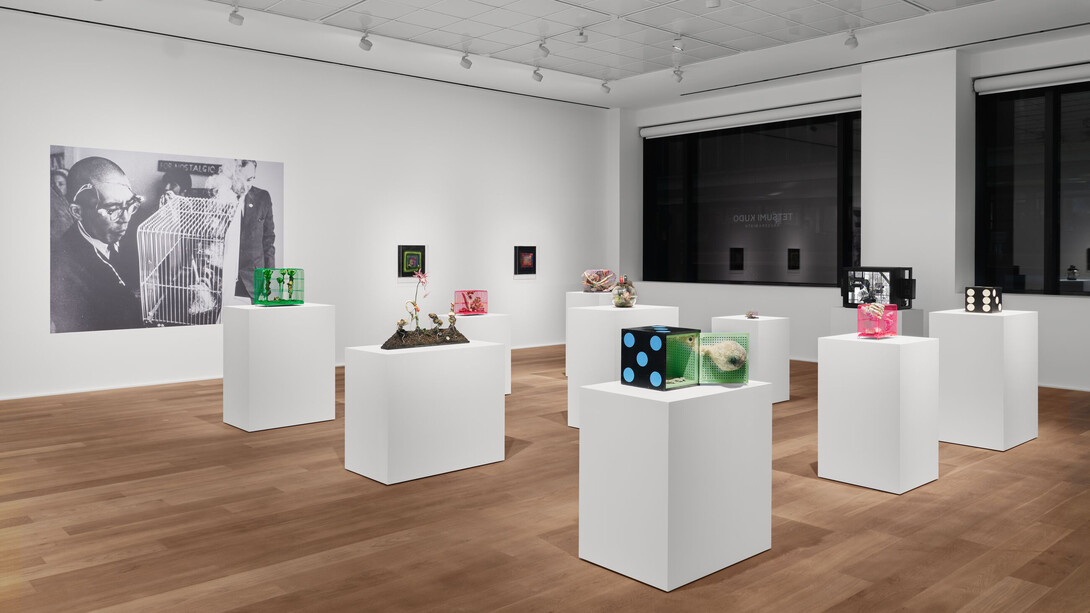
In a wide-ranging practice spanning four decades, post-war Japanese artist Tetsumi Kudo (1935 – 1990) explored the implications of what would later be termed the Anthropocene in prescient work that interrogated the proliferation of mass consumption, the rise of technology and environmental degradation.
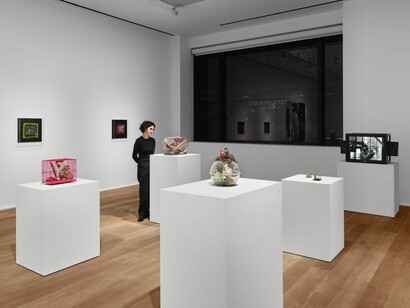
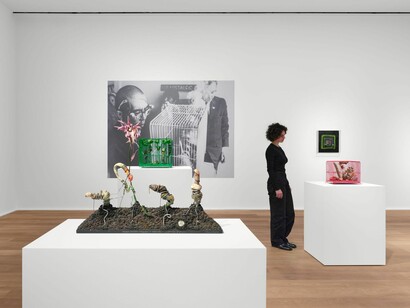
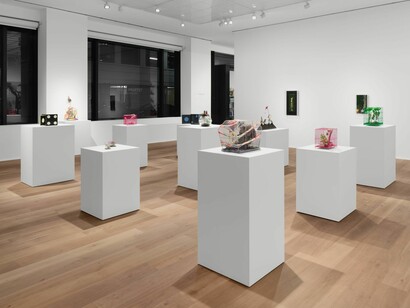
On view in the South Gallery, this exhibition is Kudo’s first in London, UK in over a decade, displaying a selection of works that include the artist’s signature cages, cubes and gardens. Using found materials, store-bought items and hand-sculpted body parts, they suggest a world in which nature, technology and humanity influence each other in a mutually reinforcing system he called the New Ecology. The varied environments he created are intended to encourage viewers to understand themselves as part of an integrated and intricate cosmos.
Running alongside Kudo’s exhibition is a solo show on Takesada Matsutani—a key member of the Japanese avant-garde collective the Gutai Art Association—in the North Gallery. Though the two artists were part of different movements, they are united by their relocation from Japan to Paris, France in the 1960s, where they became acquainted with each other, and by their rejection of established modes of making.
Kudo was born in Osaka, Japan, in 1935 and attended Tokyo National University of Fine Arts from 1954 – 1958. He remained in Tokyo until 1962, when he was awarded the grand prize in the 2nd International Young Artist Pan-Pacific Exhibition. With the prize money earmarked for study in Paris, he moved to the French capital. In Europe, Kudo thought of himself as an ‘observer’ of the West, compelled to disrupt the political, economic and anthropocentric climate of European humanism and its influence on 20th Century art and culture.
In 1965, Kudo began working with cages, which he continued to explore for the next 15 years, his longest sustained engagement with a form. In Coelacanth (1970), Kudo filled food and water trays with aspirin and antibiotics instead of bird seed, suggesting that people, like pets, were being ‘fed,’ observed or controlled by larger organizing systems. La mue - For nostalgic purpose - For your living room (1967) features forms that resemble both pupae and phalluses whilst plastic flowers offer commentary on the eager adoption and excess of mass-production, alluding to a world in which the distinction between the synthetic and natural has blurred. The use of cages, quotidian objects purchased in Parisian pet stores and titles referring to the living room contextualize these works in urban commerce and insert them into the realm of the domestic, while works such as La mue, with its cocoon-like forms allude to cycles of life, suggesting that the cages might be microcosms of organic transformation.
Kudo’s dome works, such as Cultivation of nature and people who are looking at it (1970 – 1971), are perspex spheres containing artificial plant life and soil, store bought items, spent vacuum tubes and rubbish collected in Paris. These mini-environments or time capsules illustrate the evolution of the New Ecology, the physical and cultural fusion of the biological and mechanical. His use of acrid greens and pinks suggest a highly polluted environment, illustrative of Kudo’s feeling that with the pollution of nature comes the decomposition of humanity.
Works in Kudo’s cube series are painted as die, symbolic of the role of chance in life as opposed to the idea that people can control their destinies. Here, Kudo offers a reflection on society’s abdication of agency to technology, an increasing reliance on machines and the consumption of drugs and media for personal fulfillment. Pertinent both in the 20th Century and today, these works implicate the viewer through their titles, such as Your portrait R (1965 – 1966) and Your portrait (1966). Using cages, vitrines, spheres and cubes to illustrate processes at play within our modern world, Kudo’s oeuvre transcends formal categorization, yet his microcosms are consistently universal and timeless in their language.