English
 Español
 Français
 Deutsch
 Italiano
 Português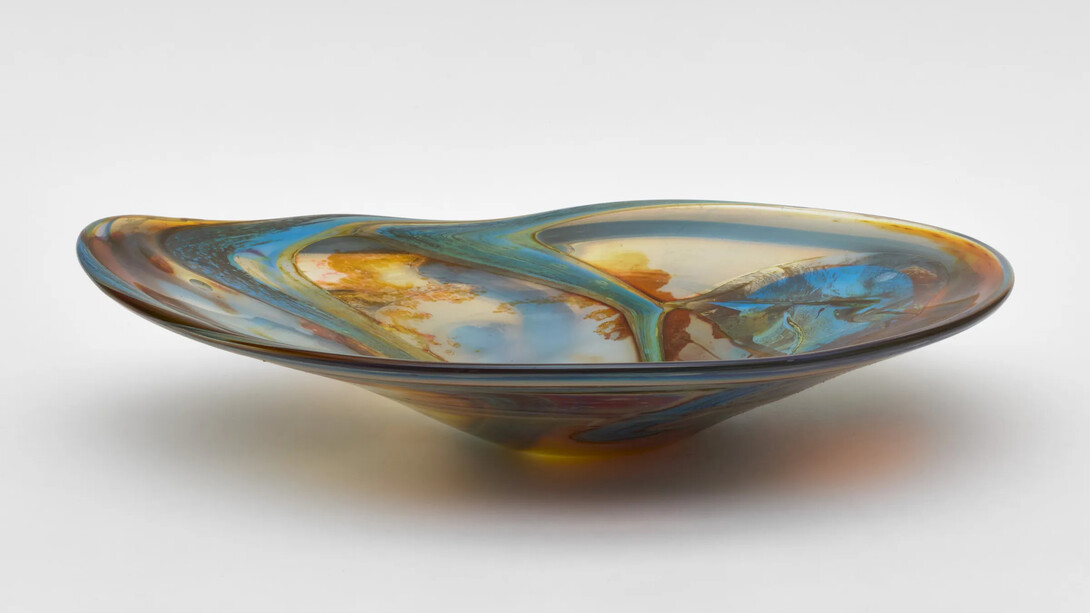
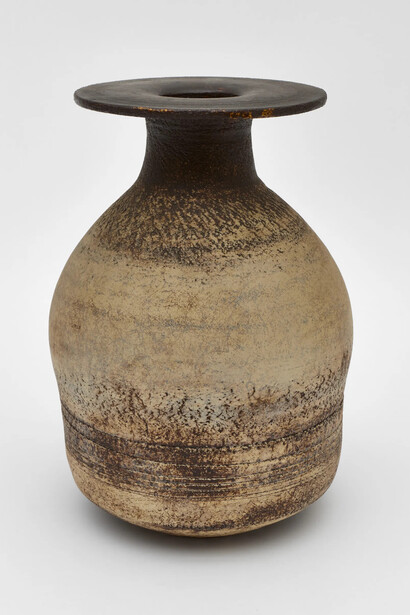
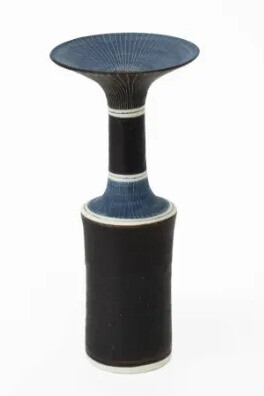
The exhibition Crossings: Hans Coper, Sam Herman, Lucie Rie & Eduardo Paolozzi co-curated by Isabella Smith & Frestonian Gallery, with the support of loans from The Crafts Council, traces the movement of ideas that reshaped British art in the post-war decades, focusing on four immigrant artists who expanded the nation’s aesthetic and material vocabulary.
Beginning with the potters Lucie Rie and Hans Coper – Jewish refugees from Nazism whose partnership in the 1940s and ’50s brought a distinctly continental modernism from Vienna to London – the exhibition follows the transnational currents that flowed through the city into the 1960s, ’70s and ’80s.
Trained in Vienna, and with her pots sought after by design aficionados across Europe, Rie initially faced indifference at best and hostility at worst from potters and curators in her adopted home, whose tastes were shaped by the ‘Anglo-Japanese’ style popularised by Bernard Leach. By contrast, Rie synthesised an idiosyncratic range of influences into an inimitable style of her own – a style that, in the 1960s, came to define the best of British studio pottery.
Coper, too, drew from a cosmopolitan array of sources, ranging from Greek Cycladic figurines and ancient Egyptian pottery to the abstract art of Constantin Brancusi. In 1969, for the exhibition catalogue for Collingwood/Coper at the V&A, Coper wrote:
Practising a craft with ambiguous reference to purpose and function, one has occasion to face absurdity. More than anything, somewhat like a demented piano-tuner, one is trying to approximate a phantom pitch. One is apt to take refuge in pseudo-principles which crumble. Still, the routine of work remains. One deals with the facts.
This focus on process over ‘pseudo-principles’ and on ‘practising a craft with ambiguous reference to purpose and function’ was shared by Sam Herman, a Mexican-born Polish Jew naturalised as an American. His arrival in London in 1965 brought the studio glass movement from the United States to the UK, and later from the UK to Australia. Herman disseminated new technical knowledge of how to work with hot glass alone, displacing the status quo of the artist-as-designer reliant on a fabricator, while advancing an approach to glassmaking that prioritised expressive, organic forms responsive to the material realities of molten glass.
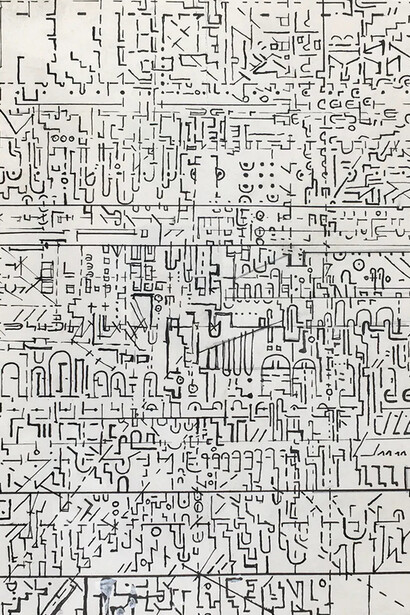
For Eduardo Paolozzi, the Scottish-born son of Italian immigrants, his self-declared outsider status fuelled a practice that defied disciplinary boundaries, spanning sculpture, printmaking, collage, textile design and public art. This sense of otherness was rooted in a childhood lived between identities and intensified by his wartime internment as an ‘enemy alien’. Later, his work would be defined by the circulation of ideas across borders and disciplines, and by an omnivorous engagement with European modernism, American mass culture and the art of the classical world alike.
Together, these artists reveal Britain as a crossroads of global perspectives: a place where exile, migration and cultural exchange sparked new forms of making. The exhibition celebrates their legacy – a modern British art energised, expanded and reimagined by international influence.