English
 Español
 Français
 Deutsch
 Italiano
 Português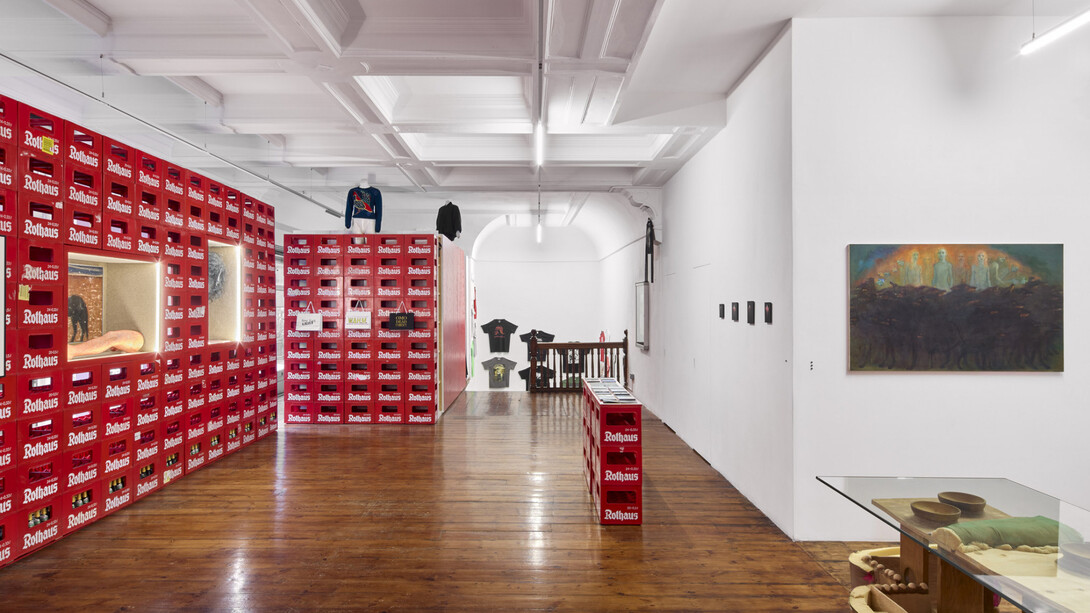
Emalin is pleased to present Means of reproduction a group exhibition of artist merchandise co-organised by Stanislava Kovalcikova and Jeppe Ugelvig.
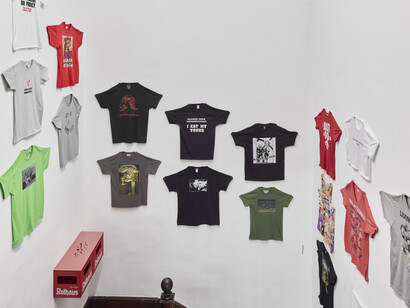
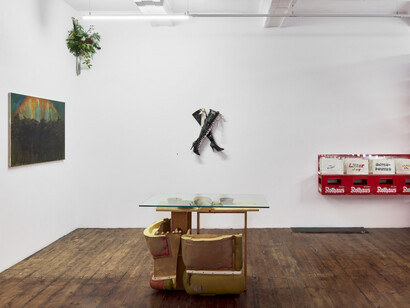
Means of reproduction brings together a selection of everyday products by an intergenerational group of contemporary artists — garments, kitchenware, home accessories, jewellery, furniture, and countless other things one might more accurately call ‘merchandise’. By engaging merchandise from thirteen artists and placing it alongside their ‘originals’, the exhibition asks both gallery and audience to question the stability of distinctions between fine artists, fine artworks, and their tiered product lines.
History tends to obscure the countless extra-original objects that leave artists’ studios — many of them functional, ephemeral, vernacular, improvised, one-offs, used as tools or props, sold in shops instead of galleries, or passed between friends and colleagues as symbolic tokens of kinship. Artists have been in the business of merchandise for at least a century (consider Duchamp’s 1921 perfume, Belle Haleine): prompted by avant-garde experiments in multiplication and dissemination, by tongue-in-cheek self-promotion, or simply to make ends meet.
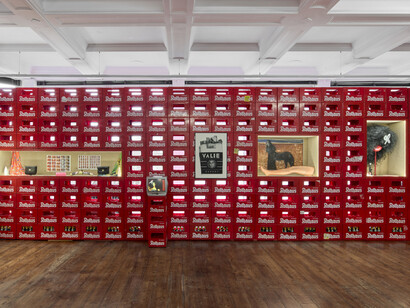
The exhibition enquires into modes of artistic production that lie outside the normatively ‘successful’ artworks that have historically dominated modern art markets: luxurious uniques, handmade by the artist in isolation and sold for high prices in bright-lit rooms. In stark opposition, Means of Reproduction offers itself as a mercurial and fantastical retail space — part Christmas market, part Dada salon, part concept store fashioned from beer crates. In bringing together the wayward object-activity of artists, the exhibition aims to honour models of practice that dare to imagine how art still has the potential to transform quotidian economies — through the humble, if eternally seductive, product form.
Artist merchandise is often understood as an inherently derivative art object — an object of art, but of lesser value, easily distinguished from the ‘real thing’. Means of Reproduction seeks to uncover the critical potential of this inferior sphere of production — the ‘diffusion line’ of art — particularly when it remains in the hands of the artist herself (as opposed to, say, Uniqlo). This becomes especially poignant within a social politics of value: who can afford to buy luxury products (such as original artworks) and, by extension, who can afford to make them. If the notion of a successful artwork has historically been gendered a masculine affair, the fine art of merchandise lends itself naturally to feminist canonization. Art history has had a nasty tendency to relegate most female aesthetic production to outsider categories such as hobbyism, craft, or silly ornament—particularly when its output is useful, pretty, or affordable. In defiance of such attitudes, the feminist imaginary conjured in Means of Reproduction is not of women as sensitive craftspeople but as savvy product hustlers — a history that has played out not only in professional commercial galleries but in artist-run off-spaces, flea-market stalls, workshops, fashion boutiques, and in/as interior decorating. The guiding logic here is not the fashioning of quaint objects of aesthetic contemplation but the realization of functional objects that take seriously the etymological origin of the word ‘economy’: the art of home management, of survival, of making a living in patriarchal market economies.
As the title suggests, the goods on display are not only conceptualist exercises but, indeed, means of reproduction: useful, potentially mass-producible, and firmly rooted in the social economies of everyday life.
(Text by Jeppe Ugelvig)