English
 Español
 Français
 Deutsch
 Italiano
 Português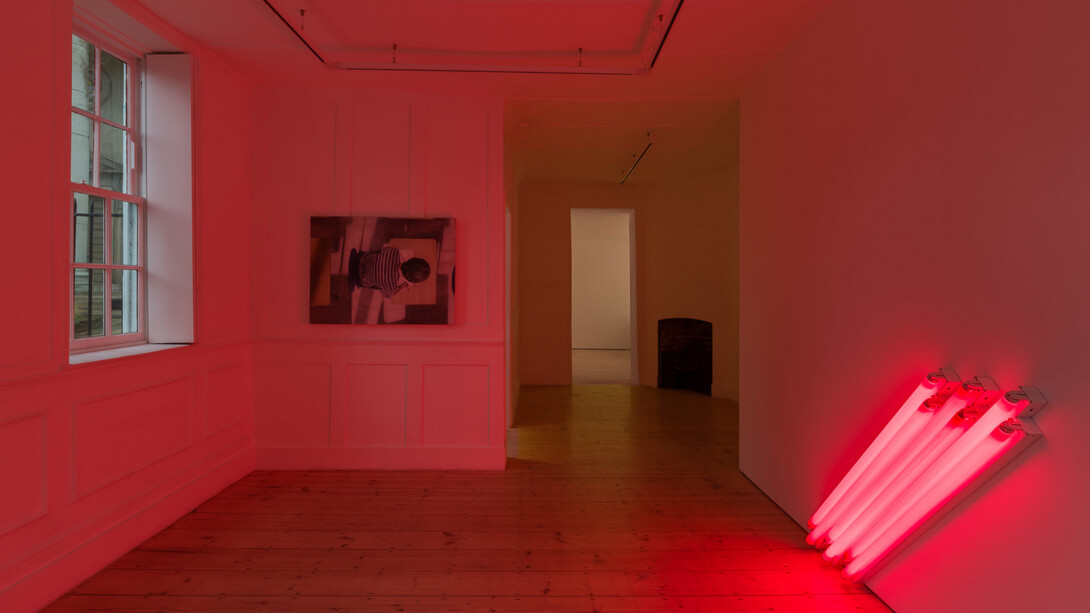
Emalin is pleased to present a duo exhibition of works by Anna Clegg (b. 1998, London) and Dan Flavin (1933-1996), organised with Peter Freeman, Inc. New York, for Condo London. The presentation situates two practices that, across differing media, contexts and generations, engage with the ways technology and conditions of circulation shape perception.
From the early 1960s until his death in 1996, Dan Flavin developed a singular body of work using commercially available fluorescent lamps to produce site-situational environments of light and colour. Working exclusively with prefabricated industrial tubes, left physically unchanged, Flavin activated them through arrangement, so that light emerged as a spatial and temporal condition beyond the discrete object itself. Flavin described these works as “image-objects,” functioning both as sources of extended illumination and as recognisable light fixtures. Installed in rectilinear configurations along walls and into corners, the works set architecture and objects into reciprocal relation, producing gradual shifts in colour and orientation across the surrounding space, and opening it to a range of perceptual possibilities.
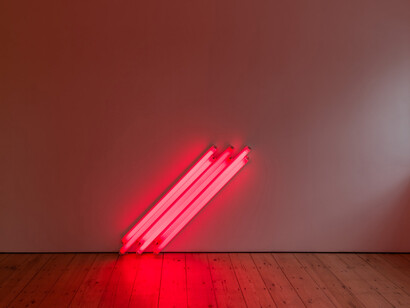
The exhibition includes two works by Flavin, Untitled (to Rainer) 2 (1987) and Untitled (to V. Mayakovsky) 1 (1987). Constructed from standardised components and marked by an impersonal visual language, both works are nonetheless shaped by their dedications to public figures, friends or artists Flavin admired, which introduce emotional and historical specificity. Untitled (to Rainer) 2 is dedicated to Rainer Judd, daughter of Donald Judd, while Untitled (to V. Mayakovsky) 1 commemorates the Russian Futurist poet Vladimir Mayakovsky (1893–1930), a figure whose revolutionary idealism and untimely death inflects the work with an elegiac register. Across Flavin’s practice such dedications recur, frequently operating as memorial gestures – points at which affect and biography puncture the apparent anonymity of industrial form.
Flavin repeatedly framed his work through ideas of loss and finitude, treating them as consequences of an unrealised modernist promise. He recognised that the aspiration toward total clarity or transcendence was never fully realised and that artistic production instead is often bound to exhaustion and contingency. The fluorescent lamp, with its finite lifespan and inevitable obsolescence, became a material index of this condition. “My fluorescent tubes never ‘burn out’ desiring a god," Flavin wrote in an essay for Artforum; they simply last the duration of their manufacture. This refusal of permanence distinguishes his practice from artistic traditions grounded in, say, stone, bronze or oil paint. Instead Flavin replaces durability with a knowingly provisional state. And it is precisely through this low, manufactured medium that the work produces effects associated with the mystical or psychological: saturation, afterimage; optical disorientation too. As perception is reorganised by a medium that is both banal and exhaustible, the work enters what Jeffery Weiss has described as a form of technologised hallucination – an experience of intensity and instability generated through the ordinary mechanics of artificial light. The dedications that punctuate Flavin’s practice sharpen this tension, introducing personal and historical resonance into a system otherwise governed by serial logic. It allows impermanence and perceptual instability to remain unresolved.
Placed in relation to Flavin’s light, Clegg’s paintings operate on a parallel, inward register of perceptual instability, where images partially withdraw. Clegg works within the circulation and consumption of images shaped by lived experience and popular culture, tracing how memory and subjectivity are assembled through repetition, recognition and the comfort of cultural familiarity. Her paintings combine photorealistic figuration – often recalling the ubiquitous aesthetics of smartphone photography – with painterly gestures that soften or thin the image. The result is a sense of distance from the outset. Images appear already processed and degraded or partially lost, as if encountered too late.
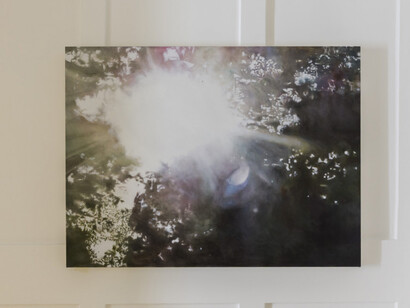
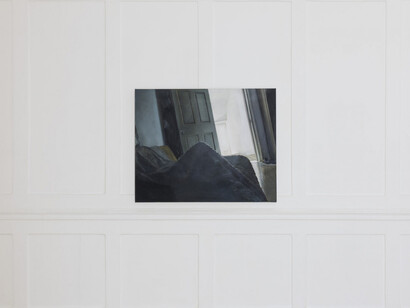
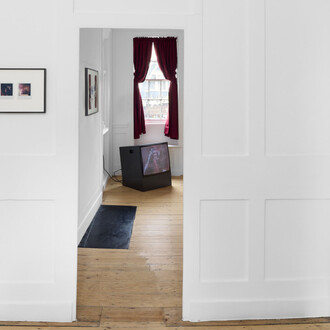
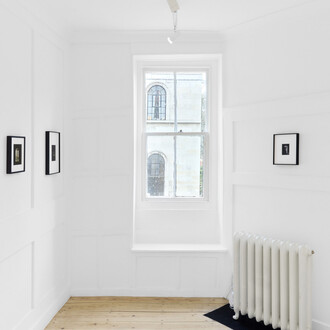
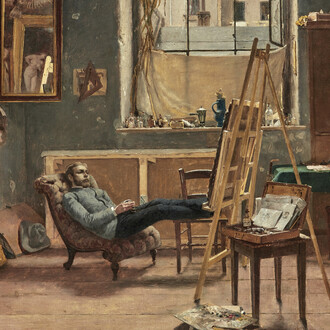
For the exhibition, Clegg has produced four new paintings whose imagery is mnemonic and lyrical, leaving narrative open and unresolved. Staged scenes feel intimate and private, yet also vaguely familiar. Exterior 4 (2025), for example, is rendered from handheld, user-generated stock footage; it depicts sunlight filtering through trees, an image intuitively translated from the words on a Thurston Moore album. In another painting, a schoolboy appears from a dissociative, out-of-body perspective. More overtly cinematic than the rest of the paintings, its POV is both invited to be and withheld as a potential narrative centre. Another scene, meanwhile, presents an apparently intimate image by staging an erection beneath bedsheets, one in fact constructed through a different bodily intervention — the artist’s arm. Across these works, imagery repeatedly returns to light and to looping phenomena. The sun rising and falling. A studio interior with photographic equipment.
As with Exterior 4, language plays a central role in Clegg’s process. Lyrics, song titles and fragments of text catalyse image-making, foregrounding translation as a generative process shaped by slippage and loss. Clegg is drawn to clichés and universally liked images: visuals optimised for circulation that accrue cultural capital and lodge themselves in collective memory. Rendered in low resolution, her paintings register the instability of images under conditions of excess – over-seen and over-used, and therefore potentially unreliable. Where Flavin’s light reshapes perception through spatial intensity, Clegg traces its afterimage, through the gradual internal degradation of images as they pass through memory and cultural circulation.
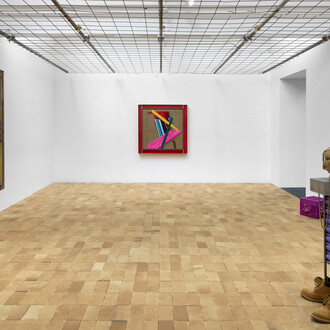
Installed within The Clerk’s house at Emalin, Flavin’s light saturates the gallery, operating according to its fundamentally environmental character and reorganising the gallery at the level of colour, duration and bodily orientation. Clegg’s paintings are encountered within this altered field. Without adjustment or hierarchy, they maintain their own internal logic while remaining subject to uneven illumination and chromatic bleed — the red glow of Untitled (to V. Mayakovsky) 1, say, and the way it recasts adjacent tones. Under these conditions, the gallery operates as a contingent perceptual environment. Seeing is partial and it is mediated. It is shaped by forces that exceed the image itself and that hold these works in productive misalignment. In this state, the interference emerges.