English
 Español
 Français
 Deutsch
 Italiano
 Português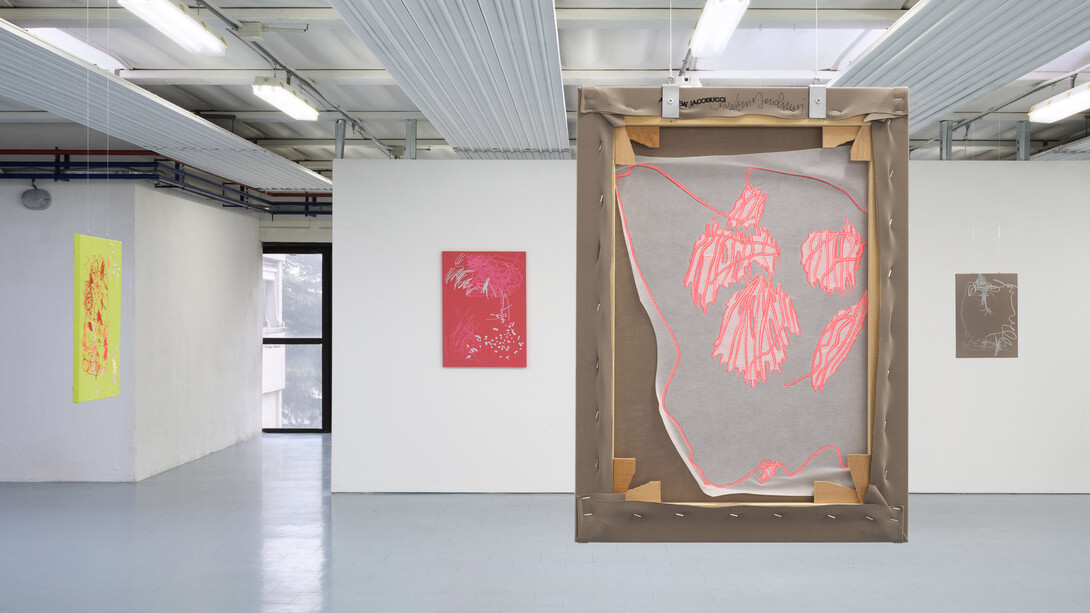
Lucky days never come loudly. What Does It Mean? The title may evoke the artist’s personal experiences. When faced with a work of art, it is natural to wonder what lies behind it. A trauma? An episode from the artist’s life? A recurring dream? An emotional tension that has sought a form? This way of looking at art belongs to the tired, yet persistent, legacy of the great Romantic myth: the belief that the artwork springs from the author’s creative genius, the pure outcome of expression freed from all constraints. But even if the title amounted to nothing more than a private fact belonging to the artist, words do not merely say something; they also do something to what they say. They cast the world in a certain light, give events a certain weight, and let them exist within a possible meaning.
The artist recounts that this sequence of words comes from a slip of paper found inside a fortune cookie in China: an object that disguises its own insignificance with a faintly ironic, faintly oracular tone, and that in this case becomes a kind of revelation. The note functions as a pretext for seeking meaning in things through association, for opening up possible interpretations, for sharing private mythologies. The title stages an “elsewhere” in which lucky days do not announce themselves with noise but arrive almost stealthily.
We can then imagine entering this “elsewhere” ourselves, like someone attempting to translate a language they do not fully command and taking on the task of transforming it into rational discourse. This is the position of the observer, even more so that of the narrator. It attracts and unsettles; it resembles the situation in which one tries to understand another person’s dream and is compelled to give shape to an imaginary world that does not belong to him or her. We see the images, but we have no privileged code to understand or explain them. The question that remains suspended over Lucky days never come loudly is simple and direct: What, exactly, am I talking about? This doubt concerns the author, first and foremost, but inevitably it also concerns us as viewers.
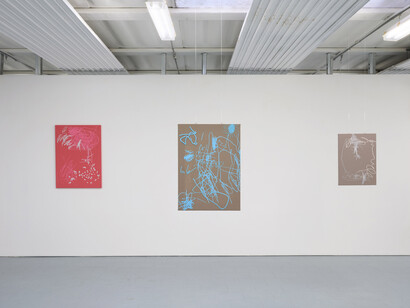
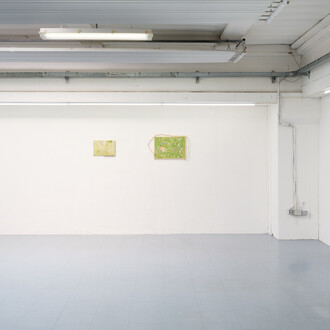
Lucky days never come loudly is composed of several works: dreamlands (notebook from Tianjin), perché le analogies ono sempre deluse, premi quando la luce si accende (in silenzio), minor errors abound, four chairs and a table, so… who won?, the fortune teller, accompanied by two untitled works. Dreams, analogies that don’t hold, light switches, a cluster of chairs and a table, a question asked after the match. At first glance, all this appears to be a small system of references, a catalogue of objects and elementary episodes of everyday life. These are presences that pass through an ordinary day and do not demand to be remembered.
We might therefore feel tempted to read the titles as keys to the works: labels that tell us where to place the emphasis in order to interpret the image. The heading points us in a direction, marks out a field, sets an emotional and cognitive tone, and invites us into the work. Yet at the very moment the title seems to offer a handhold, something starts to slip. The exhibition itself signals this clearly. The two untitled works crack the nominal order hat seems to hold for all the others, allowing us to glimpse that no word can assign stable meanings to images; that every name always arrives an instant after what happens on the canvas.
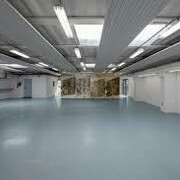
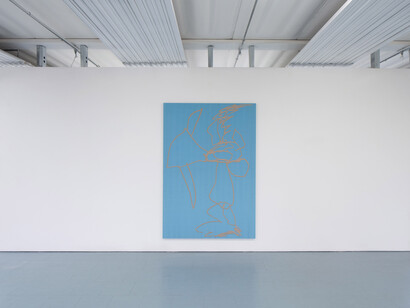
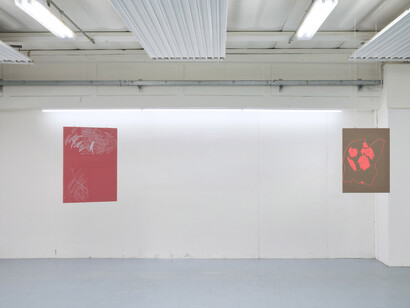
Let’s try another path, moving from words to the arrangement of painting in space, from the promise of narrative inscribed in the titles to the domain of colour and matter. We watch the contrasts between fields of color, the way a thread crosses the weave of the fabric, the weight each form exerts on the others. We notice the grain of the canvas, the thickness of the fiber, the labor of embroidery, the surface pierced again and again by the needle. Perhaps the point lies in the simplicity of all this. Nothing in the work asks for the arcane or the esoteric. Thread and embroidery build images that the eye learns to follow, little by little; a visual world emerges from the tension between the energy of artistic expressiveness and the concrete resistance of the support. In that contact, what we see takes shape, while words arrive afterward, as attempts to reach it.
Lucky days never come loudly: the title, however, remains. This phrase does not merely indicate a series; it organizes it. It is the way in which a group of works is arranged, named, and presented as a readable sequence. The statement too seems to have appeared without fanfare, like a note found by chance in a fortune cookie. Maybe art works the same way: it arrives unannounced, offering an image or a figure that keeps insisting and calling for new forms to appear again. The same theme runs through all the canvases, disguises itself, changes tone, yet remains recognizable. For this reason, it is useful to look at them side by side, as one reads a word within a sentence, in its context and in its relations with neighbouring words. But each individual object also remains irreducibly different from the others, just as the words that compose a sentence have multiple meanings.
Lucky is one of those words: it carries fortune, chance, opportunity—and at the same time the sense of being endowed with something unearned, not secured by merit. Does it name a condition? Is it just an adjective looking for a noun? It might even be a proper name, tied to a personal story or a tradition—Luciano, for instance. In this suspended state, associations arise that no one can fully control. An autonomous figure, once named, keeps generating meanings that branch from the name and shift with the relationship each viewer forms with it. A relation opens between the single work and the series it belongs to, between the one and the whole, and it only intensifies art’s equivocal nature. How can we describe all this? The language of those who speak and write tends, by nature, to close meaning. This is the paradoxical success of theory and criticism, which coincides with their structural failure: to name is to verify, each time, the impossibility of a definitive naming. Yet, it is precisely this limit that constitutes the most vital part of the aesthetic experience. The problem does not lie in understanding or not understanding a work; art has nothing to do with that alternative. We enter art’s abstraction, connecting and disconnecting, shifting emphasis, describing and interpreting.
Lucky days never come loudly. Giving value to forms, recognizing them as thresholds from which whole domains of reference may emerge, is a stroke of luck that comes almost by chance, yet demands a certain rigor. For what happens to acquire meaning in our lives, it must be interpreted: we must stop before the event, address questions to it, grant it time, allow it to settle until the experience assumes a clear and recognizable figure in our memory. The same happens with art and its meaning. Every sign presents itself as an isolated, self-sufficient event, yet it becomes meaningful only within a web of relations that precede it, accompany it, follow it, contradict it, or confirm it.
But right when words attempt to capture this web, an aporia inevitably emerges. Naming tends to stiffen, to fix, to categorize, to transform difference into a formula. Argumentation easily comes to enjoy chasing itself, feeds its own linguistic game, celebrates its interpretive moves, pushing words ever farther from the figure it claims to describe. In this theoretical space, tired and repetitive arguments may emerge; or, conversely, the highest cultural achievements may take shape, particularly when this play of words becomes a true friendship-love of knowledge; a philo-sophia that refuses the first available meaning of things and keeps testing it, checking it again and again, as though nothing were ever finally settled.
But this is another discourse, in the most literal sense of the term. What remains is a vague certainty: as every stable foothold of meaning loosens, if discourse begins to take pleasure in itself, when we stand before art, certain discreet companions remain at our side. They are forms, materials, colours. They promise nothing, proclaim nothing, yet they hold everything together. They present themselves to our consciousness as figures and possibilities of meaning whenever we allow them space to speak, through a relationship each person shapes in their own way, yet one that stays intertwined with others, as if every gaze added something to the same image. Art’s fortune coincides with this continuous re-presentation: lucky days, indeed, do not speak loudly.
(Text by Giacomo Pala)