English
 Español
 Français
 Deutsch
 Italiano
 Português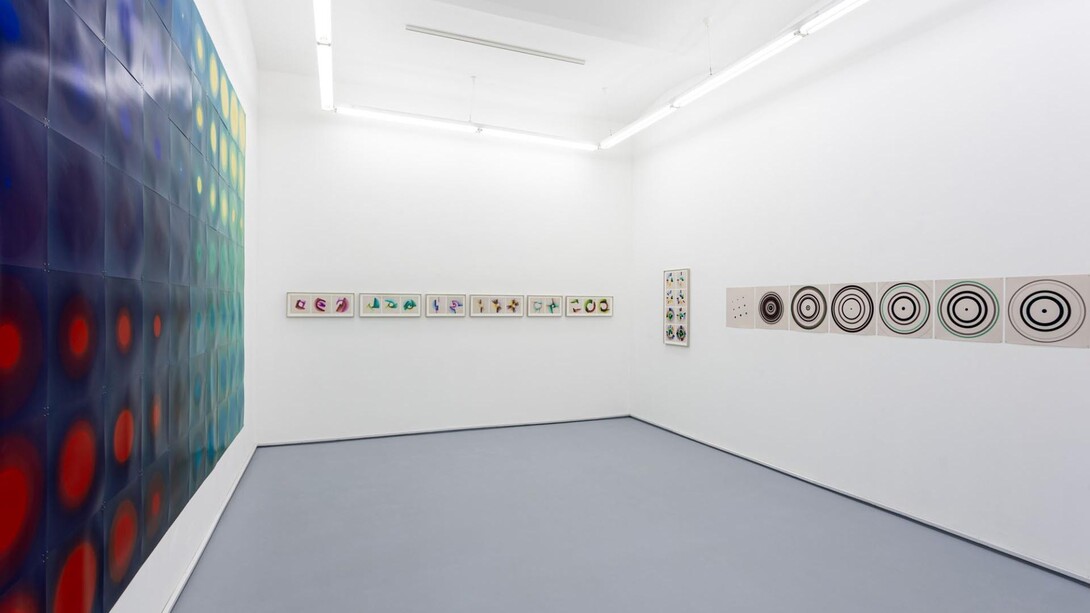
“For me, the use of color light-sensitive material signifies something akin to the role of a mediator - one that carries the possibility of consensus (resolution, reconciliation, agreement, solution, synthesis, etc.) between two positions that appear opposed and irreconcilable. The color light-sensitive material itself creates a connection between two opposing color systems, since exposure operates according to the system of light colors, while processing functions according to the system of pigments. Under normal circumstances, these two systems exclude one another; they become an either - or situation, a question that demands a choice. In working with the medium, I mentally become a mediator: my role is to make the starting points and aims of both sides visible with precision, thoroughness, and rich detail, so that consensus does not amount to self-negation but to genuine agreement. I am interested in whether there is a situation in which light does not dissolve into the logic of pigment, and pigment does not congeal in relation to the temporality of light. I am concerned with whether it is possible to create a situation in which photography becomes neither a mere technical image nor a metaphor for painting. I aim to create images in which one system is not the tool or mechanical supplement of the other, but in which they become cooperating, mutually supportive partners. This interpretation of my role is what keeps me committed to the color photogram. My task is to make it as suitable as possible for this purpose. The medium itself, therefore, is not a simple tool for me, but an actor. Every single work is risky because consensus is not a given, but an experiment; it is not a stable state, but a delicate balance that must be recreated over and over again in every single image." Ágnes Eperjesi reflects on the conceptual background of her recent works and her long-standing commitment to the color photogram.
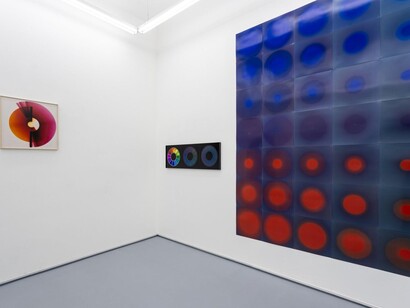
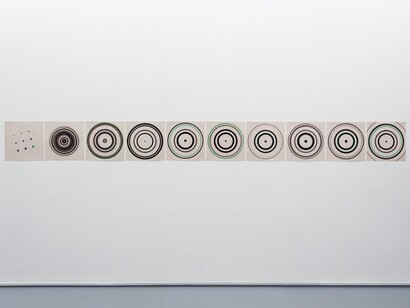
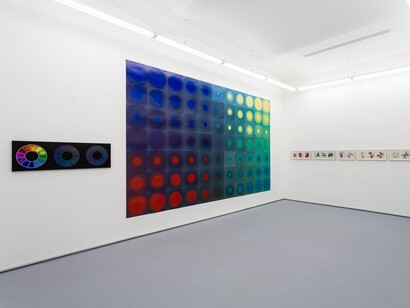
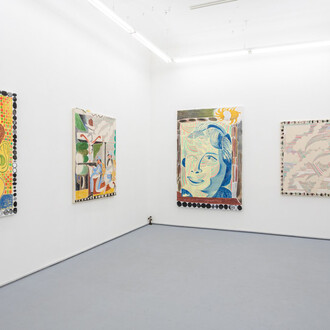
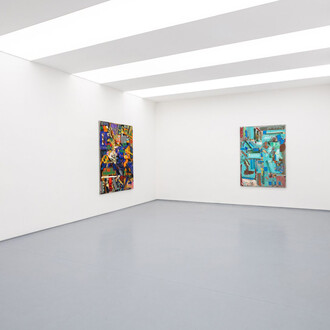
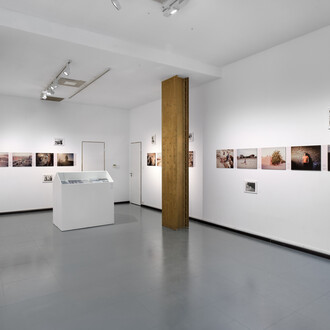
The works exhibited at acb Attachment are animated by a constellation that already appeared in Revved up photograms (2009): rotation and, together with it, the displacement - shifting and repositioning - of the center of rotation, which results in the mixing and transformation of colors (Shifting the center, 2025). Although these works may evoke certain pieces of classical avant-garde art and geometric abstraction, here it is the gesture of rotation that is emphasized – a gesture that sets in motion the emblematic and obsessive figure of color theory, the color wheel (Rotating the color wheel, 2017).
In effect, these works place the toolkits of both painting and the photogram onto a common platform, while remaining rooted in a media-conscious approach. The artist selects color pairs that are formed not based on aesthetic considerations, but on their ability to retain their character and avoid turning black even after differing exposure times.
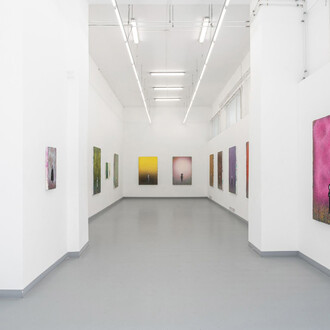
If the images in the exhibition are organized by the conceptual model of a customized color wheel, the question arises as to how we can interpret the works that relate not to the closure of the circle, but rather to the logic of a crack or a drip. Geometric forms are replaced by block-like dark masses and a narrow stream of color appearing like a vein. In the space of the image, the color does not fill but pierces through the dark surface, as if the process of mediation has been forced into a corner, and the light-pigment relationship is compelled to reshape itself in a solarized, strained transition. (Color: remains though I-II, 2023)
Ágnes Eperjesi (b. 1964) graduated in 1989 from the newly founded photography department of the College of Applied Arts (now Moholy-Nagy University of Art and Design, MOME), and continued her master's studies in Visual Communication, a program incorporating photography. She obtained her DLA degree from the Hungarian University of Fine Arts in 2010; her doctoral work was a triple exhibition series titled Color matters (Színügyek). She formerly taught at the Intermedia Department of the Hungarian University of Fine Arts and has been a faculty member at Budapest Metropolitan University (METU) since 2021.
acb Gallery has collaborated with the artist since 2019. A volume presenting her early photographic works (1986–1999) was published by acbResearchLab in the same year.