English
 Español
 Français
 Deutsch
 Italiano
 Português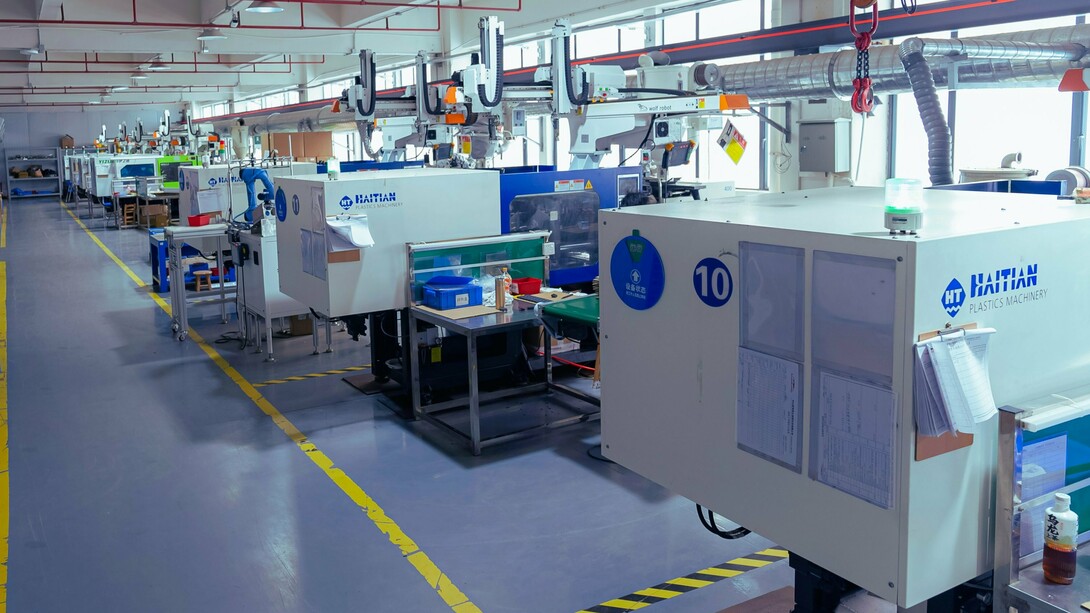
Every product begins as an idea. In manufacturing, the challenging part is transforming that abstract concept into a tangible form without compromising any design specifications. It also demands consistent quality from the first run to the final fabrication, with the ability to scale efficiently for mass output. Industries have found that injection molding and product development go hand in hand.
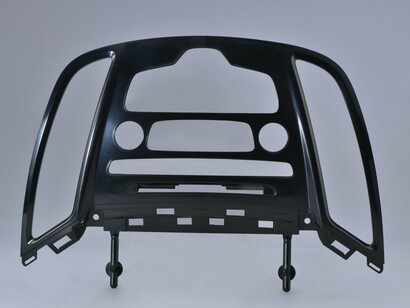
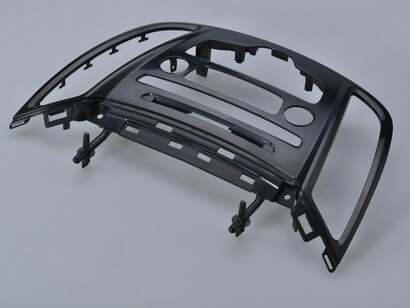
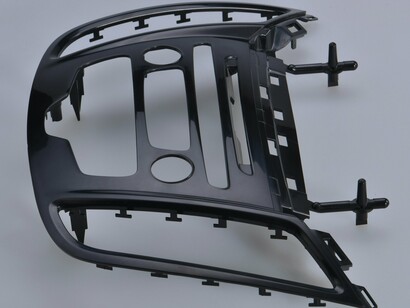
Today, the technique easily shapes car dashboards, medical syringes, children’s toys, and construction fasteners, giving life to blueprints.
What is injection molding and how does it work?
Injection molding uses an “injection” process that forces molten material, typically raw resin, into a template. The entire operation depends on heat, pressure, and precise timing.
Plastic pellets are first fed into a heated barrel and melted, either through heat alone or with the help of mechanical force that crushes the pellets for faster melting. The molten resin is then pressure-inserted into a steel or aluminum mold cavity. Cooling solidifies the plastic into its final shape, after which operators remove the part from the cast.
It is now ready for the following stages: trimming excess polymers, quality testing, or direct assembly with other components.
Done once, the process might not seem remarkable. Its repeatability makes it exceptional. Traditional methods were slow, wasteful, and labor-intensive. Machining requires hours of carving away material, and casting takes longer to cool and offers lower dimensional accuracy.
This technique solves those issues. A single completed mold can reproduce thousands or even millions of identical components with astonishing accuracy. The consistency makes it one of the most expandable and cost-efficient manufacturing systems humanity has ever developed.
However, tooling costs drive the expensive upfront investment. It takes money and time to perfect injection molds, even taking as long as 20 weeks1 or more, for the entire process.
Molds must endure clamping forces measured in tons while capturing every contour of a design. Steel templates are used for high-volume runs because they last longer, while aluminum casts suit prototypes or smaller batches where speed and lower expenses matter more. Additionally, complex shapes require intricate tooling. Parts like slides, gates, cooling channels, and ejector pins become puzzle pieces that must fit together to form the final product.
How injection molding reshaped product development
Modern product development runs on three forces: speed, precision, and creative freedom. Since resin injection fuels all these, it now becomes the link between an idea’s first sketch and its factory-scale manufacturing.
Accelerated prototyping and design validation
Injection molding turned prototyping from a guessing game of “Will this work in the real world?” into a modifiable step. Before manufacturing even begins, short-run tools like 3D printing and computer numerical control (CNC) machining help engineers test the form and function. The step is crucial before fully committing to automated production because the digital concepts turn into physical proofs that they can hold, inspect, and refine.
Hence, true validation only happens when a design interacts with its first test version and the molten plastic reveals flaws that the CAD software couldn’t foresee. By closing that feedback loop, teams move from idea to validated model in weeks instead of months.
Influenced material science
The type of thermoplastic resin determines how a part performs in real-world conditions. Common engineered materials, such as ABS, nylon, and polycarbonate, are chosen for their balance of strength and thermal stability.
For instance, automotive manufacturers use nylon and ABS to create dashboards, bumpers, and housings that are both lighter and stronger. The payoff is improved fuel efficiency, reduced emissions, and extended vehicle life. Materials science doesn’t just serve design, but defines it. For higher demands, high-performance resins like polyether ether ketone (PEEK) match the durability of metal while reducing its weight2 by 80%.
Redefined manufacturing efficiency
Good design harmonizes art and physics. To start, uniform wall thickness prevents warping from uneven cooling. Draft angles ease ejection through well-tapered parts, while rounded corners distribute stress across the surface.
Before cutting any steel, engineers run mold flow simulations that predict how molten resin will fill the cavity. Each virtual test sharpens the model, refining geometry and saving both time and money.
From there, designers use coring to remove unnecessary bulk, ribs to reinforce thin sections, and gussets to add stability. These fine details are difficult to achieve with other manufacturing techniques and make efficiency effortless in injection molding.
Scaled cost-effective production
Once the tooling is set, the duplication becomes almost rhythmic and consistent. Each cycle takes only seconds to minutes, depending on the part’s size and complexity. Every piece emerges nearly identical to the last, with tolerances often within ±0.002 inches for stable resins3 and up to about ±0.025 inches for more variable polymers.
Such fine allowance and repeatability make injection molding one of the most reliable mass-production methods ever developed.
Industries from automotive to consumer electronics depend on it. PVC fittings, smartphone housings, and surgical instruments all owe their precision to the same reproducible process. Even startups benefit. Low-volume molders that fabricate 10,000 components or fewer4 can match the quality of larger manufacturers while maintaining profitable production.
By preserving cost efficiency at smaller runs, injection molding also opens the path to scalability. Even small to medium-sized businesses can grow their output when demand rises without having to reinvent their workflow.
Advanced sustainability with bio-resins
Resin injection has evolved out of necessity. Efficiency is no longer measured by speed alone. Modern machines consume far less energy, often through all-electric or hybrid drives that cut power use dramatically. They also enable the reuse of excess material through regrinding systems and operate more cleanly than ever before, with quieter cycles and minimal waste.
Meanwhile, bio-based and biodegradable resins continue to gain traction5 as sustainable alternatives.
Shaped mold innovation
Modern molding has also gone beyond the cast. Advanced techniques have expanded configuration possibilities:
Overmolding innovated multi-material integration and allowed designers to combine plastics or add soft-touch grips, color layers, and seals directly in-cast.
Insert molding improved hybrid part manufacturing, where metal or pre-made inserts are embedded inside the mold to eliminate secondary assembly.
Gas-assist molding upgraded part geometry control. It creates hollow sections to save weight, material, and cooling time.
Structural foam molding has refined low-pressure, lightweight manufacturing, enabling the duplication of large, rigid sections using cheaper tooling and less resin.
Key characteristics of an injection molding manufacturer
With injection molding becoming more accessible, many manufacturers have entered the market. Only those with key qualities deliver the high-caliber results that certain projects demand. Here are the characteristics that set top suppliers apart:
Precision and consistency: Manufacturers adhere to strict geometric dimensioning and tolerancing (GD&T) standards to ensure that pieces meet exact specifications.
Tooling expertise: They provide skilled tooling design and maintenance, enabling quick prototype turnaround and efficient production.
Volume flexibility: These companies handle both low-volume and high-volume runs without sacrificing quality.
Transparent communication: Teams keep clients informed with regular updates on process progress and product review.
Reliable quality control: They enforce thorough inspection and testing routines that guarantee consistent and dependable output every time.
Perfecting production with precise processes
Plastic resin injection has been around for over a century, yet it remains a cornerstone of modern manufacturing. Its ability to merge design precision, scalability, and material versatility keeps it relevant as industries evolve. Injection molding turns CAD files into real-world products with an efficiency and consistency that is the magic of science.
Notes
1 All About the Basics of Plastic Injection Molding at Xometry.
2 Lightweight Plastics: Transforming Metal-Based Applications at Plastics Engineering.
3 A Beginner's Guide to Injection Molding at Protolabs.
4 How to Choose a Custom Injection Molding Manufacturer at Polycraft Products, Inc.
5 Emerging trends in biomaterials for sustainable food packaging: A comprehensive review at ScienceDirect.