English
 Español
 Français
 Deutsch
 Italiano
 Português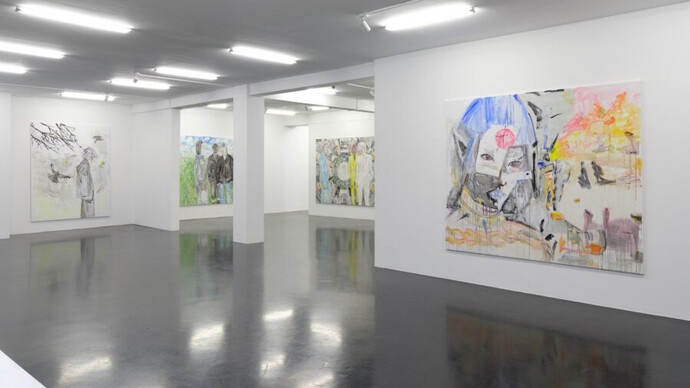
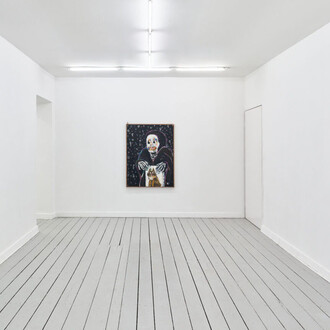
Post society is the title of a 2016 album by the Canadian sci-fi metal band Voivod, and this is what Mayer calls his exhibition at Nagel-Draxler in Cologne.
The women cyclists of the infamous one-day race Paris-Roubaix are racing on slippery cobblestones in the Hell of the North. In bright high-tech jerseys and mirrored glasses, which can only be painted this way in synthetic acrylic colors, they seem equipped for one of the most challenging cycling routes. The rest is executed in oil.
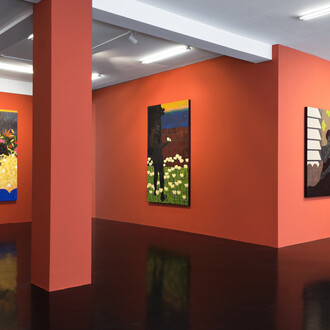
Mayer's pictorial scenes often take place in a landscape after a catastrophe, in the post-catastrophe, the life after, as in the painting titled Accept. Again and again, the sky over Chernobyl appears, taken from original photographs. Apart from steppe-like meadow scrub and short-growing lichens, hardly anything has survived. Larger areas are merely sketched.
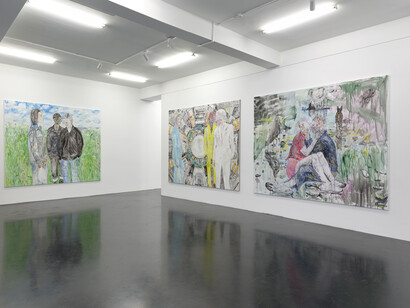
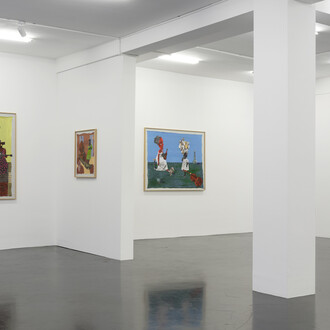
In this inhospitable and dystopian area, this "life after," he places mostly women, often with androgynous character. In contrast to the still-present catastrophe, the women sit or stand, unperturbedly aware of their appearance and clothing. These seem to be casual meetings, perhaps a lunch break among workers. All those depicted appear to be waiting in good spirits, smiling in anticipation of how all this will continue. Style and attitude still matter, or perhaps even more so now. Mayer's entourages and female formations are placeholders for a feminist society that resolutely faces the future despite the post-catastrophe.
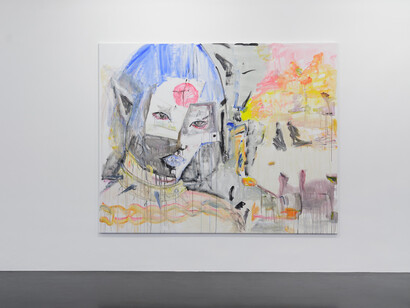
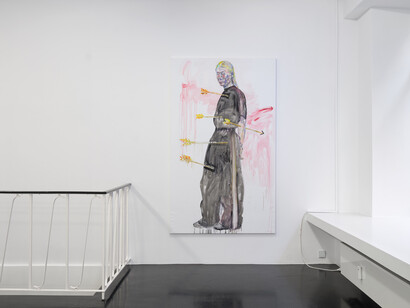
The people, nature, and even the animal world in Mayer's paintings bear traces of events and their injuries: scars, torn clothing, Joker grins, pointed animal or elf ears, so that it seems these figures have already experienced and survived quite a bit.
"Zone II", an actually peaceful-seeming scene, refers to Andrei Tarkovsky's film Stalker; the plot takes place in an area that was evacuated after destruction. The stalker acts as a guide through the uninhabitable landscape. A first-person shooter computer game from 2024 is set in a Chernobyl backdrop. Behind the three women in their perfect streetwear, one can recognize a factory hall, perhaps also the concrete sarcophagus over the destroyed reactor.
"Winter Is Coming" quotes from Game of thrones, a warning about the eternal winter and its inhabitants, who appear like reanimated dead. A few directly placed, mostly very light and quick brushstrokes result, with restraint of means, in an immediately convincing placement of forms.
The arrangements of Mayer's figures go back to depictions of the "Sacra Conversazione", the representation of saints around Mary with the Christ child or other models from classical art history. Already in the early 2000s, he recognized that advertising designers of major fashion companies for glossy print media like Vogue, Esquire, etc., adopted figure representations from classical painting as templates for their haute couture advertisements (see Hans-Jörg Mayer, Galerie Christian Nagel, Berlin 2003). Mayer closes the circle and returns the models via painting back to art.
Emblematically, he places his larger-than-life and hyper-contemporary icons, who could often have emerged from nightlife or dark movies, in a world that is in greatest danger but already has a post-apocalyptic personnel at its disposal, ready to continue living.
Hans-Jörg Mayer is a storyteller. Since the beginning of his artistic work, he has also been a gifted portraitist and finds his artistic echoes equally in language, in abstractions, and generally in the cultural/designed environment of the Western world. He is an echo-ist. He sings the echo of all post-catastrophes.
(Text by Christian Nagel. Translation by Claude, corrected by the gallery)