English
 Español
 Français
 Deutsch
 Italiano
 Português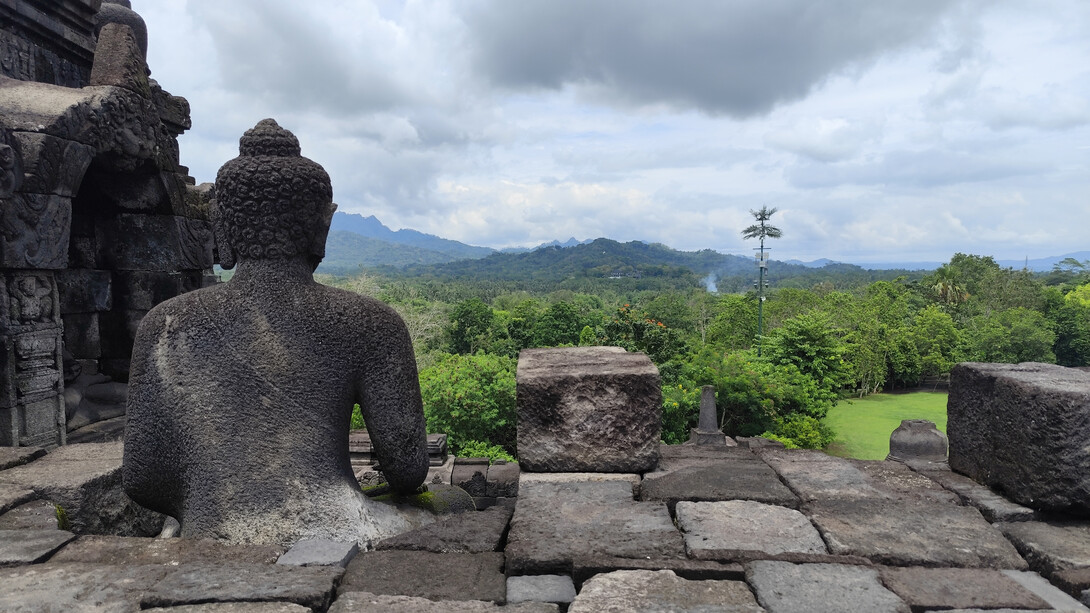
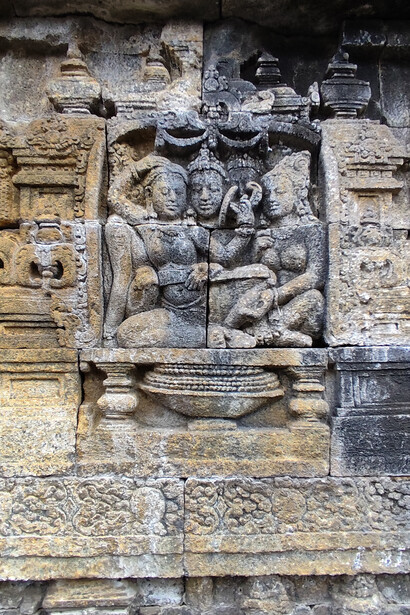
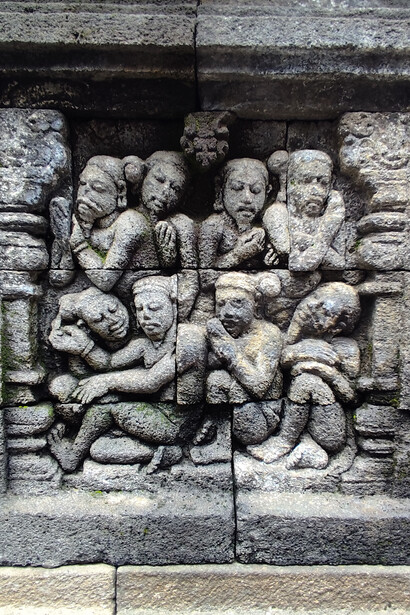
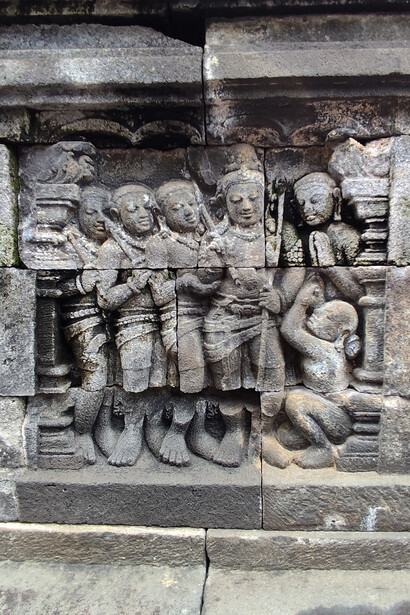
Borobudur is an allegory of self-awareness, growth, and social engagement, told in volcanic stone. It is not a temple built for veneration, but for engagement, experience, and self-change. Pilgrims once walked its terraces level by level, rising higher with each level, learning about the stages of Buddhist enlightenment while being challenged, through sculptural depictions of the Buddha’s life and teachings on corridor walls, to reflect on their own development and to rise.
Unfortunately, current, restrictive preservation methods have rendered Borobudur’s purpose hollow. Its terraces are reduced to museum corridors, its sculptures stripped of dialogue, its ascent transformed from a lived allegory into a regulated spectacle. What was once a dynamic journey of reflection and transformation has been frozen into static heritage, guarded against true experience, emptied of meaning, and severed from the very engagement it was built to inspire.
Built in Java in the 8th century, Borobudur belongs to a moment in Mahayana Buddhism when enlightenment was believed possible within a single lifetime. Teachers of that era offered tantras—“manuals”—to help individuals understand themselves and move toward higher, more humane states of being. Borobudur itself can be read as such a manual: an education in stone, guiding its visitors through an embodied lesson in self-discovery.
There is no doubt that the temple was meant to be experienced and not meant to be a source of worship. My favorite interpretation of the pedagogical layout of Borobudur is that the temple unfolds in three great levels, rising from the everyday to the transcendent.
The first level represents ordinary life, the world of habit, impulse, and unexamined reaction. Here, there are sculptures showing people acting as they are conditioned to act, moved by fear, desire, expectations, or custom, rather than reflection. Here, you see frustration becomes anger, and anger turns to violence. Here, you see violence directed against those who are considered enemies. You also see dissolute and uncontrolled behavior. One lives, but without a sense of peace, freedom of mind, or meaningful self-restraint.
The second level marks a turning point: recognition. It is here that one begins to see the roots of one’s own behavior, to ask whether things must be as they are, whether one can change for the better and become more tolerant, forgiving, kind, and pro-social. This is where moral imagination awakens, the dawning sense that life might be lived with compassion, mercy, forgiveness, and purpose, and not the way one has seen life modeled by others who cause pain in the world. This is the passage from mere existence to meaningful being.
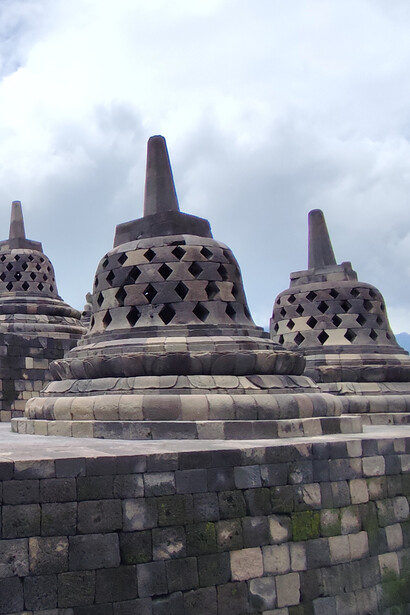
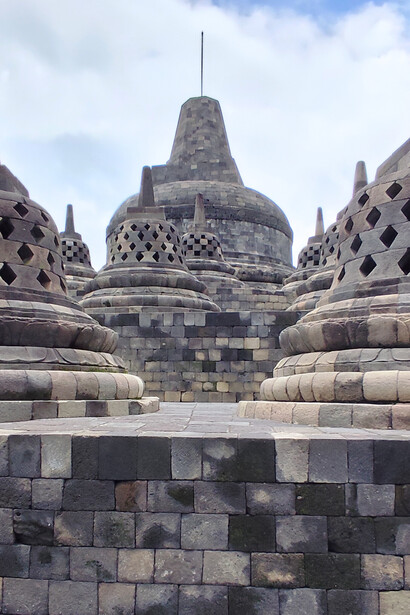
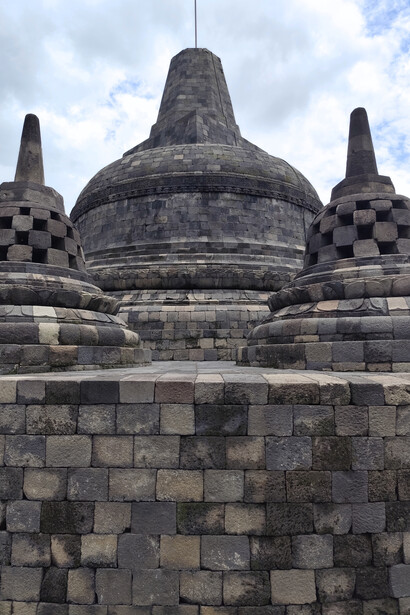
At the third level, or the stupas, is the summit where the stupas stand, overlooking the jungle. This final stage represents liberation, freedom not only from suffering, but from the moral striving that can itself become another form of bondage. Here, as one emerges into the open air surrounded by verdant life as far as the eye can see, one becomes open, receptive, still. Enlightenment is no longer something one has to accomplish, but something one may joyfully receive.
And perhaps there is a fourth stage, unmarked by stone: the descent. Having glimpsed clarity at the summit, one returns to the world below to live, act, and serve with greater understanding.
What sets Borobudur apart from other grandiose “religious” temples is that it was not built by slave labor or under the direction of a self-serving despot to his own glory, like Abu Simbel in Egypt or Angkor Wat in Cambodia. There was no Ozymandias behind the construction of Borobudur. Researchers have established that the monarch most responsible for Borobudur was Samaratungga of the Sailendra Dynasty (which ruled central Java, c. 8th–9th century CE). The temple was built between 780 and 830 CE.
Samaratungga was a Mahayana Buddhist king, dedicated to spiritual rather than militaristic pursuits. Unlike many rulers who built temples to glorify their power or deify themselves, Samaratungga’s reign is remembered for peace, cultural flourishing, and religious devotion, not conquest.
No evidence of slave labor has been found in connection with Borobudur’s construction. Archaeological evidence and inscriptions imply that it was built through collective effort involving skilled artisans, local villagers, and Buddhist devotees, coordinated as a religious and communal project. This aligns with Buddhist principles of dāna (generosity) and karma, contributing to such a monument earned spiritual merit.
As John N. Miksic notes in Borobudur: Masterpiece in Stone, even demons and malevolent figures are depicted serenely, as if the sculptors themselves worked in a state of inner calm. They could not create the horrific. This is another way we can tell that Borobudur was a “labor of love.”
Now, above I mentioned that one theory of the temple is that it is broken into 3 stages. This is, however, disputed by some scholars. Some believe that, perhaps, ten levels are depicted at Borobudur as these would correspond with the ten steps one must take to become a bodhisattva—a being that can transcend the world and escape, but who stays to enlighten and liberate others. There is the belief that the way toward becoming a bodhisattva was illustrated and established as a guide for every pilgrim to follow.
Despite how the structure was divided, it is beyond doubt that this structure was meant to provide a beneficial experience, to guide them to it. It was a benevolent gesture created through a sense of goodwill, guided by a king driven by good intentions, and executed by those who were believers, to the benefit of any visitors.
So, here’s the big question I think you are asking yourself: can you come to Borobudur and walk the same path of the pilgrims during the brief time that Borobudur functioned as a place of spiritual transformation?
No.
I learned of Borobudur when I was very young and, frankly, never thought I would get to experience or see it. Circumstances, however, brought me to Asia, and I suddenly realized it was within my financial means to get to this remarkable place. I wanted to walk the path of the pilgrims. I wanted to experience the amazing sculptural reliefs on the walls of the differing levels to derive inspiration for my own humane growth. I wanted to be a part of this humane legacy.
Overtourism has, however, stopped this. From what I understand, for the past two years, new rules have been established to prevent modern-day pilgrims from wandering through the stone complex of levels and walkways. I could have cried when I learned I would be in a group of 14 other people with a guide telling us what we were looking at. I would get one-hour of access to Borobudur for 440,000 rupiah ($28). These rules were apparently established to preserve the structure.
Thus, today, Borobudur risks becoming nothing but a backdrop for selfies rather than a setting for self-reflection. Preservation is vital, yet so is the living experience it was built to offer. What good is saving the form if we lose the function that gave it meaning?
Wouldn’t the folks who constructed this temple of spiritual education have danced in the streets if they had known that over 1,000 years later, people still wanted to walk the way of the pilgrims who used to come here? Don’t we owe it to them to preserve the experience? Has UNESCO and the Indonesian government struck the right balance here? Sure, the structure must be preserved, but the structure is also calling to be experienced.
Borobudur is a unique and revolutionary religious structure meant to be experienced. It was an act of benevolence meant to endure for the benefit of others indefinitely.
A unique structure meant to educate has now been turned into a purely tourist and selfie experience, where people learn mere facts and are stopped from having the depth of experience possible. The modern pilgrim passively follows a guide who is compelled to make comments geared toward the attention level and level of engagement of a typical tourist, not to the interests of someone who understands the meaning of the structure and wishes to experience it as it was meant to be.
So, what can be done? I would like to see UNESCO and Indonesia recognize the special meaning and function of Borobudur and make it possible for folks to take the journey the builders wanted people to take. What is the point of preserving a structure if the meaning of the structure is completely lost through your efforts? I am not sure how this can be done, but if we all put our heads together, if we have good intentions, I am sure we can fix this. A pilgrim permit? Perhaps just reopening the temple to be as it was a few years ago, but sell a limited number of tickets per day online, and give people special flip-flops to wear (they already do this). Tell people that if they touch anything, they will be removed.
Maybe put a special protective layer on the stones that people walk on—come on, get creative. The stones that folks walked on over 1,000 years ago were, apparently, covered with a type of paint anyway. The entire monument was coated in white plaster and then colorfully painted, so that the gray andesite stone we see today was never meant to be exposed.
If there are people who really want to experience the temple, let them. Borobudur, as a tourist attraction instead of a spiritual experience, is a shocking development and, frankly, a disservice to the sanctity of the purpose of the temple and an affront to those who labored to construct a structure of meaning and relevance that is still valid to this day.
If Borobudur was built as an education in stone, then its preservation should include the preservation of its purpose: to teach, to move, and to awaken. It deserves not just to be seen, but to be walked.