English
 Español
 Français
 Deutsch
 Italiano
 Português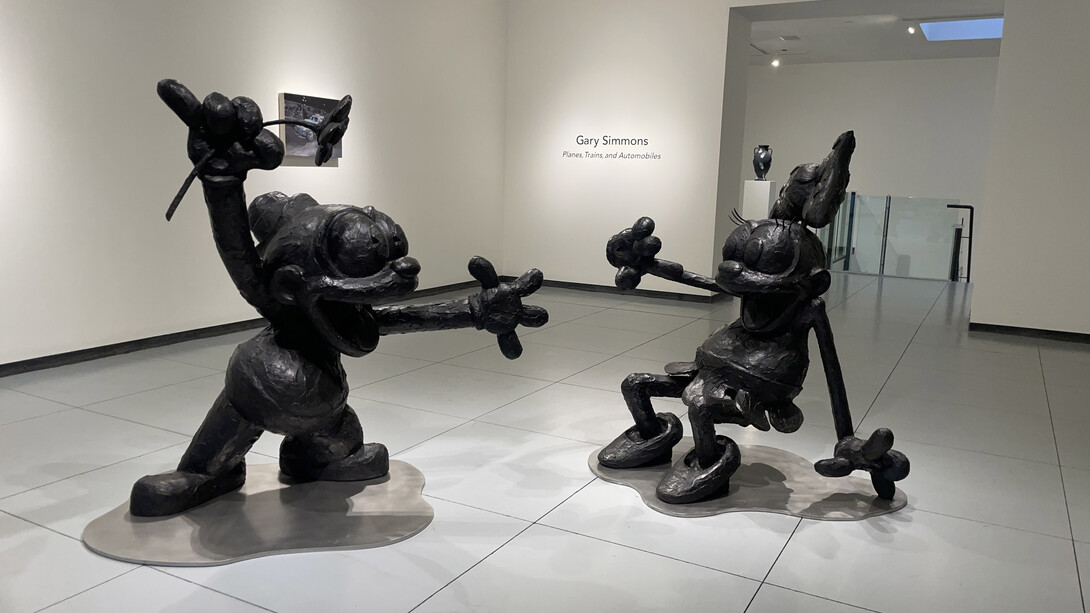
Gary Simmons is known for his searing engagement with race, memory, and the visual structures that shape American cultural history. Working with motifs such as chalkboards, erasure, and appropriated imagery, Simmons addresses the persistence of racial stereotypes and the haunting residue of violence embedded in collective memory. His blurred, ghostly forms create spaces that hold both absence and presence, confronting viewers with what history remembers—and what it chooses to forget. Born in 1964 in New York City, Simmons received his BFA from the School of Visual Arts and his MFA from CalArts. Early in his career, he established his studio in a former school building, where abandoned chalkboards first inspired the materials that became central to his practice. Simmons currently lives and works in Los Angeles. His work is included in the permanent collections of the Baltimore Museum of Art, MoMA, and the Walker Art Center, among others.
Lyle Ashton Harris’s work explores the intersections of gender, sexuality, race, and historical memory through psychologically charged self-portraits and performance-driven imagery. His photographs and mixed-media works reimagine cultural symbols and interrogate the camera’s role in shaping identity. Through vulnerability, theatricality, and layered narrative, Harris presents identity as fluid, constructed, and deeply relational. His practice merges personal history with broader cultural experience, creating images that challenge stereotypes while centering Black and queer presence. Born in 1965 in the Bronx, NY, Harris earned his BA in Studio Art from Wesleyan University and his MFA from the California Institute of the Arts. He participated in the Whitney Museum’s Independent Study Program and served as a juror for the Africa Pavilion at the 1997 Venice Biennale. His work has documented pivotal moments in queer and activist history, including the second wave of AIDS activism, and he published Today I shall judge nothing that occurs in 2017. Harris lives and works between New York and Accra, Ghana. His work is represented in major museum collections including the Solomon R. Guggenheim Museum, MoMA, the Museum of Contemporary Art Los Angeles, and the Museum of Fine Arts Boston.
Jim Hodges creates poetic, materially inventive works that explore impermanence, tenderness, and human connection. Incorporating materials such as rocks, denim, silk flowers, glass, photography, and mirrors, Hodges transforms humble objects into meditations on time, presence, and emotional resonance. His practice ranges from intimately fragile constructions to monumental installations, consistently revealing the quiet power and vulnerability embedded in the everyday. Born in 1957 in Spokane, Washington, Hodges studied at Fort Wright College before receiving his MFA from the Pratt Institute in 1986. He later served as Chair of the Sculpture Department at the Yale School of Art from 2011–2012. His major mid-career retrospective traveled from the Dallas Museum of Art to the Walker Art Center in 2013–2014. Hodges’ work is held in the collections of the Art Institute of Chicago, the Solomon R. Guggenheim Museum, MoMA, the Centre Pompidou, and the Hirshhorn Museum and Sculpture Garden. He lives and works in New York City.