English
 Español
 Français
 Deutsch
 Italiano
 Português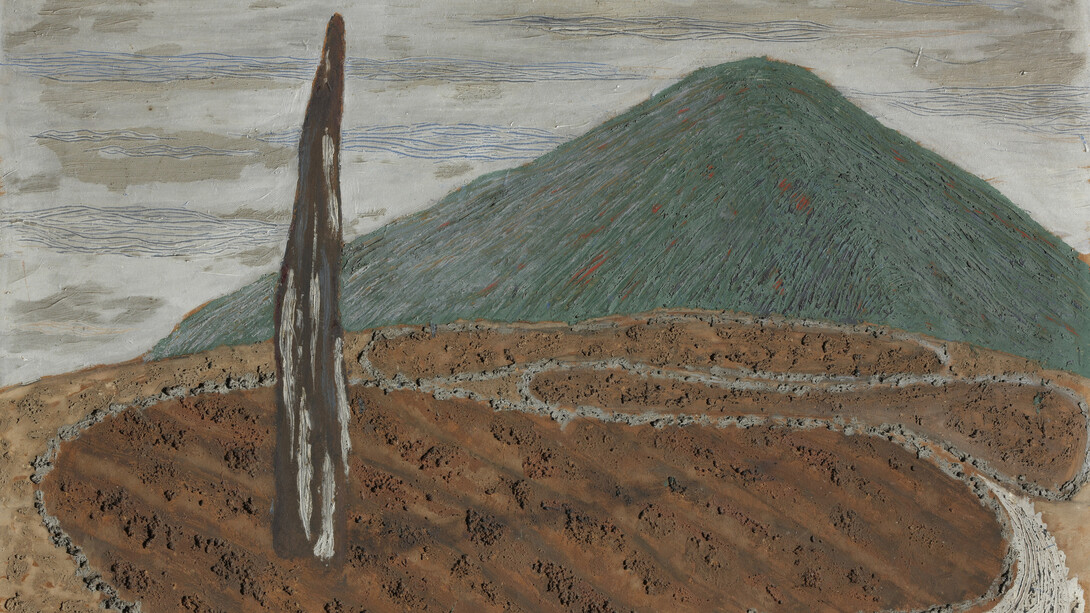
The earth and a primordial language of signs and basic forms – or, as we have defined it in this exhibition, the telluric (terrestrial or geological) and the primitive (primordial) – offered two paths of renewal starting from the very first episode in modern Spanish art (the 1920s and 1930s). Persistent and recurrent, they constitute an idiosyncratic substratum of Spanish avant-garde art that is still recognisable today.
The break with academic tradition before the Spanish Civil War and the resumption in the late 1940s of the advances interrupted by the conflict was a joint endeavour involving artists with very diverse leanings. Individuals or groups representing trends ranging from Surrealism to Art Informel and its offshoots (and beyond) relaunched artistic expression based on new avant-garde principles. To do so they turned to the earth, proposing their own ‘natural creations’ with unusual, original and surprising appearances that transcended reality. They went back to cave, indigenous and primitive art in a historical context that was pushing for a fresh start in order to rediscover a new artistic identity. It was as if Spanish art were beginning all over again, at the forefront, from the most absolute origins: the matter of which nature is made and the most ancestral signs of early human expression.
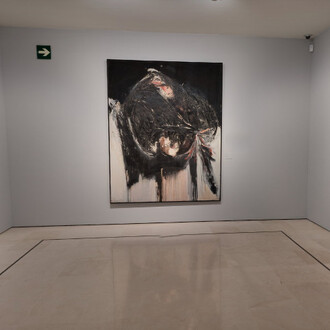
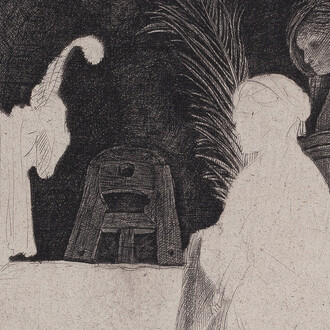
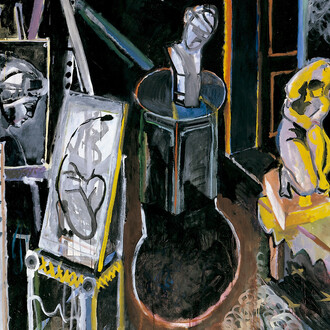
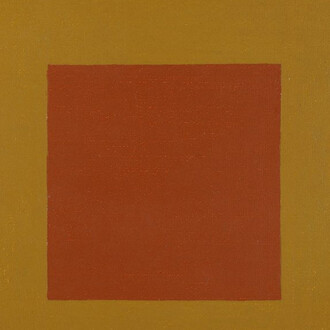
The more than sixty works brought together here – including paintings, sculptures, drawings, photographs and prints – are shown in two sections depending on which of these leitmotifs is predominant. Nevertheless, the two approaches are continually intertwined and inseparably interwoven in this narrative, which calls for a new look at the greatest artistic renewal in Spain that lasted until the late 1900s. In these eclectic and highly evocative images with their earthy colours, sometimes saturated with matter, sometimes intensely expressive and always with a powerful personality, practitioners of the telluric and primitive trends alike turn to the atavistic, the gestural, the graphic, the organic and the dreamlike in their avant-gardist proposals, irresistibly drawn to these two driving forces of a specifically Spanish modern art.
Telluric
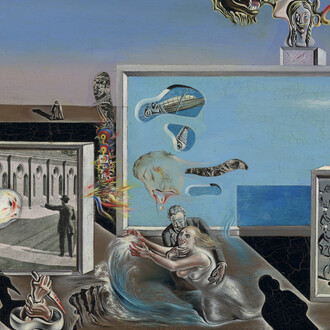
In the 1920s and 1930s a variety of artists, such as the Vallecas School (Palencia, Alberto, Lekuona) with their rural focus and those in the orbit of Surrealism (Miró, Domínguez, Esteban Francés, Moreno Villa, Mallo), strove to invent a radically new personal landscape that emerged from the primal essences of nature, the subconscious, or dreams. This new relationship between art and nature made the latter a central theme for the Spanish avant-garde and gave rise to a poetics of the telluric (from the Latin tellus, -ūris ‘the Earth’, earth, soil’). These principles permeated the renewal-oriented figurative art of the post-war period (Ortega Muñoz) and, especially, abstract Art Informel from the 1950s onwards (Juana Francés, Palazuelo, Manrique, Torner, Chillida, Millares, Tàpies, Guinovart). It even extended to more recent artists fascinated by the primordial forces of the earth (Goenaga, Barceló, Sevilla, Muñoz and Lanceta).
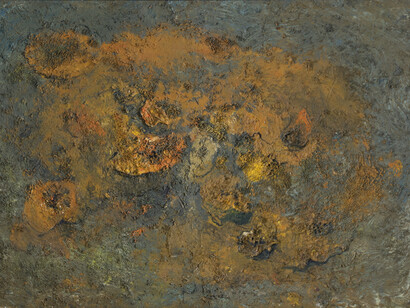
What prevails in the telluric artists is an instinctive, visceral, irrational and experimental art that progressively blurred the boundary between figuration and abstraction and heralded the huge success of the latter at the height of Franco’s dictatorship. Barren landscapes and fanciful universes that also seem to be in a primitive or antediluvian state coexist in their works alongside biomorphic beings – made up of organic forms – and figures metamorphosed into walking rocks or living sculptures, picture surfaces dominated by matter, and works composed of unconventional media (found materials, fabrics). In other words, they are works that illustrate an avant-garde extracted from the bowels of the earth over the past hundred years.
Primitive
With a few forerunners among the artists of the 1920s and 1930s who also explored the telluric avenue, a primitivism very different from the early Parisian avant-garde’s fascination with African and Oceanic art had a particular impact in the 1950s, when Spanish abstraction emerged under its influence.
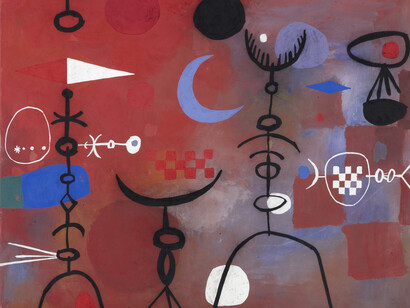
With concerns ranging from the prehistoric paintings of Altamira (Ferrant, Goeritz, Picasso, Lagunas, Aguayo) and the indigenous culture of the Canary Island Guanches (Millares, Chirino) to the unconscious and dreams as a primitive state of mind (Tàpies, Cuixart), the influence of Paul Klee's primitivist abstraction (Palazuelo, Sempere) and Art Informel’s rewriting from scratch an art that was clearly already different (Saura, Chirino, Chillida, Millares, Tàpies, Manrique, Feito, Canogar), a plethora of primitive artists coincided in their desire to reconstruct the avant-garde during the Franco regime. They made use of a vocabulary – applied in various syntaxes – of signs, geometries or forms reduced to their bare essentials, working on surfaces that look like walls or floors and have the primary appearance of a hand drawing in complete freedom, that of a creator faced with a blank canvas for the first time in art history. Following in their wake, the artists who remained faithful to abstraction beyond the 1960s or more recent primitivist approaches (Barceló) gave continuity to an avant-garde that had also found its origins in the Earth’s interior, on the walls of a thousand-year-old cave.