English
 Español
 Français
 Deutsch
 Italiano
 Português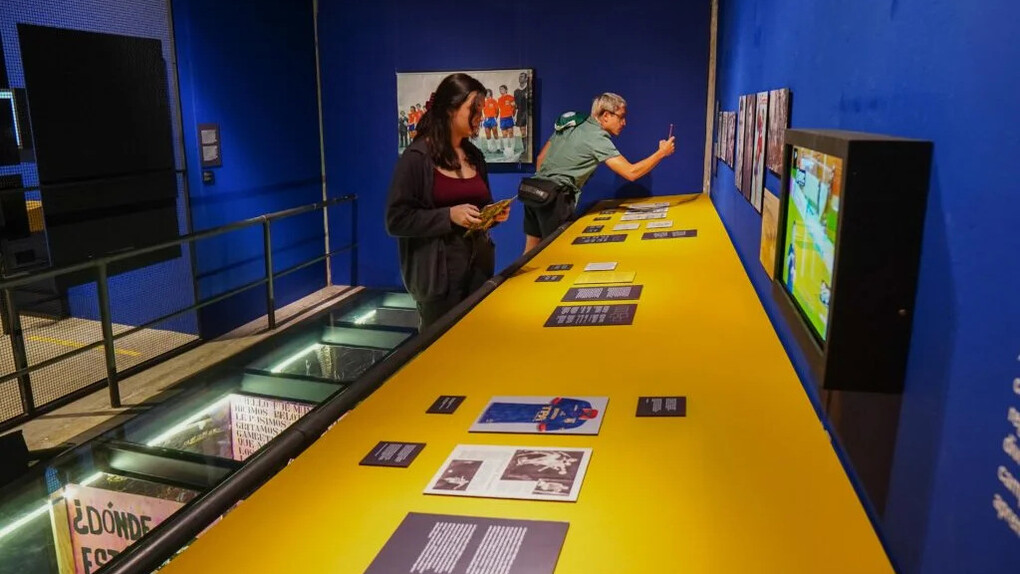
The exhibition, curated by Luiza Romão, Matias Pinto, and Gisele de Paula, offers a historical, political, and poetic journey through the subcontinent based on football. It explores audiovisual installations, soundscapes, interactive experiences, photographs, and artworks, many of which were produced exclusively for the exhibition. Sponsors of the exhibition include Mercado Livre, Arkema, Goodyear, Farmacêutica EMS, and Itaú, with additional support from Adidas, Grupo Globo, Pinheiro Neto, Zanchetta, and Sabesp—all through the Federal Culture Incentive Law, Lei Rouanet.
As the title suggests, the exhibition is bilingual, exploring the intersections between Portuguese and Spanish. Cancha is a word of Quechua origin that means both ‘popcorn’ and ‘field’. And Brava means both “angry” and “great”. Together, they describe the fans who support and follow their teams intensely and unconditionally, everywhere, through thick and thin. !Cancha Brava! is thus a synthesis of the history of our football, comprising a lot of passion, peculiarities and fifty-fifty balls.
“The word ‘cancha’ carries an ancestral and indigenous memory that predates football itself. And when we add ‘brava’ to it, we capture the intensity, vibrancy, and collective nature of the South American experience of the game, which is often confrontational. This title does not express a fixed essence, but rather a particular way of transforming football into part of our culture,” says curator Gisele de Paula.
Luiza Romão sheds light on the off-field aspects of South American soccer. For her, the sport ”reveals both what brings us together and what sets us apart,” and is characterized by both celebration and competition. Politics has also occupied this territory, with dictatorial regimes using stadiums for propaganda and as centers of repression. “The history of South American football is made up of tensions, but also of celebration, passion, music, poetry, and art,” she summarizes.
Party and resistance
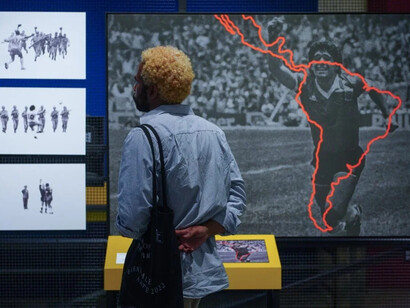
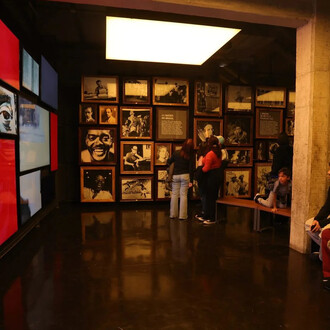
¡Cancha brava! Futebol sudamericano en disputa celebrates football as a collective invention, one of resistance and celebration. The exhibition discusses how the game is not only permeated by celebration and passion, but also by the various conflicts present in South America, such as colonialism, racial discrimination, inequality, authoritarianism, and violence. It invites the public to step onto the pitch along the memory, the affection, and the struggle of the people who resist through the medium of football.
The exhibition is divided into the following sections: “Stealing the Ball”, “A Century of Celebration and Rivalry,” “Interlude,” “Foul Play,” “We Are Here so You Remember,” and “A Never-Ending Carnival.”
Right at the beginning, visitors are greeted by an interactive sound installation. They can choose a “station” corresponding to one of the ten countries in the region from a giant radio dial. The selected country is illuminated on an interactive map while local music plays and a native of that country narrates general information on demographics, geography, and football—in Portuguese, but with a Castilian accent. The voices belong to announcers and ordinary people—born in various countries, but living in Brazil—who were involved in the production of the exhibition in some way.
In the central space of the exhibition is a grandstand that evokes the festive atmosphere of stadiums. It features chants from 25 South American fan clubs that parody well-known songs. The structure is equipped with a bass shaker mechanism that makes it vibrate in time with the sound.
Artworks
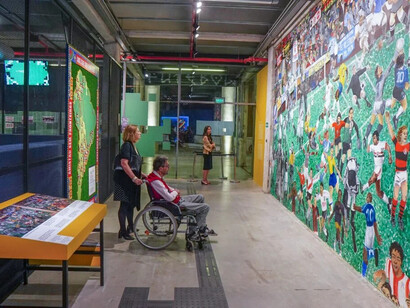
Among the original works produced for the exhibition is the mural Un siglo de fiesta y rivalidad [A century of celebration and rivalry] by artists Marina Ceglie and Cleber TTC. The mural features a perspective view inside a soccer stadium with more than 180 characters depicting South American soccer personalities and stories. Visitors will be challenged to discover who the characters are.
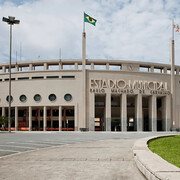
Another new addition is Sabrina Savani’s site-specific work, Escadaria de memória [Stairway of memory], an intervention on the staircase that used to connect the old Pacaembu locker room to the field. Visitors can walk on a glass floor above the installation, which offers a poetic and political reflection on the recent history of South America, based on the memory of victims of military dictatorships.
Jaime Lauriano will present his work, Nunca foi sorte [It was never luck], which uses acrylic, stickers, photographic prints, and wooden miniatures. Shirley Espejo’s collage of important but little-known Black South American soccer players will play with the audience’s memory.
Other artists presenting works include Mulambo, Roberta Estrela D’Alva, and Frente 3 de Fevereiro.
Language and literature
The exhibition also explores the relationship between South American literature and football, as well as its connection to popular art. Quotes from renowned authors like Uruguayan Eduardo Galeano, Colombian Gabriel García Márquez, and Brazilian Mário de Andrade are featured using various visual techniques, including Chilean arpilleras embroidery and Brazilian abridores de letras, a method employed for painting boats in Belém, Pará.
Portuguese and Spanish coexist in an interactive glossary where visitors can select a football-related word and discover its equivalents in both languages, as well as the variations between countries. Among the exhibition’s various accessibility features, this installation will include a Braille table displaying the available terms. Blind visitors will be able to activate the device using voice commands.
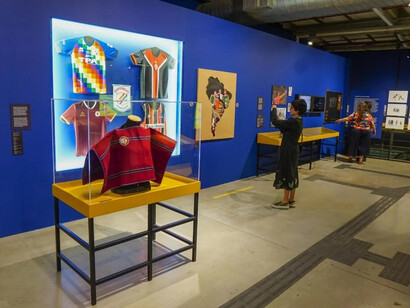
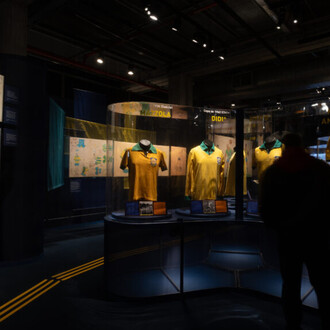
Regarding the visitor experience, Luiza Romão says, “We tried to create a journey that provides (historical, cultural, etc.) information while provoking immersive experiences for the public. To this end, the exhibition features documents, photographs, books, sound installations, interactive games, and fan paraphernalia.”
Matias Pinto hopes that visitors will recognize themselves in the diversity of South America. “Visitors will find a mix of information and emotion. We sought out the most interesting stories and characters from our continent, ranging from football stars and cultural icons to nearly anonymous figures. The mural designed by Marina Ceglie and Cleber TTC and the installation by Sabrina Savani are two pieces that will only be available during this exhibition.”