English
 Español
 Français
 Deutsch
 Italiano
 Português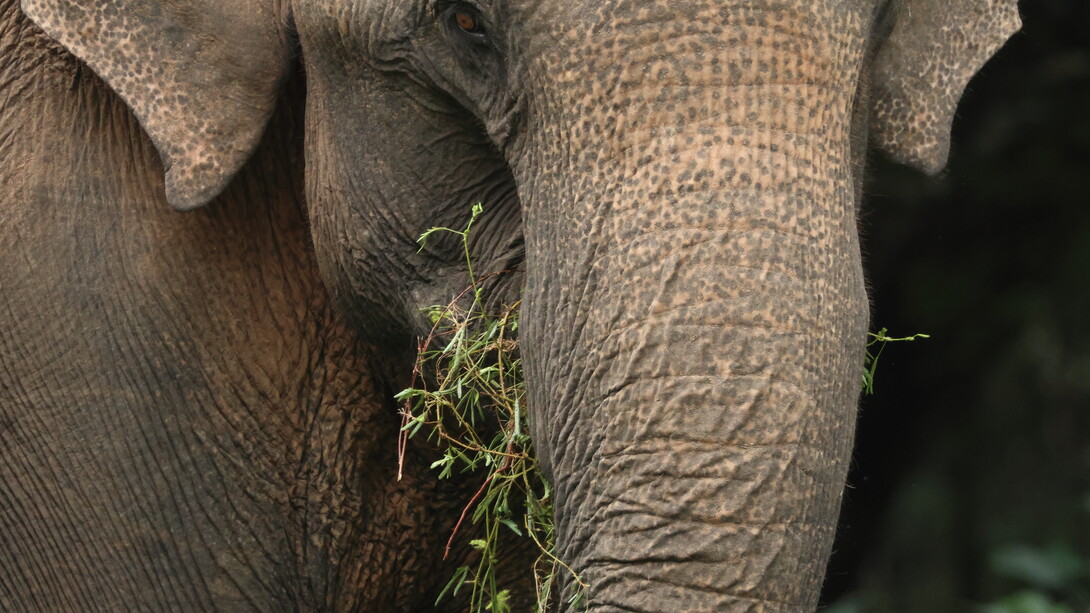
Dawn is always special in Sri Lanka for a bird watcher. Even when I am in central Colombo, I hear several species of birds calling from just before daybreak until an hour after daybreak. A few days earlier in Colombo, the commercial capital, between 5.45 am and 7.30 am, I had recorded 23 species of birds just from their calls without even stepping out of the house. In February, I was also hearing migrants such as the blue-tailed bee-eater, a colorful bird that uses TV antennas as a perch. Much less colorful and plainly dressed in muted brown was the Brown Flycatcher, another migrant that goes unnoticed by many urbanites. In February, I had travelled from Colombo on the west coast to the port city of Galle on the south coast, where I was an invited speaker at the Galle Literary Festival (GLF).
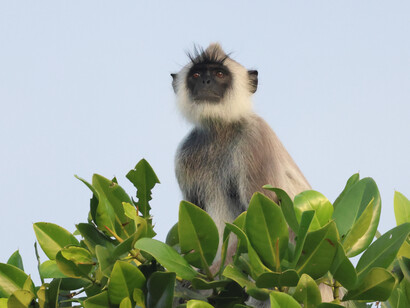
I had been put up at Poojakanda, a charming villa close to the Koggala Lake. It was my last morning in Poojakanda, a lovely villa about a 30-minute drive from the port city of Galle, which was the main venue of the annual Galle Literary Festival. Together with other invited authors, I was hosted at this villa, complete with a swimming pool and a visiting troop of the endemic purple-faced leaf monkeys. I knew after I left, I would miss the conversations over breakfast with the other authors, which had ranged from the use of AI to how words construct the reality of the world as perceived by us.
Nevertheless, to compensate, a wonderful bird-watching itinerary awaited us, which would take us from the wet zone in the southwest of the island to the dry zone and beaches in the east and finally up to a tea estate in the highlands, which would be a base for a visit to the roof of Sri Lanka in the Horton Plains National Park. On my last morning at Poojakanda, from the first-floor balcony, I watched as the rising golden orb silhouetted Imperial Green Pigeons on a fishtail palm. In the distance, a crested hawk-eagle called.
On the birdwatching tour were my wife Nirma, a nature poet; Helen Macdonald, who had great literary success with her book 'H is for Hawk'; her friend Christina; and our host Hashan Cooray from Jetwing Hotels. My original plan was to start with a brief visit to Kanneliya Rainforest, an hour's drive away, to visit one of the largest remaining lowland rainforests in Sri Lanka. But with a long drive ahead of us, we decided to head directly towards the seaside village of Pottuvil, very close to Arugam Bay, which is arguably the best-known surfing location in Sri Lanka. We permitted ourselves a detour to Jetwing Kaduruketha in the lowlands at Wellawaya, where, by chance, we met Razeen Sally, another GLF author. At the GLF, he had interviewed Sunela Jayawardene on her new book, 'Ravana's Lanka.'
Sunela was also the architect of Jetwing Kaduruketha. She was also the architect of Jetwing Vil Uyana, which was inspired by the London Wetland Centre managed by WWT, a leading conservation charity based in the UK. As we chatted over tea and Sri Lankan snacks, it seemed as if the GLF conversations were still rolling on. The flat paddy fields beside us, where heirloom rice is grown organically, stretched away, coming to a stop at a range of hills. These were the foothills of the central mountains, which we will ascend in a few days.
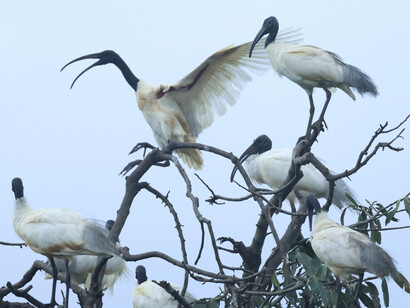
Tempting as it was, we did not linger over lunch for long at Jetwing Surf after our arrival on the East Coast. We drove 15 minutes to the Urani River, where a community project on ecotourism had been set up with overseas funding. Soon, we were on a boat safari. A Marsh Crocodile swam away and clambered ashore rather ponderously. Black-crowned Night-Herons, which were awaking, took flight, clattering as they emerged through the trees. It was a good chance to see this bird well and at close range, which is often seen as a ghostly silhouette in the sky in the fading light. A Brahminy Kite perched atop a mangrove tree studied us steely. A male peacock danced in the presence of peahens. The boat slipped through a grotto of mangrove roots and branches as if we were entering the rib cage of the skeleton of a giant animal. As night fell, Mars, Venus, Saturn, and Jupiter were aligned on an east-to-west arc across the sky.
Later in the conversation, Helen mentioned that she has been on many river safaris, but this was special because there was no engine noise. Two men at the back of the raft had used wooden paddles to propel us on the boat safari. It made me and Hashan think again about why this river safari was special. Hashan is the Director of Marketing for Jetwing Hotels. One of the reasons why he had also come on this trip, although not being a birder himself, was so that he could pick up on spontaneous comments like this. In tourism, it is so important to see things from a visitor's viewpoint, and unfiltered comments like this are as important as a formal report by an ecotourism consultant. In Helen's case, she was not just a prize-winning author (the Samuel Johnson Prize for a work of nonfiction and the Costa Book Prize), but she was also a keen birder. I was struck by how she also knew the Latin names of birds, the mark of a serious birder.
After breakfast the next day, we headed to Kumana National Park (formerly known as Yala East National Park), an hour and a half away, although the time of travel can vary with the state of road maintenance. But almost as soon as we had turned inland from the coastal road, despite the presence of villages and paddy fields, it seemed like we had entered a managed nature reserve. I am often fond of telling people that the whole of Sri Lanka is like a giant nature reserve. A few days earlier, Helen and I had led a birdwatching walk at Malabar Hill, a luxury boutique hotel that lies atop a hill a few miles inland from Weligama Bay. It was a ticketed event organized by the Galle Literary Festival. We ended the walk by descending the hill to the paddy fields, which was like a wetland nature reserve. We had storks, egrets, kingfishers, and several species of migrant waders.
Here once again, we could stop almost anywhere on the road and feast our eyes on birds. Helen and I remarked that the RSPB would give anything to have a wetland site so rich in birds. Tri-colored munias and plain prinias were on the wooded thickets with crested hawk-eagles, and Brahminy kites in the air. Common and Wood Sandpipers, smart Black-winged Stilts, tall Little Egrets, Grey Herons, Purple Herons, and colorful Painted Storks were all milling around. At the paddy fields below Malabar Hill, from a single viewpoint, it was possible to see between twenty and thirty species of birds. On the birdwatching walk, in total, we recorded 47 species of birds, despite starting at the unpromising time of 3 pm.
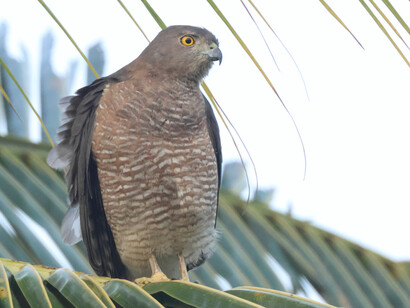
Helen has a special affinity for birds of prey. Her first book, titled 'Falcon,' was on falcons, and 'H is for Hawk' is about her bond with a goshawk. Not surprisingly, on our way into the park, we lingered to study a juvenile changeable hawk-eagle that was calling from a tree. The juveniles are snow white on most of their bodies and gradually turn darker as they age. The adults also have dark streaks on the underparts. The subspecies found in Sri Lanka is endemic to the island. A little later, we paused to observe a crested serpent eagle, which caught some prey on the ground. We had made a good start with large raptors and seeing them at close range.
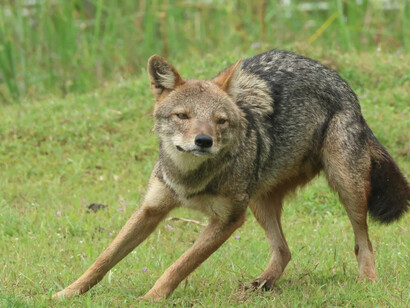
Kumana is similar to but not identical to the contiguous Yala National Park on its western border. In the area we were in, species of trees such as Palu (Ironwood Trees), which are a dry zone climax species, were largely absent. But we drove through groves of Weera with their trunks beautifully patterned with bands of color on their multi-stemmed trunks. A lone elephant fed on aquatic vegetation. A pair of hunting jackals was beautiful to watch, elegant with a purpose. We stopped at a distance to avoid spooking them. A less thoughtful safari vehicle drove past them, forcing them to disperse. Ruddy and Grey Mongoose showed themselves. We pulled over and took time to watch a Land Monitor excavate earth as it dug for invertebrates. It seemed laborious and was performed in slow motion. But nevertheless, productive for the hunter.
On our return journey from the park, we paused to look at a gathering of waders, herons, and egrets on a muddy paddy field. The birds took off in alarm. But not all the birds were fast enough, and a White-bellied Sea-eagle swooped in and carried away a Black-winged Stilt. A fitting finale for our visit to Kumana in the presence of a GLF author known for her fondness of raptors.
The ticket office for Kumana National Park was at least an hour and a half away from Jetwing Surf in Pottuvil, although a good area for birdwatching can be reached in just half an hour. The turnoff from the coastal road travels through the Kudimbigala Sanctuary from the village of Panama, which is about half an hour away (18 km) from Pottuvil. The Kudimbagala Sanctuary is contiguous with the national park. For keen birdwatchers who are based in Pottuvil and Arugam Bay, it is possible to birdwatch from this public road without requiring tickets to enter the park. Even elephants may be seen outside the park boundaries. Furthermore, this wonderful area for birdwatching is much closer than going all the way into the national park.
The Lahugala National Park, which I visited the following morning with Hashan, is another fabulous park just 20 minutes away from Pottuvil. The park is a wonderful example of intermediate forest and has at its centerpiece the Lahugala Lake. The public road (A4) from Moneragala to Pottuvil passes the lake with the national park on one side of the road. Within the park, there are several bodies of water, which are good for bird life. The highlight of our safari in the park was an Indian rock python crossing the road. On a previous visit, I had an endemic red-faced malkoha at close range. It seems odd that despite Pottuvil and Arugam Bay being so well located to wildlife reserves, they are still better known as bases for surfers than bird watchers.
In my next article, I will continue with the birdwatching tour, which took us up into the tea country and cloud forests in the mountains.