English
 Español
 Français
 Deutsch
 Italiano
 Português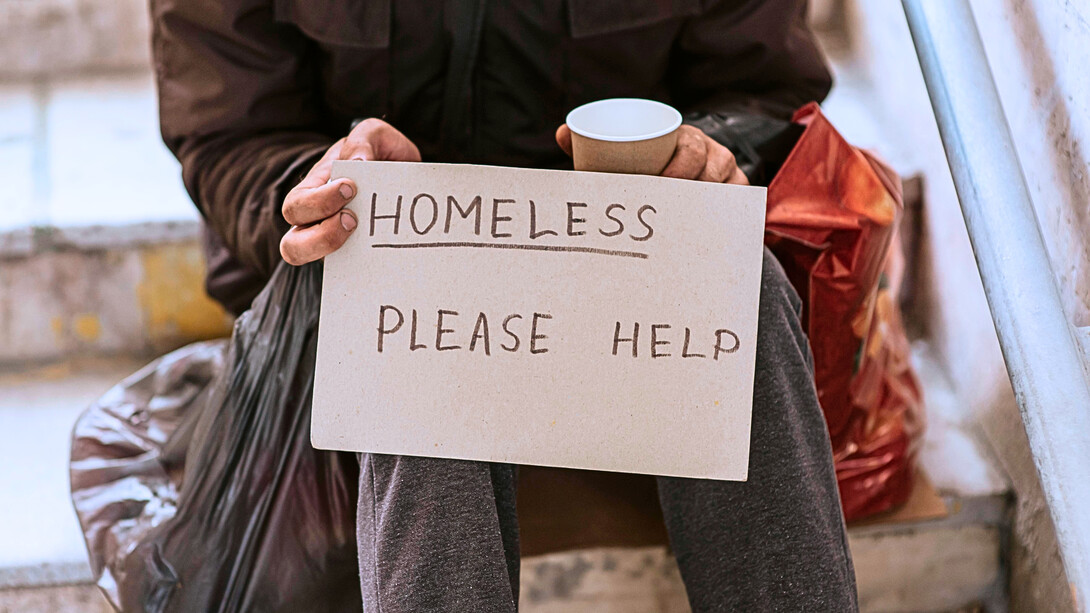
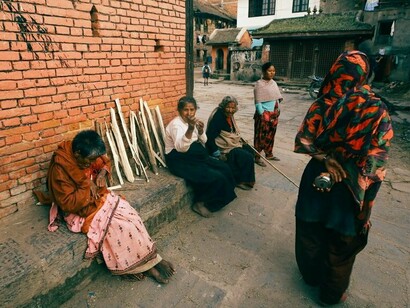
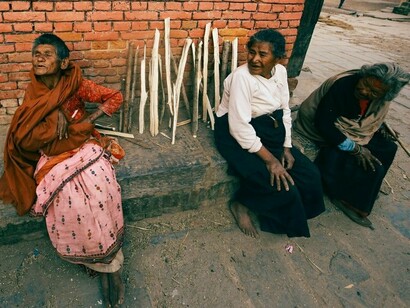
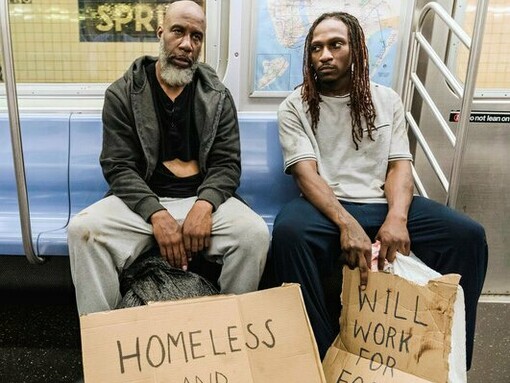
When the cold sets in, there is comfort in staying indoors, warm, watching frost form on the windowpanes. But not everyone has a place to retreat to. In most places, winter eviction moratoriums have not been enacted, and families continue to be forced into the streets. Eviction notices are posted on the doors of apartments and public housing; they are impossible to ignore.
These are real tragedies, often unfolding in silence—faster and more violently than before. With public institutions failing to provide solutions that respect human rights, evictions generate despair and catastrophe.
In Italy, for example, recent weeks have seen a surge in people taking their own lives or blowing up their homes during eviction operations, killing the police officers sent to carry them out—piling new horrors onto the original injustice and adding further, unbearable tragedy to their own. Tragedies that could have been avoided had those people been followed and supported by public institutions and social organisations.
To give voice and hope to victims of evictions, and strength to the proposals put forward by the organisations supporting them, World Zero Evictions Days were held across all continents—accompanied, once again this year, by the International Zero Evictions Marathon.
October: a global display of evictions
In October, the northern hemisphere is already cold, while in the southern hemisphere conditions are no better: the climate crisis is intensifying extreme weather, floods, and droughts. And yet, in the outskirts, in working-class neighbourhoods, and even in the historic centres of countless cities, you see families dragging their suitcases through traffic.
They are not tourists. They are mothers trying to reassure their children, elderly people rubbing their cold hands, struggling to understand how they could lose everything at the very moment the world was supposed to become less hostile.
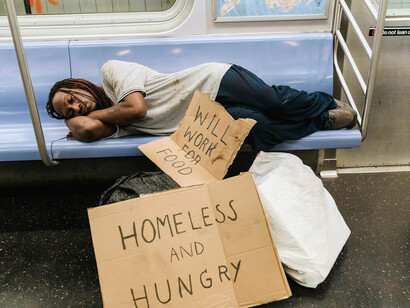
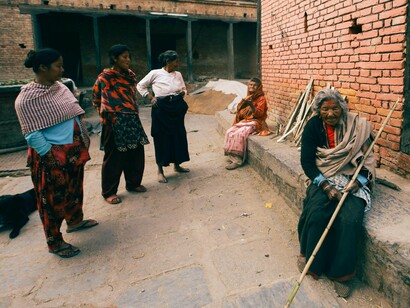
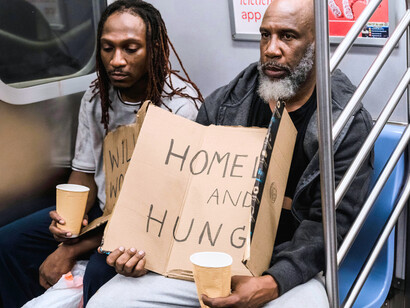
More than 1.6 billion people worldwide are homeless or living in inadequate housing—evidence of a deepening global housing crisis. By the end of 2024, the number of people displaced by war, conflict, and environmental disasters had surpassed 123 million.
These crises are driven by domicides—bombardments, landmines and explosive remnants of war, military occupation, the construction of military bases—and by the climate crisis itself, in the absence of adequate policies, or because of wrong ones.
To this must be added the evictions triggered by a multitude of factors contributing to the housing crisis: the spread of “extractivist economics” fuelling chaotic urbanisation in poorer countries; an increasingly financialised and unsustainable real estate market worsened by inadequate public policy; mortgage crises; the logic of mega-projects and mega-events; and the “Disneyfication,” “museumification,” and gentrification of cities driven by the tourism industry and over-tourism.
The surge of artificial intelligence in property markets and urban planning is exacerbating unsustainability, discrimination, and housing insecurity.
The evidence is clear: forced evictions and homelessness are direct and indirect consequences of systemic patterns of contempt for housing rights—revealing the failure, or unwillingness, of states to implement adequate housing policies.
Saying no: the World Zero Evictions days

Zero Evictions Marathon Poster.
In response to this bleak landscape, many actors are taking action to support people and families without homes and victims of forced evictions. The first Monday of October marks World Habitat Day, established by the United Nations to reflect on these issues—this year focused on responses to urban crises.
It is the starting point of an “urban October” filled with initiatives, campaigns, and mobilisations across the global South and North, organised by grassroots resistance groups, tenant unions, international networks, local authorities and progressive governments, NGOs, cooperatives implementing effective plans to counter speculative investors, and organisations engaged in advocacy, training and outreach—supported also by universities and committed researchers. All of them stand behind defenders of the human right to housing.
This connection, now very strong, has been reinforced since 2003 by the International Alliance of Inhabitants (IAI)1 through its global Zero Evictions Campaign and the coordination of World Zero Evictions Days, giving global visibility to the initiatives of members and allies on every continent.
Their focus: promoting the right to safe and dignified housing, as established in international conventions—particularly the International Covenant on Economic, Social and Cultural Rights (ICESCR)—and defending people who have lost their homes or are at risk of losing them.
World Zero Evictions Days2 have proved to be a powerful tool for raising awareness: you are not alone; eviction is not a personal failure but a social injustice—and resistance is possible, with real victories. As part of the events, the International Tribunal on Evictions (ITE), now in its 11th session, gave voice to evicted individuals and communities, placing those responsible for such violations symbolically on the stand.
This year, hundreds of initiatives took place on all continents—from the fifth anniversary of the Zero Evictions Campaign in Brazil to mobilisations in Peru, the Dominican Republic, and Argentina to Nepal and India. In Italy alone, at least twenty activities were organised by the Union of Tenants, including a press conference in the Chamber of Deputies calling for a public housing plan and demonstrations in various cities under the banner “Knowledge Needs a Roof.”
The International Zero Evictions Marathon: a shared megaphone, an innovative tool
Closing the 2025 World Zero Evictions Days were meetings organised by IAI together with the Unione Inquilini3, various local organisations, Roma Tre University, and the Human Rights Center of the University of Padua4—with the participation of Balakrishnan Rajagopal, UN Special Rapporteur on the Right to Housing.

UN Special Rapporteur, Prof. Balakrishnan Rajagopal.
The most intense and exhilarating moment was the second edition of the International Zero Evictions Marathon (ZEM)5, following its debut in October 2024. The event was held at the University of Padua through collaboration between IAI and the Master’s Program in Human Rights and Multilevel Governance (HRG) at the same university’s Human Rights Center.
On 31 October 2025, ten hours of programming—online and onsite—brought together 53 organisations from many countries across all continents: the Philippines, India, the Occupied Palestinian Territories, Iraq, Kenya, Spain, Sweden, Argentina, Colombia, Chile, the United States, and more. They provided first-hand accounts and personal experiences of the housing crisis and the impact of evictions.
The Marathon featured human rights scholars, activists, social leaders, network coordinators, and IAI’s volunteer interpreters, who enabled dialogue across languages. Jurists, sociologists, economists, and urban-studies experts analysed the causes and consequences of evictions, explained tenants’ rights and legal tools, and shared strategies to support at-risk families.
Human rights and social justice organisations presented best practices and successful case studies; community leaders described methods for educating residents on housing rights and eviction-prevention options.
Other contributions focused on urban planning and sustainable development—how to expand affordable housing and confront gentrification. Academics and international-network leaders shared updated data on eviction numbers, demographic trends, economic impacts, and alternative approaches to market-driven housing models.
Why and how the Zero Evictions Marathon works
This unprecedented tool serves multiple goals.
First, it supports social movements and local initiatives—strengthened by academic engagement—by organising dialogues among human rights defenders and committed communities across continents, highlighting struggles, challenges, and potential. Sharing tools, proposals, and lessons learned is crucial for networking and cooperation.
In this context, the satellite mapping of neighbourhoods facing eviction—developed by the Permanence Observatory—attracted considerable interest.
Once again, the Marathon addressed the disruptive impact of irresponsible uses of artificial intelligence in real estate markets and urban governance, which fuel housing insecurity and social and gender discrimination.
Another key objective is raising broad public awareness that forced evictions and homelessness are human rights violations—stemming from the inability or unwillingness of many states to honour their commitments to the most vulnerable. The Marathon also underlined the environmental consequences of this institutional failure and its connection to the climate crisis.
Young people and the academic community took part as well: in lectures with UN Rapporteur Prof. Balakrishnan Rajagopal and in sharp testimonies about how the free market exploits students with precarious rental contracts and exorbitant bed-space prices that remove housing from residents. He began by condemning war—particularly domicide, the destruction of Gaza accompanying Israel’s genocide of the Palestinian people—and stressed the need to respect the UN. Drawing on missions carried out worldwide during his mandate and on meetings held in Italy those days, he emphasised the obligations of all branches of states that have ratified the ICESCR to respect and promote adequate housing and related human rights.
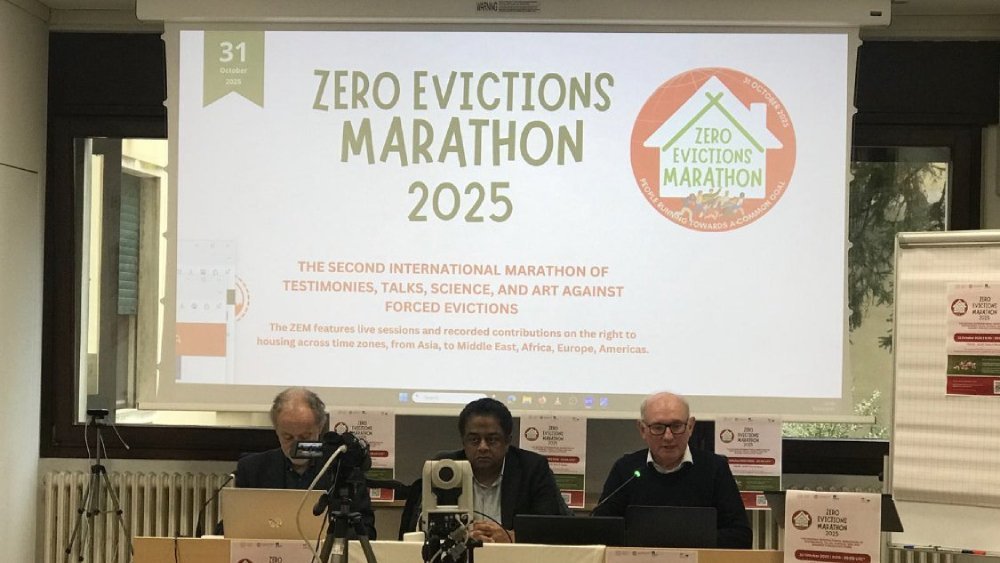
The panel including C.Ottolini, B.Rajagopal, and P.De Stefani at Zero Eviction Marathon 2025.
He then highlighted the need for coherent policies like those implemented in Barcelona, Vienna, and Singapore. Following these examples, he urged institutions at all levels—local, national, and supranational—to prevent and prohibit evictions when no adequate alternative housing is offered, promote public housing in healthy environments, and regulate rents with proper funding. By contrast, laws that accelerate evictions and criminalise housing-rights activists violate these legal obligations.
The ZEM continues: a global commitment to fight evictions and advance the right to housing
Paolo De Stefani6, Professor at the Human Rights Center, and Cesare Ottolini7, IAI Global Coordinator with G and C, were the tireless driving force of the ZEM task group—bringing all participants together on equal footing, creating a space for learning and knowledge exchange, strengthening local initiatives and shaping public policy, and amplifying the impact of the anti-eviction movement.
The relationship between global events and local policy—highlighted by the ZEM—offers a crucial response to the worldwide challenges surrounding the right to housing. The ZEM is proving essential in showing how to counter the rise in evictions.
It is vital for governments and social organisations to work together to find fair, practical solutions. Ongoing commitment to adequate housing can help reverse current trends and secure a better future for those threatened by eviction.
Through planning, awareness-raising, alliances, and monitoring, the ZEM can expand its impact year after year—maintaining strong cohesion among participants and stakeholders, an essential condition for effectively addressing housing crises and advancing the right to dignified, just housing.
Based on this positive assessment, the Human Rights Center and IAI have already committed to continuing this shared effort with a third edition of the Zero Evictions Marathon during the World Zero Evictions Days in October 2026. Participants from the 2025 edition have already been called to contribute, beginning with responses to a questionnaire aimed at making the ZEM even more inclusive.
Notes
1 Soha Ben Slama, 20 years of IAI: leading the fight for housing justice. Meer. 15 February, 2024.
2 World Zero Evictions Days.
3 Union of Tenants.
4 Human Rights Center of the University of Padua.
5 International Zero Evictions Marathon (ZEM) 2025. University of Padua. October 31, 2025.
6 Paolo De Stefani is researcher, senior lecturer and aggregate professor in international law at the University of Padova, Department of Political Sciences, law and international studies.
7 Cesare Ottolini has been engaged since 1977 in global/local struggles for the right to housing and the city, he is member of the Union of Tenants National Secretariat, and coordinates the Union of Tenants of Padua, and he was a member of UN-HABITAT Advisory Group on Forced Evictions.