English
 Español
 Français
 Deutsch
 Italiano
 Português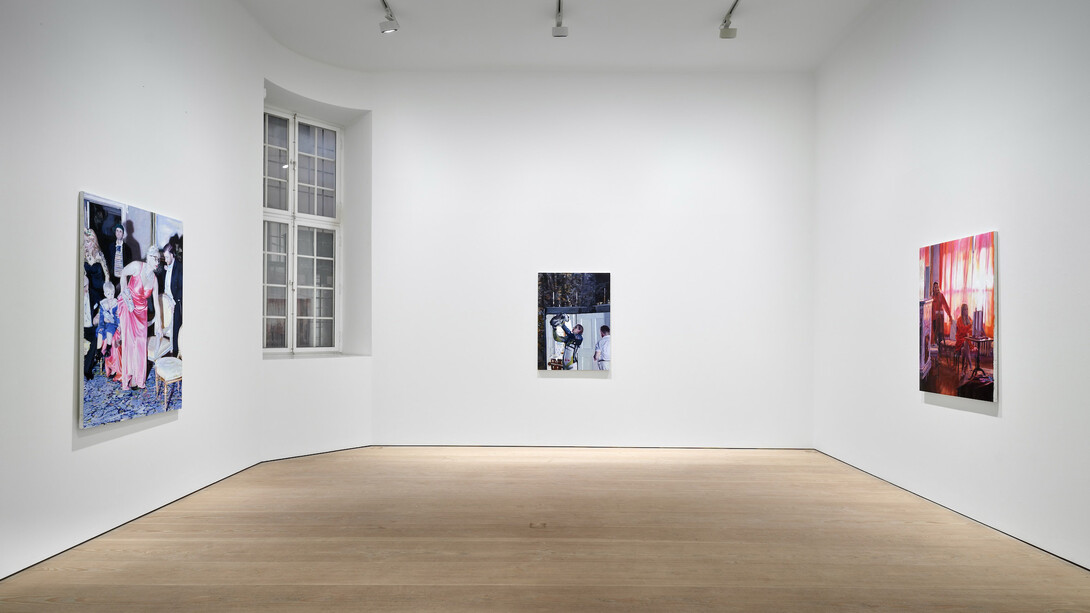
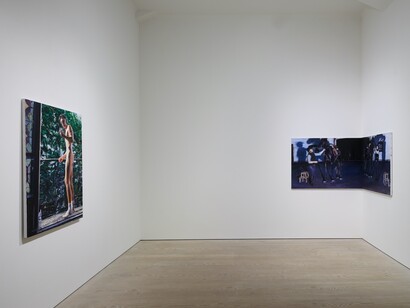
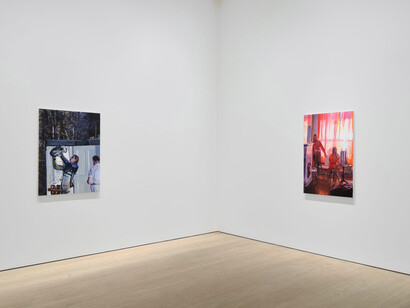
It is with great honor that we present Niklas Holmgren’s second solo exhibition, Le complexe du temps perdu, at Galleri Flach, a follow-up to the exhibition Aspects of a summer,’ which was shown in the winter of 2023. Then, as now, the focus is on elapsed time, memories and life patterns, as they may emerge through dreams and sudden recollections. In a series of paintings, we encounter people and situations in motion, captured in an unguarded instant, as if the artist is trying to capture an image that reveals and exposes something unexpected both in himself and in his surroundings.
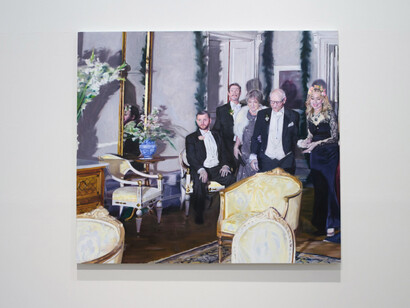
The paintings bring together different layers of time, space and relationships. Both the people and the settings are carefully chosen, all with connections to the artist himself. A woman in a pink dress, ”La privilégiée en rose”, whose drape and lustre are rendered in as much detail and care as in a description by Proust, is about to settle into a chair. Her face is beautifully observed, rendered with an intensity of expression that evokes thoughts of her beauty both in the present and as it once was, engraved in the artist’s memory. A little boy peeks at the viewer, and in the background stands a man with a straight back and a squinting gaze. Together with the other people in the painting, the rich patterns of the carpet in the foreground and the shadows in the background, a larger narrative is woven together. With equal parts painterly and psychological acuity, Niklas Holmgren describes the characters’ intricate relationships and interactions with their environment. As viewers, we step right into the picture and become part of the situation. As if the artist’s gaze were a camera lens, we can follow how he zooms in and out on the whole and the details.
The title of the exhibition refers to memories and traces from the artist’s life that have emerged during several years of reading aloud Marcel Proust’s A la recherche du temps perdu. Niklas Holmgren describes how the text has opened up a flow of emotions and images, often mysterious and unresolved, that have remained etched in his mind. Painting is not an activity that begins on the canvas but in the interior of a room, he says, referring to the wealth of subtext contained in Proust’s descriptions. Niklas Holmgren’s method resembles that of a director; he stages environments and portrays people who then form the basis for the painting. Like Proust, he seeks to depict a reality beyond reality and the surface, in an attempt to capture the moment when the rug is pulled out from under one’s feet.