English
 Español
 Français
 Deutsch
 Italiano
 Português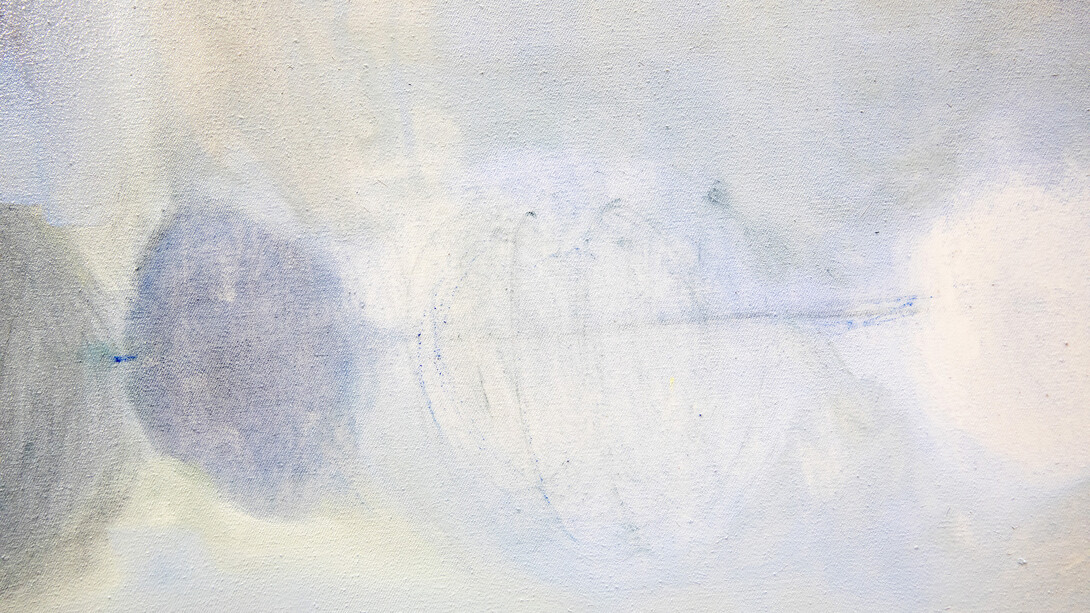
A work needs only to be interesting.
Most works finally have one quality.(Donald Judd)1
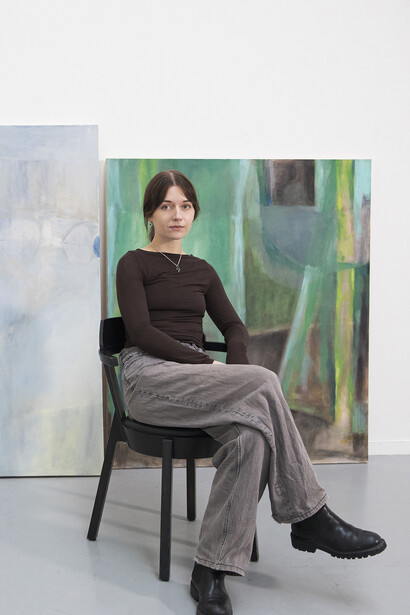
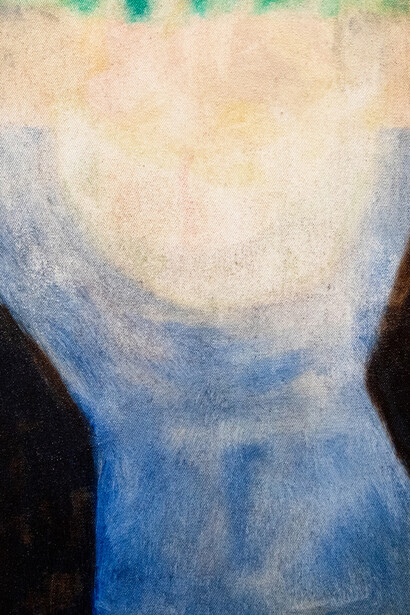
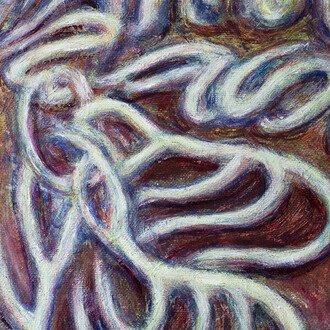
There is a specificity in the paintings of Filippa Friberg that elevates them from first glance. Colours, forms, empty spaces and dense areas do not follow any clear pattern or are deployed in a way that reveals a method, a clear process. They instead describe very clearly a way of using the medium of painting, canvas, stretchers, primer, oil paint, oil, which searches in a very specific way for very specific answers. The paintings are different between each other, as the answers differ, but they are also not. There is a quality, eerie and familiar, that links all of them in a simple and intuitive way.
Friberg describes her paintings as a “research into specific feelings and those fleeting moments which we have no words to describe,” and her process starts from applying a specific tone to the primed canvas and responding to that with another, intuitively developing practical choices. She paints to a degree of detail sometimes that we could make us believe we are starting to see things in these abstract compositions, especially when juxtaposed to their often quite descriptive titles, yet she says that she is interested in the quality of a line, or the trace left from a pentimento on the surface of the paintings. More than being confusing, these aspects tell that she really knows what she is doing. Refusing to produce paintings that are very cohesive, yet being able to bring together a practice which is instantaneously personal tells something about that. The way she really manages to imbue these works of emotions and feelings is another, in my opinion.
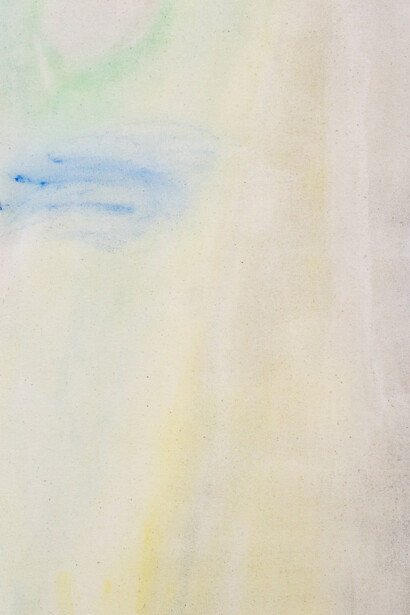
The surface of these paintings would be then worth of a chapter on its own. It is another painting onto the painting itself. As soon as one gets close enough to them, these surfaces lose their forms and intention, the picture one was looking at disappears and all that is left is this vast monochromatic surface, impressionist and minimalist at once. There are lines and scratches on it. There are slight nuances meeting and touching. Something incredible happens on these surfaces and it is something so delicate that one is scared to lose it by turning away the gaze for just a second. It is in this fragile and delicate nature that lies Friberg’s quality: the intentionality of a gesture, the gentle and determined, and delicate and savvy hand of an artist that does not look for grand gestures, yet is able to offer to us these large abstractions, and small details, which are maybe grand-er in their own way.
“The real or usual anthropomorphism,” Judd also wrote, “is the appearance of human feelings in things that are inanimate or not human, usually as if those feelings are the essential nature of the thing described. The relation between the parts of a composition is usually anthropomorphic and hierarchical, and very few abstraction could be called abstraction in a pure sense and isn’t anthropomorphic in any way.”2 The specificity of these paintings, the way in which Friberg uses and deploys paint show a clear hierarchy among their parts and is indeed anthropomorphic, yet none of these traits seem to be hierarchically relevant if the works are taken as a group. Friberg’s artworks take advantage of these aspects as they use colour and micro tonalities: as instruments, tools one could say, that in the hands of the Swedish painter become feelings, those in-between sensations impossible to describe otherwise. In their quiet and domestic nature, they remind of a passage from Rachel Cusk: “[…] he wasn’t interested in change. He was interested in the fragments that change leaves behind in its storming passage toward the future.”3 Abstract, fleeting and indescribable as feelings are, these paintings are greatly able to specifically, clearly, represent the unrepresentable, intimate, invisible: the Blind spot.
(Text by Mattia Lullini)
Notes
1 D. Judd, Writings, New York: Judd Foundation and
David Zwirner Books, 2016, p. 142.
2 Ibid. p. 181.
3 R. Cusk, Parade, London: Faber & Faber Limited,
2024, p. 174.