English
 Español
 Français
 Deutsch
 Italiano
 Português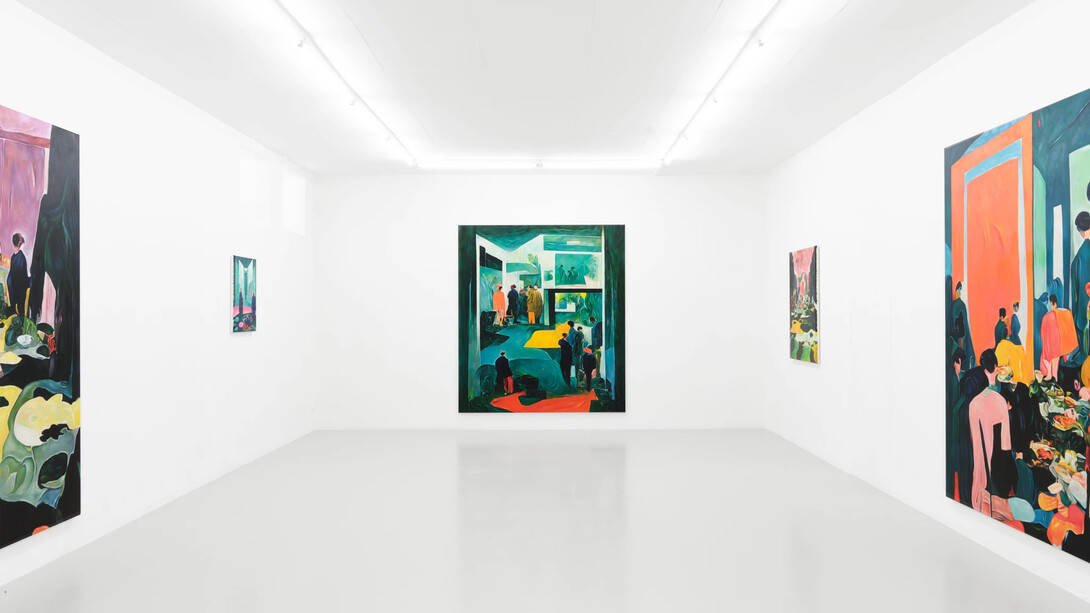
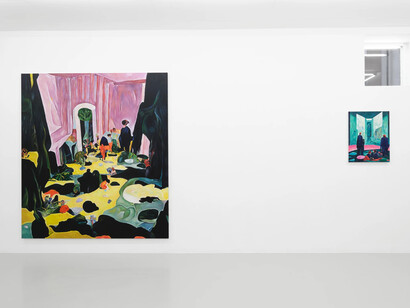
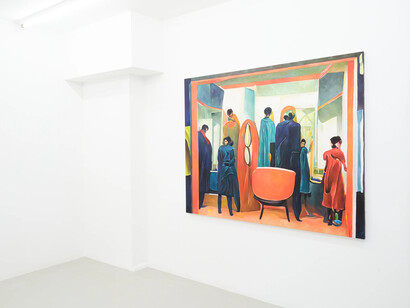
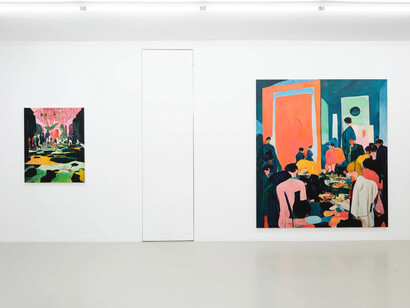
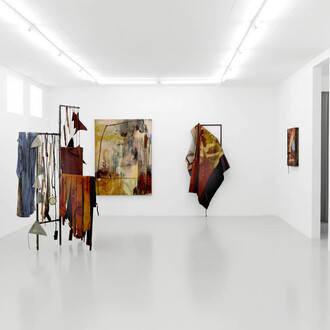
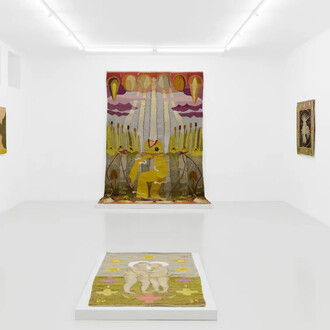
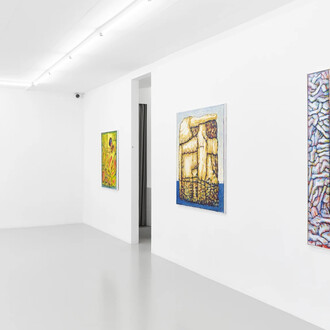
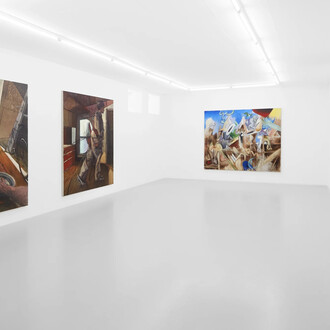
Willem Andersson’s painting is dreamlike. In dreams, everything is both familiar and strange. The shapes and colour fields appear to be in motion; something is taking shape — though it’s unclear exactly what.
Clothes, hair, and fabrics form silhouettes that somehow feel both surprising and completely natural. Light falls unevenly across delineated fields that resemble walls, while human figures hover in a state between dissolution and emergence. Turquoise, purple, umber, ultramarine, and coral pink come together to build spaces — rooms, or perhaps landscapes — where colour interacts intuitively.
The abstract is just as present as the figurative. There is no hierarchy in the composition. Andersson’s painting may begin in the personal, but it develops into something almost impersonal, more universal.
In his working process, the hand knows more than the head — similar to the spiritual process through which sacred images are created in Hinduism and Buddhism. When thought starts to take over, let it go and return to the movement.
The ideas embedded in the works are reflected in the titles, drawn from Andersson’s own archive of texts, books, memories, and phrases. Titles such as End of matter and The ache of atoms bring to mind the world of physics, where revolutionary observations have recently been made. For example, this year’s Nobel Prize winner has made discoveries that suggest reality may not be as solid or self-evident as it once seemed.
In other words: the world is in flux — until consciousness, or observation, determines what it should be.
Perhaps Andersson’s paintings do not depict a dream, but reality itself — the one our limited ability prevent us from seeing.