English
 Español
 Français
 Deutsch
 Italiano
 Português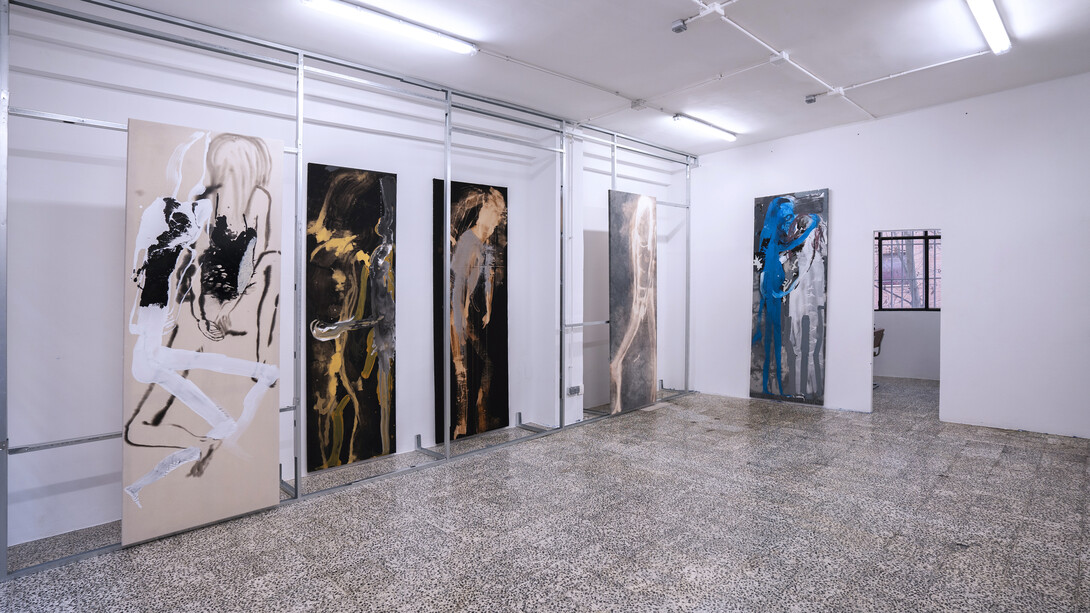
Recently, the relationship between painting and poetry has become more evident to us. It’s not that they are parallel disciplines, but rather that painting is, for artists, what poetry is for poets: a way of understanding the world by subverting what already exists, stretching the possibilities of the known to generate something unknown—something beyond language, yet born from it.
Why do painters keep painting? Probably because, if they didn’t, they would fall silent. Why do we keep looking at painting? Because it teaches us the possibilities of the world, the infinite and unfamiliar forms that exist. Painters produce images that did not exist, that lacked the potential to be until they were rendered on the surface; yet once they appear, that potential anchors itself in the world, transforming it— not into one, but into all possible worlds. And this cycle is infinite, as long as painters continue to paint.
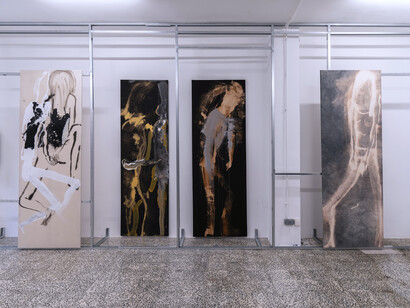
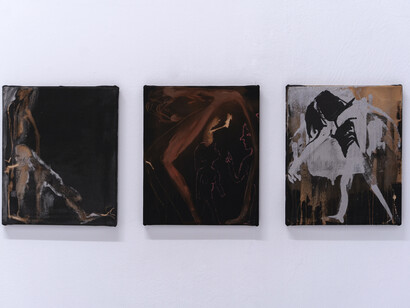
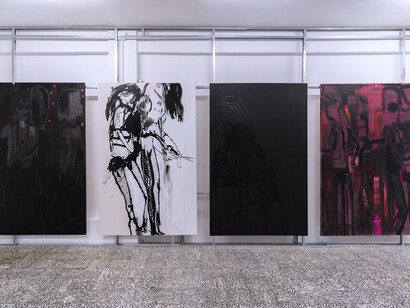
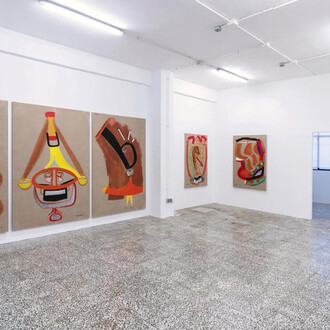
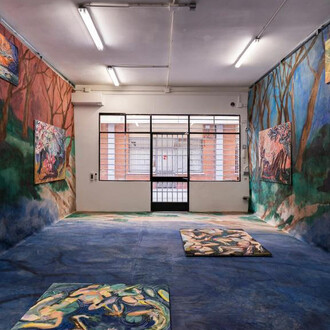
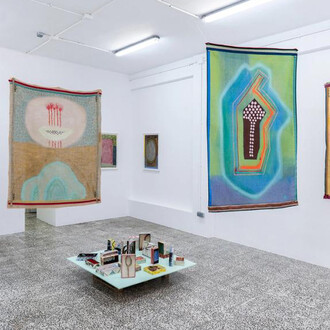
Irene’s work is precisely that: the creation of possible worlds that, at the same time, help her understand the place she inhabits—her context and her time. We have always believed that Irene’s work holds the potential to be a sign of her era, and in this new body of work that potential becomes effect, though only for a brief period. The works in this exhibition are the artist’s exercise in locating herself within her context—a response to the stimuli that arise from encountering a new place, another possible world. Hence, the painting changes, mutates, and transforms; it is impossible to paint the same in different places. London has sparked a need to express everything that a body cannot experience within a given period of time. A characteristic that we can now affirm as fundamental to Irene’s language is risk, and the impossibility of remaining in the same place—physically and metaphorically. Since 2021 we have followed the evolution of her work and, with great satisfaction (and often uncertainty), we continue to ask ourselves: where does this come from?
When we speak of evolution, we don’t mean to impose a positive adjective; rather, we refer to a movement forward. And the poetry of this movement lies in the fact that, quite often, moving forward means returning. This body of paintings revisits the interests that emerged at the beginning of Irene’s path as an artist: nocturnal bodies, life in darkness, the flicker of light from a warm bulb or the ember of a cigarette barely visible. These paintings portray Irene’s surroundings— not only the real ones but also the imagined. The figures we glimpse in the dark are the post-adolescents who once paraded through her earlier paintings; now they are older, inhabiting new parties and spaces. There is something in the darkness that speaks not only of the environment but also of intention. Though adults, they continue to explore their own selves through play, through all the possible encounters that may exist. We return, then, to the potency of possibility.
Marlene Dumas —to whom this body of work pays homage— says that one never makes art alone. Though solitude is necessary in the studio, what one produces never truly emerges in isolation, but always with and through others. Thus, personal life becomes public, and this entails a risk—for the artist and for us—since we do not know our own possibilities until we are confronted with this work. Where does desire lie? In a slight gesture of the hands, in an embrace, or in a body blurred within complete darkness.
In this work, Irene once again pushes her practice forward. The movement is vertiginous and full of uncertainty, but it is movement nonetheless—born from the need to unlearn what she already knows how to do, to use disorientation as a method. Perhaps that is why the new figures emerge from darkness, revealing themselves at the end of the path which, as we have already learned, inevitably becomes the beginning once again.