English
 Español
 Français
 Deutsch
 Italiano
 Português
During the past three decades, computer-aided design (CAD) has become an essential foundation of design work in both academic and professional contexts. Its widespread adoption has led to significant advantages as well as certain drawbacks within the discipline.
As an educator for nearly a decade, I witnessed firsthand the contrast between my own upbringing and architectural education and that of the newer generation, who were exposed to digital tools and software much earlier in their development, and how they were completely limited by the exact tools that were supposed to widen their horizon.
The history of design
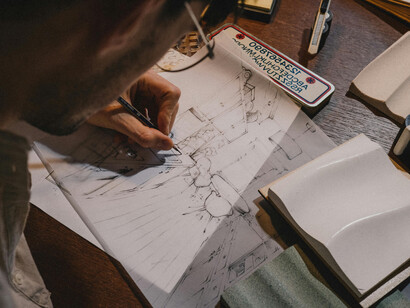
For centuries, humankind has relied on simple tools such as paper and pencil to bring creative ideas to life. Although this remains the first step in any creation, it is also the most crucial part that failing to fully understand an idea’s various aspects can lead to significant flaws or even disasters.
This traditional approach persisted until the latter half of the 20th century, when computers began to develop at an exponential rate. One of the most influential and widely adopted software programs to emerge during this time was AutoCAD, developed by Autodesk in the 1980s. Of course, Autodesk was not alone in this endeavor; other companies, such as those behind ArchiCAD, were also developing architectural design software. However, their widespread recognition and impact would not come until much later.
Today, AutoCAD remains one of the most enduring and trusted tools in engineering and design. Yet, with the rapid advancement of computing power, a wide range of new software solutions has emerged, programs such as Revit, SolidWorks, Vectorworks, and many others, each offering unique capabilities that continue to expand the boundaries of digital design.
CAD software
Today, a wide range of CAD programs is available for design, drawing, and project development. As mentioned earlier, AutoCAD, Revit, and ArchiCAD are among the most widely used, but the list extends far beyond these. Numerous related programs and plug-ins, such as Rhino, Vectorworks, Google SketchUp, and many others still emerging, continue to expand the designer’s toolkit. In addition, non-CAD software such as Adobe Creative Suite (Photoshop, Illustrator, etc.), 3ds Max, Lumion, and V-Ray support designers in producing more realistic, refined, and accurate visualizations. Leveraging these tools has become essential for fully utilizing the technological advancements available to the field.
The positive aspects of CAD
First, what is CAD design? Computer-Aided Design (CAD) refers to the use of specialized software developed over the years to assist architects and engineers in improving the quality of their work while reducing the time required to complete it.
By serving as a strategic tool, CAD supports the development of multiple aspects of the design and construction process, from the initial concept to detailed material estimation, scheduling, and construction planning. This comprehensive approach has brought significant value to both employers and contractors, streamlining workflows and enhancing overall project efficiency.
However, despite its many advantages, the influence of CAD has also introduced certain challenges and setbacks.
The negative aspects of CAD design
The negative aspects of Computer-Aided Design can be discussed in two main areas: academic and industrial.
Computers have had a profound impact on the academic side of design. Before the 2000s, most design methods, classes, and projects involved a rigorous and demanding process to achieve meaningful results. However, since the early 2000s, as computers became more widely accessible and design software rapidly advanced, these traditional processes began to change.
At first glance, CAD appeared to be a valuable tool to support students in developing their ideas, helping them create more refined and practical outcomes. Unfortunately, as students became increasingly dependent on such software, many began to replace the entire creative process with computer-based tools. This overreliance has, in many cases, hindered their creative thinking and limited their ability to explore diverse design approaches.
A similar trend can be observed in the industrial sector. Due to a lack of in-depth understanding among some employers and contractors, there has been a growing emphasis on visually appealing digital designs, often at the expense of genuine innovation. As a result, many designers have found their creative potential constrained by market expectations and software-driven aesthetics.
With the continuous rise of technology and the transition into a new digital era, this decline in creative exploration may pose an even greater challenge for future architects and designers.
Conclusion
Computers have provided architects and engineers with powerful tools to develop more precise, efficient, and thought-provoking designs. However, if we fail to use this technology as a means to foster creativity rather than replace it, we risk confining ourselves to a repetitive and stagnant cycle of design.
This does not mean we should return to older methods of designing solely with our hands and drafting tools. Rather, it’s important to understand the roots and foundations of design, remain aware of how it has evolved over centuries, and preserve a spirit of creativity and curiosity.