English
 Español
 Français
 Deutsch
 Italiano
 Português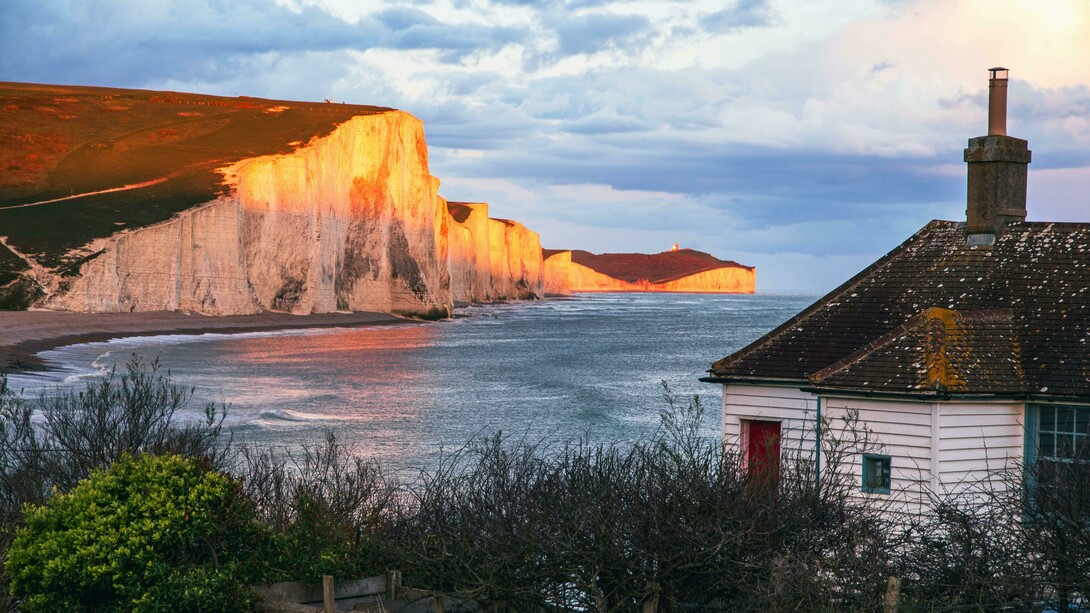
There are places that don’t just exist on a map—they exist inside us. They are a tattoo in our souls.
(Patricia Gomes)
For me, the Seven Sisters Cliffs, on England’s southern coast, are exactly that: a fixed point in my personal geography, a Fortress of Solitude. A place where the wind speaks to me, the silence is louder than any city, and time folds in on itself like the waves that endlessly crash against the white chalk. Here, creation and evolution are written into the cliffs themselves, a landscape both born and continuously reborn.
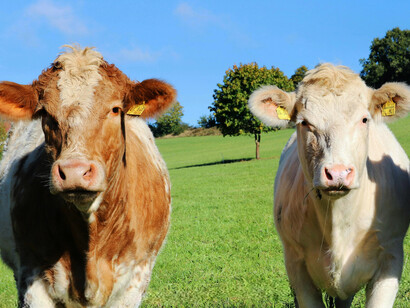
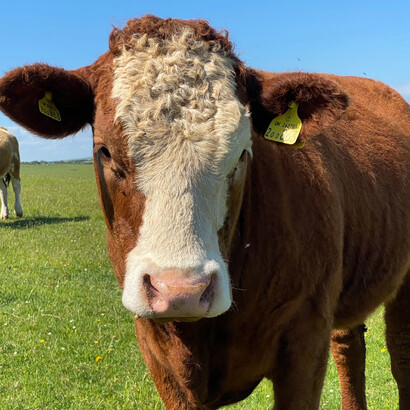
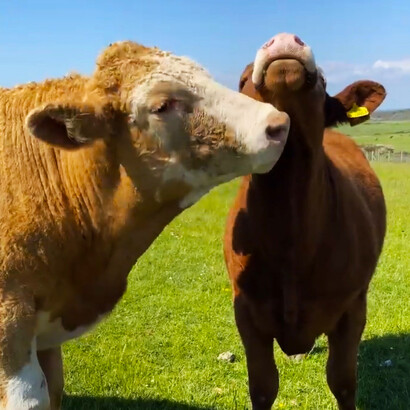
The first time I arrived at the Seven Sisters was in 2021. I still remember the sky—undecided, with clouds and sunlight wrestling for dominance. The train left Clapham Junction station early in the morning, cutting through golden wheat fields and villages that looked frozen in another century, with cows grazing peacefully in the fields.
When I stepped off at Seaford station, the air already smelled of salt and wind—and it brought me back to my childhood in Rio de Janeiro, a subtle echo of the city where I was born, especially when I passed a coffee shop called Copacabana.
From Seaford to Eastbourne, it takes about six hours to walk the full stretch of the Seven Sisters, depending on pace and pauses to take in the view. I remember each step as a meditation, feeling the cliffs rise and fall beneath my feet, the wind and sea shaping not only the landscape but also the rhythm of my own thoughts. By the time I reached the final peak near Eastbourne, the white chalk felt part of me, each collapse and curve echoing life’s passage.
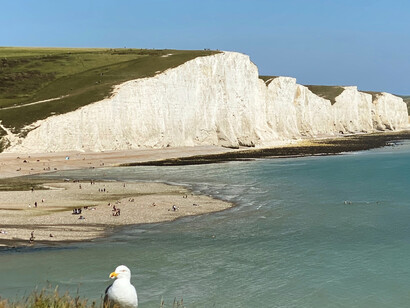
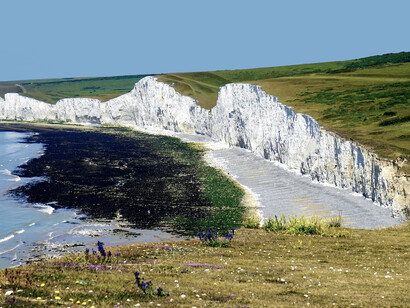
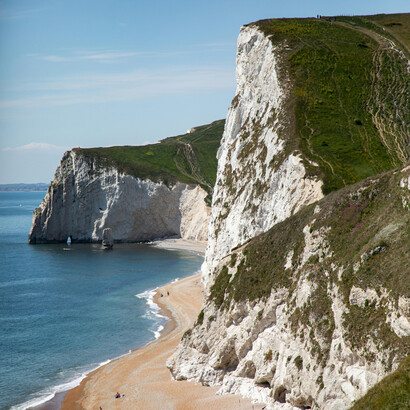
As I followed the path toward the coast, the landscape suddenly opened up—vast, bright, almost unreal. The cliffs stood before me, monumental and still, carved by centuries of erosion like open pages in the planet’s geological diary. It was there, facing that immensity, that I understood why so many people describe this place as sacred. I felt myself in a nature temple open to all, ready for a deep meeting with myself and creation.
The Seven Sisters were born around 70 million years ago, during the Cretaceous period, when much of what is now Europe lay beneath shallow seas. On the ocean floor, microscopic shells—mostly from algae called coccolithophores—accumulated in thick layers. Over millions of years, these layers compressed into white chalk, the same substance that forms the cliffs today.
Later, tectonic movements lifted the seabed above water, and the relentless forces of wind, rain, and waves began to sculpt the landscape we know today. The Seven Sisters are not static monuments; they are living landscapes. Shaped continuously by the movement of wind and sea, each cliff tells a story of erosion and renewal. In their folds, rises, and collapses, the cliffs mirror life itself—fragile, resilient, and in constant transformation. Each collapse is creation; each newly exposed slope is evolution in motion. The lost creates something new at the Sisters, and that is what makes the cliffs unique: they are never the same.
The name “Seven Sisters” dates to the 19th century and refers to the sequence of seven distinct peaks stretching between Seaford Head and Birling Gap. The term “sisters” reflects a poetic and symbolic tradition in British folklore—the idea of harmony, protection, and kinship embodied by the natural world.
During World War II, the Seven Sisters served as natural sentinels. From their heights, soldiers kept watch over the English Channel, scanning for signs of invasion. Today, subtle traces of that vigilance remain—a concrete bunker here, a path worn by forgotten boots there.
But long before the war, these cliffs had already witnessed centuries of human passage. Shepherds, fishermen, and wanderers crossed these same trails. In modern times, the cliffs have become one of Britain’s most photographed, Instagrammed, and painted landscapes—a recurring backdrop in films, literature, and art.
Over the decades, the Seven Sisters Cliffs have appeared in numerous films, their brilliant white face standing in for both fantasy and reality. The cliffs’ cinematic presence is unmistakable—dramatic, pure, and endlessly photogenic.
They feature prominently in Atonement (2007), in the haunting scene where Briony walks along Cuckmere Haven toward the sea—one of the film’s most visually poetic moments. Parts of Fantastic Beasts: The Crimes of Grindelwald (2018) were also filmed here, using the cliffs to evoke a sense of otherworldly grandeur.
In Summerland (2020), the cottages overlooking the Seven Sisters serve as the heart of the film’s coastal setting, grounding its story of loss and imagination. The cliffs also make a brief but memorable appearance in Harry Potter and the Goblet of Fire (2005), visible in the backdrop of the Quidditch World Cup sequence.
Even earlier, the classic Chitty Chitty Bang Bang (1968) included sweeping aerial shots of the Seven Sisters, capturing their gleaming contours as the magical car soared above the English coast.
From period dramas to fantasy epics, filmmakers keep returning here—drawn, perhaps, by the same pull that draws walkers and dreamers to the edge: the meeting point of earth, air, and time itself, where creation, evolution, and life itself are visible in every fold of chalk.
Walking along the cliffs is an act of surrender. There are no fences, no shelter, only the wind, the sea, and the infinite horizon. The trail undulates gently, rising and falling in rhythm with the landscape. To the right, green fields stretch into the distance; to the left, the earth drops sharply into a chalk-white abyss.
The stretch between Cuckmere Haven and Birling Gap is, to me, the most captivating. There, the Cuckmere River winds elegantly toward the sea, and the cliffs line up like sleeping giants. As the light shifts, the white chalk reflects an ever-changing palette—golden at sunrise, silver under clouds, and rose-colored at dusk. It is impossible not to feel life and time itself moving through that light, as wind and waves continue to shape the cliffs in a ceaseless act of creation and evolution.
It was during one of these walks that I realized what the Seven Sisters truly mean to me. London never stops, and neither do I. But here, time slows down. Silence gains weight. The wind has a voice. And solitude feels like a form of clarity, not absence.
The cliffs have become my Fortress of Solitude—not a place to hide from the world, but to reconnect with it. Here, I remember what is essential. When the city noise becomes too heavy, I recall the sound of waves echoing against the chalk, and everything quiets inside me.
Standing on the edge, I feel renewed. The layers of history beneath my feet—millions of years compressed into stillness—remind me of the endurance of time. And I know, deep in my heart, that one day, I hope my ashes will become part of this place, mingling with wind, sea, and chalk in eternal continuity.
Nature doesn’t shout here; it whispers. And in that whisper, I find peace.
Even after countless visits, the Seven Sisters are never the same. Every season reshapes them: in summer, the cliffs are framed by wildflowers and glistening seas; in winter, fog and wind give them an almost lunar austerity. Yet, the feeling remains constant—a sense of belonging.
People often come here to take photos, to walk, and to post. I come to remember that the world is larger than the everyday. That there is beauty in erosion, poetry in impermanence, and strength in silence. Creation and evolution live in every fold of chalk, every cliff that falls and rises again. The Seven Sisters are alive with movement, shaped by wind and sea, and in them, we see life itself.
The Seven Sisters Cliffs are more than a natural landmark. They are a reminder of time’s passage, of fragility and endurance, and of beauty that persists through change. To me, they are a mirror of existence—steadfast, yet ever-evolving.
As I turn back and see the seven peaks lined up in the golden light of late afternoon, they seem to look back at me—calm, ancient, knowing. And as I walk toward another town, I carry their silence with me, the same silence I return to every time I need to breathe.
They are a tattoo in our souls—etched not in ink, but in memory, wind, grass, water, and salt. And whenever I return, their silence returns with me, steady as ever, alive as ever.