English
 Español
 Français
 Deutsch
 Italiano
 Português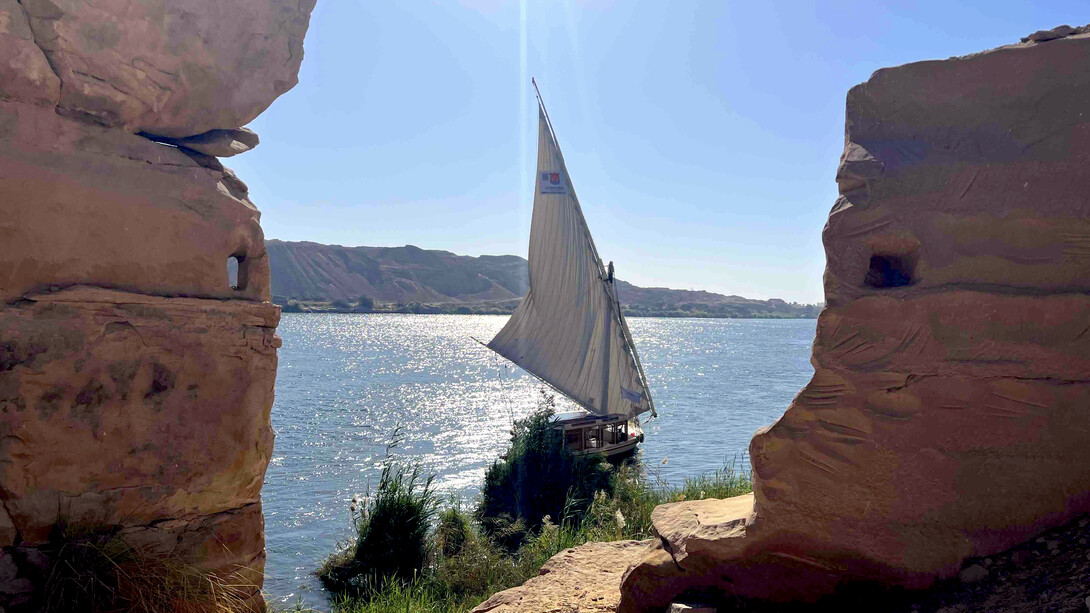
The Nile doesn’t rush. It never has. And the best way to understand that is from the deck of a Dahabiya.
The Dahabiya, named after the Arabic word "dahab," meaning "gold," was Egypt’s floating palace. Its origins stretch back to pharaonic barges depicted in ancient tombs, later adopted and gilded by medieval rulers as official state vessels. It was once the gold standard of elite travel, famously sailed by Florence Nightingale, Gustave Flaubert, and Agatha Christie, who found inspiration in the river’s slow drama when she wrote Death on the Nile.
Long before cruise ships arrived with their buffets and rigid schedules, the Dahabiya was how travelers moved along Egypt’s great river. Flat-bottomed and shallow-drafted with two triangular lateen sails, the Dahabiya is perfectly adapted to the Nile as it glides quietly between Luxor and Aswan, powered by wind (but recently mostly a small tugboat) and current.
Today, stepping onto a Dahabiya feels less like boarding a boat and more like slipping into another century. There’s no engine, no dock announcement, and no sense of being herded from sight to sight. Mornings begin with a light spilling across the water and the soft creak of wood. Afternoons drift by with stops at places that larger ships can’t reach; quiet ruins where you’re more likely to hear birds, cows, or dogs. Evening arrives with the scent of dinner cooking onboard and the sun melting into the river in shades of copper and rose.
What makes the Dahabiya special isn’t luxury in the modern sense, though it has its splendor. It’s the way it restores scale. Upper Egypt stops being a checklist of monuments and becomes a lived landscape again. You begin to understand why the ancient Egyptians saw the Nile not just as a river, but as a lifeline and a calendar.
Traveling by Dahabiya isn’t about getting somewhere quickly. It’s about surrendering to distance, light, and time. And in that unhurried movement, between sail and shore, past and present, the Dahabiya becomes what it has always been: a way of seeing. Traveling this way turns the Nile into a living corridor, with each bend revealing another layer of history as the journey moves steadily from Luxor to Aswan (and back), including the following highlights.
The Karnak Temple in Luxor
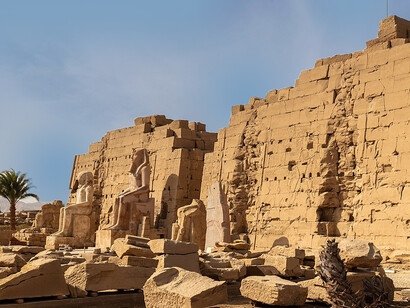
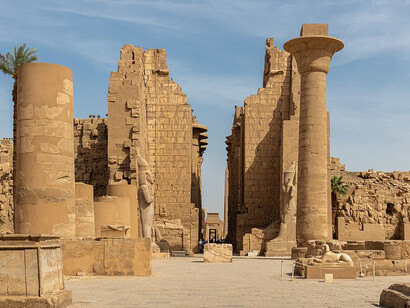
The Karnak Temple isn’t just one temple, it’s an entire city of temples, built up over centuries by more than thirty pharaohs, each adding something to outdo the last. Walking through it feels a bit like time travel, with layers of history stacked on top of one another. The complex is dedicated mainly to Amun-Ra, the sun god and king of the gods, but it also honors his wife, Mut, and their son, Khonsu, together known as the Theban Triad. The Karnak Temple was the heart of the annual Opet Festival, a 27-day celebration that reinforced the divine bond between the pharaoh and the gods while also marking the end of the agricultural year.
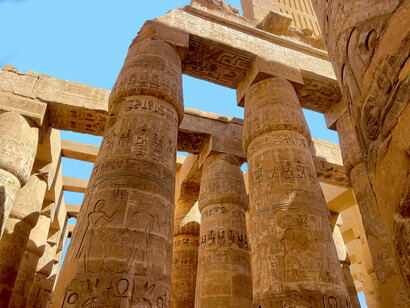
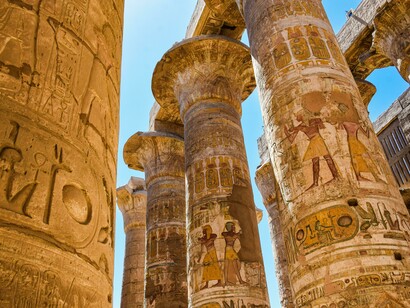
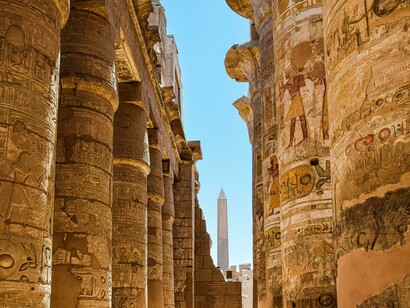
The Great Hypostyle Hall - and honestly, no amount of photos really prepares you for it - is the largest room ever built for a religious structure, covering nearly 5,000 square meters and filled with 134 colossal columns. Twelve of them rise to about 24 meters, while the remaining 122 stand around 15 meters tall. Originally, these columns supported a massive stone roof, but today only a few stone-grille “windows” remain, hinting at how sunlight once filtered into the space.
The hall was designed to symbolize a primeval swamp. The taller columns have open, bell-shaped capitals that resemble blooming papyrus flowers, while the shorter ones are topped with closed buds, evoking dense reeds. Look closely, and every surface tells a story; hieroglyphs, royal rituals, offerings to the gods, and scenes celebrating military victories are carved into the stone.
Another striking sight in the Karnak Temple is the towering obelisk of Queen Hatshepsut. It’s the tallest surviving ancient obelisk in Egypt, carved from a single block of red granite and standing nearly 30 meters tall. Hatshepsut commissioned it to celebrate her jubilee and, just as importantly, to assert her legitimacy as pharaoh in a world dominated by male rulers.
Close by and near the northwest corner of the complex, you’ll find the giant scarab beetle dedicated by Amenhotep III. Associated with the sun god Khepri, it symbolizes rebirth and good fortune. Tradition says that walking around it seven times brings luck and future blessings, which explains why you’ll almost always spot tourists quietly circling it, counting under their breath.
The Sacred Lake can’t be missed and was once used by priests for ritual purification. During the Opet Festival, sacred barques carrying statues of the gods were floated across its waters. Still visible today are some of the priests’ living quarters and storerooms, which once surrounded the lake.
Beyond its sheer size and spectacle, the Karnak Temple was built with astonishing spiritual and astronomical precision. For the priests and astronomers, this wasn’t just a place of worship; it was also a living calendar, used to track time, festivals, and the farming seasons that sustained ancient Egypt.
That relationship between stone, light, and belief becomes especially vivid after dark. During the nightly sound and light show (in multiple languages), visitors move through the temple as its history is narrated around them, columns emerging from shadow and hieroglyphs briefly illuminated before fading back into darkness. The experience transforms the Karnak Temple from a vast archaeological site into something closer to what it once was, a ceremonial landscape shaped by ritual, astronomy, and the careful choreography of light.
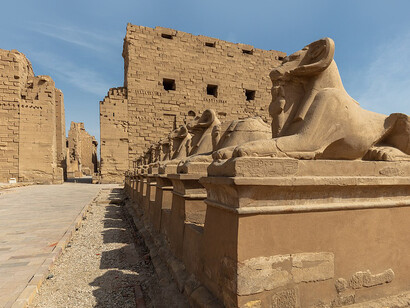
The Karnak Temple is now linked to the Luxor Temple by the Avenue of the Sphinxes, a grand processional road stretching nearly three kilometers. This avenue played a key role during the annual Opet Festival, when sacred barques carrying statues of the Theban Triad were paraded from the Karnak to the Luxor Temple. The journey was meant to renew the pharaoh’s divine power and celebrate the fertility of the Nile. Lined with sphinxes - some with ram heads, others with human faces - the avenue acted as a sacred corridor guarded by divine protectors.
The Luxor Temple
The Luxor Temple also served as the ceremonial heart of the Opet Festival and the symbolic stage for the renewal of kingship. Construction of its inner sanctuary and colonnade began under Amenhotep III, with later contributions from Tutankhamun and Horemheb. Then Ramses II transformed the complex on a grand scale, enclosing it within a vast open courtyard, erecting a monumental pylon, and commissioning towering obelisks. Even centuries later, rulers continued to leave their mark on the temple, including Alexander the Great, who added his own chapel.
Originally, two pink granite obelisks, each rising over 23 meters, stood at the temple’s entrance. One remains in place today; the other was removed in 1830 and now stands in Paris’s Place de la Concorde. The Luxor Temple is remarkable not only for its architecture but also for its continuity of sacred use, having served as a place of worship across ancient Egyptian, Christian, and Islamic eras.
Unlike most Egyptian temples, the Luxor Temple was not dedicated to a single god. Instead, it was devoted to the renewal of the royal ka, the spiritual essence of the pharaoh. During the Opet Festival, divine statues were carried here from the Karnak Temple, and the pharaoh was symbolically reborn, reaffirmed as both ruler and god on earth. In this way, the Luxor Temple functioned less as a static monument and more as a living ritual space, where power, divinity, and renewal were enacted again and again.
Esna Locks and the Temple of Khnum
As the Dahabiya sets sail south, the river narrows and slows near Esna, where modern engineering briefly interrupts the Nile’s ancient rhythm. About 60 kilometers below the Luxor Temple, the boat must pass through the Esna Lock and Dam, a working relic of the early 20th century designed to regulate water levels, support irrigation, and keep river traffic moving between Upper and Lower Egypt.
Shortly before the Dahabiya approaches the locks, small wooden skiffs appear out of nowhere, rowed hard by local men who seem to be heading straight for a collision. At the last possible moment, they tie themselves alongside the Dahabiya. At first, you assume they’re simply heading toward a better fishing spot, but within seconds, their real purpose becomes clear. These aren’t fishermen at all, they’re floating marketplaces, expertly unfurling their wares alongside your boat. They present bright tentmakers’ textiles and unfurl their wares: bright tentmakers’ textiles, embroidered tablecloths, and flowing galabeyas (traditional Egyptian loose-fitting gowns for men and women). If something catches your eye, it’s tossed up with practiced accuracy; payment is slipped into a bag and thrown back down in return.
The passage through the locks is surprisingly intimate. Two vessels glide into the chamber, ropes are tossed upward to operators waiting above, and the gates close behind. Within minutes, the water rises and the boat lifts gently, bringing passengers eye level with the staff who moments earlier seemed far overhead. The entire process takes only a few minutes, but it feels like a pause in time.
Just beyond the lock, Esna offers one of the Nile’s quieter surprises. Tucked nearly nine meters below street level, the Temple of Khnum emerges from an excavation pit, its columns rising where centuries of silt once buried them. Dedicated to Khnum, the ram-headed god believed to shape humanity on a potter’s wheel and control the annual flood, the temple dates to the late Ptolemaic and Roman periods. Its hypostyle hall contains 24 columns capped with lotus and palm capitals, while the walls are carved with remarkably crisp reliefs.
Here, as elsewhere along the Nile, the contrast is striking: modern locks and ancient temples sharing the same stretch of water, both quietly shaping life on the river. On a Dahabiya, the past and present drift together so naturally you stop noticing the seam.
Gebel el-Silsila
About 150 kilometers south of Luxor, the Nile narrows sharply at Gebel el-Silsila, the primary sandstone quarry behind many of ancient Egypt’s greatest monuments. Dahabiyas can anchor here, placing visitors directly beside the source of stone used for the Karnak and Luxor Temples, the Ramesseum, and others.
The cliffs are etched with evidence of ancient labor: tool marks, quarry lines, and workers’ graffiti that show how blocks were cut, lowered, and floated downriver. Before the 18th Dynasty, Egyptian builders relied mainly on limestone. The shift to durable Nubian sandstone, quarried here, allowed temples to grow larger, taller, and more ambitious.
More than thirty rock-cut shrines and inscribed stelae line the west bank, the only side accessible today. Unfinished blocks still cling to the bedrock, stone paused mid-extraction, making Gebel el-Silsila feel less like a ruin and more like a workshop momentarily left behind.
Kom Ombo Temple
Set on a dramatic bend of the Nile about 45 kilometers north of Aswan, the Temple of Kom Ombo is one of Egypt’s most unusual sanctuaries. Built during the Ptolemaic period between the 2nd century BC and the early Roman era, it is the only “double temple” in Egypt, perfectly mirrored along its central axis. One half is dedicated to Sobek, the crocodile god associated with fertility and the life-giving power of the Nile, the other honors Haroeris, Horus the Elder, the falcon-headed god of kingship and protection.
Carved into its walls are some of the ancient world’s most intriguing reliefs, including detailed depictions of surgical instruments and a ceremonial calendar tied to the Nile’s seasonal rhythms. Nearby, a small museum displays mummified crocodiles once worshipped here, a reminder that the reptiles drawn to this stretch of river were not feared but revered. Particularly striking at sunset or when illuminated after dark, Kom Ombo feels less like a ruin and more like a carefully composed dialogue between gods, medicine, and the river that sustained them all.
By the time the Dahabiya pulls into Aswan, it feels like you’ve been gently eased back into the present. The river widens, granite boulders dot the water, and feluccas glide past in every direction. Aswan immediately hints that there’s more to come, the dam that changed the course of the Nile, Nubian villages where people casually mention keeping crocodiles as pets, and markets where spices, peanuts, and hibiscus tea are must-purchase items. But a Dahabiya isn’t about squeezing everything in. It teaches you to leave some places for later. Aswan has plenty to explore, but that’s a journey for another day and another story.