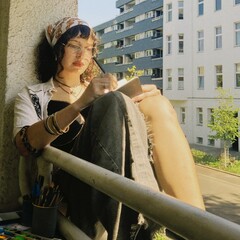
My name is Salima, but my friends call me Mimi. I was born in West London in the nineties, in a hospital that no longer exists. Born into an alarmingly large English/Algerian household, I associate my early childhood with Nintendo, playing imaginary games with my sisters, and a lot of reading. My mother used to read me fairy tales, and Enid Blyton’s The Folk of the Faraway Tree was the beginning of what was to become a lifelong passion for literature. I taught myself to read before I was old enough for school, losing myself in fictional worlds and imagining that I would grow up to fight dragons and take part in epic sword battles.
I spent the majority of my childhood travelling. We lived in the Middle East at various points. It was quite a culture shock for a little British kid—I remember the disbelief I felt leaving Dubai airport when I was nine years old, trying to comprehend the suffocating heat that hit me like a wall. But that excitement of landing in a distant foreign land stuck with me, and I’ve been chasing that feeling ever since.
Growing up, my love for books and art remained constant. I read voraciously, anything from Victorian gothic to science fiction. Reading Rebecca by Daphne De Maurier as a fifteen-year-old inspired me to pursue literature further, and I started studying for a degree online at the age of sixteen. I managed a couple of years before dropping out, but my love for books remains. For me, self-care is lying in the sun, undisturbed, lost within the personal imaginarium conjured up by little more than words on paper. I think it’s magic. As I grew older, my love for literature led to me writing my own stories, always fantasy and always in first person. I still love writing to this day, though in recent years I’ve shifted my focus more toward academic papers and poetry.
The satisfaction I experienced from creating expanded, as it so often does, into a passion for art. Baby Mimi drew all the time—there’s no record of any of it, but the art created in my early childhood was heavily inspired by the old anime I watched dubbed into Arabic, especially Detective Conan. I continued to draw extensively as a teenager and went on to study art as an A-level. Although having unlimited access to drawing supplies made me feel like a child in a sweet shop, I didn’t enjoy being told what to draw and how to draw it. Art should be about creative freedom of expression, and I still strongly believe that fine art should be a practice, not a subject taught within the constraints of the academic curriculum.
The ambition to peek behind the curtain of greatness led me to eventually study the history of art at the University of Leeds, graduating in 2020 with a first-class degree. I loved having the opportunity to indulge in my desire for knowledge, as well as my passion for art, discovering fresh interests and a newfound love for film and cinema. With Edward Said as my intellectual mentor, I wrote a 17,000-word thesis on Orientalism and the role of the colonialist gaze within the art world. The ways in which Western media chooses to represent the Arab woman is a topic I am deeply invested in, especially considering my own lived experience in post-9/11 Britain.
Studying art in an academic context was fascinating to me, and whilst that period of my life will always remain precious, I couldn’t ignore the historic exclusivity and self-indulgence that so often surrounds the artistic milieu. Despite this, the ideas and questions I engaged with during that time have stayed with me, continuing to inform how I see myself, the world, and the ever-shifting relationship between the two.
Although I would say that studying the history of art was an homage to my creative drive, in time, I began to feel something was missing. My academic work fed my intellect, but I craved a deeper engagement with the lived realities of identity, politics, and representation in today’s world. Driven by my ongoing exploration of identity and disillusioned by the apocalyptic, post-Covid atmosphere in the UK, I decided to leave. I relocated to Berlin, where I am now studying for a master's in Middle Eastern studies. Here, I continue to interrogate the politics of identity, displacement, and representation—particularly within the context of the Arab world and diaspora.
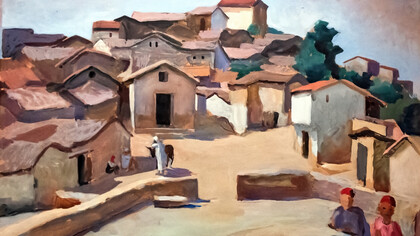
Being exposed to different cultures as a child instilled in me a fascination with the diversity of tradition, especially within the Muslim world. Growing up mixed-race, I always questioned my own identity. Feeling neither fully English nor Algerian, I struggled to place myself within a world obsessed with labels, where individuals are sorted into divisive categories based on race, nationality, and religion. Although I (mostly) grew up in England, I have always felt a deep connection to my Kabyle roots and remain passionate about Algeria’s rich culture and its long, complex history of struggle and revolution.
It is my hope to one day consolidate my creativity with my academic interests, finding a space where culture and critical inquiry intersect. I want to amplify overlooked narratives, challenge dominant discourses, and contribute meaningfully to conversations about identity, representation, and belonging. The journey’s ongoing, but what I do know is that I feel most at home in those spaces that exist between cultures, ideas, and traditions.

 English
 Español
 Français
 Deutsch
 Italiano
 Português