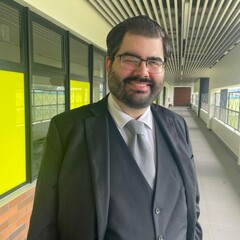
Dr. Richard A. Ballard Fabrega weaves his expertise in International Relations, Philosophy, Political Science, and Education into a cohesive, if occasionally wry, view of the world. He refuses to settle on any single ideological corner, though he’s well-versed in International Relations' schools of realism, liberalism, and constructivism. He prefers an integrated, broad-minded approach, convinced that the messy realm of global affairs demands every tool in the box. This stance didn’t emerge overnight. It’s the product of over ten years of teaching, journalism, and news translation, and a stint at the Ministry of Foreign Affairs of Panama during the Martin Torrijos administration.
Those years in government revealed that realpolitik, idealism, and the more nuanced schools of thought all illuminate parts of the diplomatic puzzle. Working on policy wasn’t just about memorizing positions; it required grappling with day-to-day friction between moral imperatives and the reality of finite resources. Later, translating news stories and writing articles sharpened his ability to capture nuance. The English language might call him a teacher; in practice, he was part storyteller, part fact-checker, part mediator—roles he would reprise in every classroom, lecture hall, and editorial office he entered.
His academic path crisscrossed continents. He earned a BA in History and Political Science from the University of British Columbia, a foundational journey into the currents that shape societies. From there, he sought a global lens, completing an MSc in International Security at the University of Dundee in the United Kingdom. China then called to him, and he answered by pursuing a PhD in International Relations at the University of International Business and Economics. That final stop in Beijing wasn’t mere theoretical study; it was immersion in a different worldview, forcing him to reconcile Western theories with Eastern realities. The result: a conviction that no single nation or philosophical stance holds the secret recipe for universal truths.
He’ll cite hegemonic stability theory in one breath, then pivot to moral philosophy in the next—though he’s quick to note that moral philosophies often overstep, insisting on universal applicability where none might exist. That doesn’t translate to moral relativism, at least not in his day-to-day. Ask him about the ultimate aim, and he’ll tell you he believes in doing the greatest possible good for the greatest possible number of people. To him, it’s more a guiding star than a universal law, a prompt to stay humble about the complexity of human societies.
His teaching style reflects that blend of pragmatism and curiosity. Spend five minutes in his classroom, and you’ll encounter historical anecdotes, thorny ethical dilemmas, and a quiet, mischievous humor that keeps students on their toes. He likes to keep them guessing—one moment analyzing Cold War polarity, the next asking whether universalizing ethics might do more harm than good. He’s never out to stump them but prefers that they wrestle with questions no single textbook can answer.
Born abroad in a country that refused him birthright citizenship, he eventually returned to his family’s homeland at eleven. The experience taught him to view borders as lines that shape opportunity, identity, and privilege in ways that textbooks rarely capture in full. Now, he counts himself a “double migrant,” a label he carries with the same understated pride he shows when discussing his geekier passions. Yes, he reads voraciously, dabbling in fantasy novels and historical documents in the same weekend. He’s also the sort to collect obscure trivia and draw parallels between a medieval crusade and a modern-day cosmic science fiction storyline, all in one conversation.
He doesn’t promise tidy conclusions for every global crisis or philosophical conundrum. He prefers to remain flexible, both in teaching and in scholarship. Students sometimes ask for the final word on a difficult topic. His response often invites further debate. Theory, after all, is only as strong as its ability to adapt. Still, his work—spanning diplomacy, translations, classrooms, and academic research—consistently circles back to that key question: how do we, as individuals and societies, maximize the collective good without naively believing in one-size-fits-all frameworks?
It’s a question that keeps him writing, teaching, and engaging with colleagues around the world. Whether he’s discussing polarity in IR, dissecting a moral philosophy text, or rethinking traditional approaches to education, Dr. Richard A. Ballard Fabrega remains a curious observer and a dedicated participant. He leans into contradictions, sees value in multiple viewpoints, and calls on all of us to look past ideological blinders. In that sense, his life’s work stands as a testament to embracing complexity and walking the fine line between conviction and open-mindedness—always in service of the greatest possible good.


 English
 Español
 Français
 Deutsch
 Italiano
 Português