English
 Español
 Français
 Deutsch
 Italiano
 Português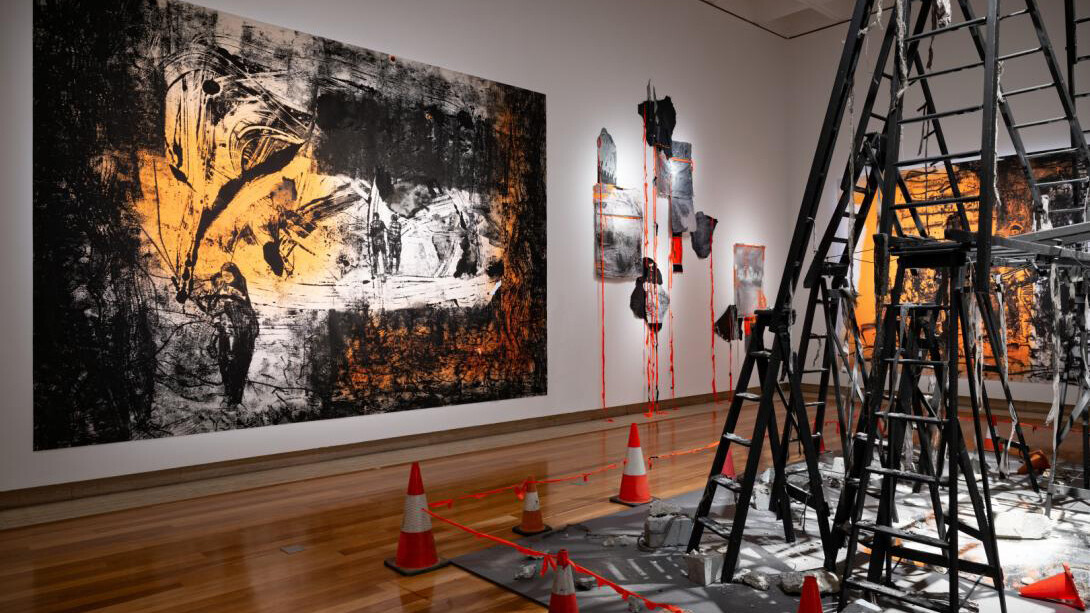
Pat Hoffie’s career as an artist spans over five decades. Ambitious and expansive, cross-cultural and interdisciplinary, Hoffie’s practice frequently addresses themes of power and postcolonial legacies through consistently centring on aspects of the human experience.
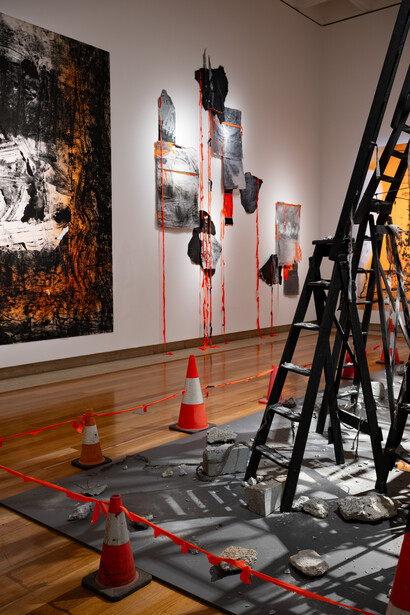
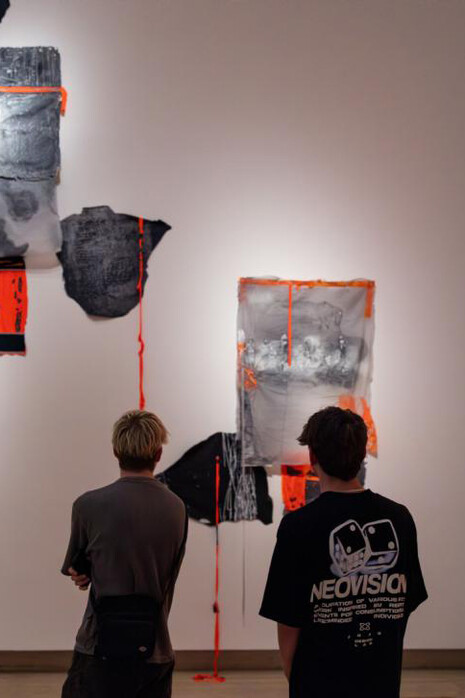
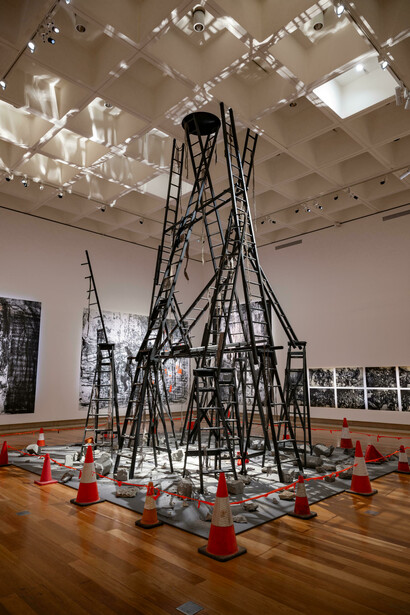
Hoffie’s I have loved/I love/I will love presents the artist’s first extensive body of work in printmaking. Engaging with printmaking’s historical legacy in transmitting images of human conflict, these works draw from the socially mediatised imagery Hoffie has described as interminably running on as “the background to my days”. She transforms scenes she has witnessed through the media by using techniques that combine monoprint, drypoint, digital technologies, and found materials.
Given our current cultural climate, the art institutions are practically the only places where we can actually step back from our own present and compare it with other historical eras. In these terms, the art context is almost irreplaceable because it is particularly well suited to critically analyse and challenge the claims of the media-driven zeitgeist.
(Boris Groys, ‘The fate of art in the age of terror’)
"This body of work is about many things. Each lies on top of the next to form a topography of accrued interests. In order to dig a little deeper, the viewer might have to stay around a little longer. Look a little more closely. Optically scratch away at the surface until less immediately obvious shapes and shadows emerge.
Like all art, it’s partly an homage to other art that has come before it. And, also, it’s a response to the new visual technologies of its time.
Each work has been produced through some form of printmaking. As such, the series pays homage to works by artists from the past: Callot, Rembrandt, Goya, Kollwitz, Grosz, Dix among many others. The graphic power of these artists’ works has long staked out turf in my brain. Simultaneously skilful, yet crude and cruel; historically specific yet somehow eternal — these images still manage to perform as anchor points capable of pinning this present moment to those of the past.
The digitised mediascapes of the present are transforming the way we relate to imagery, just as the production of the first photograph in 1826 catapulted the production, distribution, reception, interpretation and consumption of visual media into new ways of seeing. Now print media has succumbed to image data. We scroll in silence, usually on our own. We scroll so fast that we avoid absorbing the images. It has been said that we are inhabiting a post-scopic era — a time when we view images as immediate signs rather than things-and-ideas-caught-in-time — just like us.
I produced these images slowly in 2024. During that year, as the quotidian details of daily life were endlessly punctured by details of conflicts fought out in global ‘elsewheres’, the work progressed as a kind of exhumation of the past — in order to seek out some way of understanding the present. Images from the art of the past provided both a wound and a salve. Later in life, looking back on the work he produced in response to World War One, George Grosz wrote, ‘I thought the war would never end. And perhaps it never did, either.’ There are miracles, though — small details where, in the midst of unimaginable hellscapes, people reach out to help each other, to hold each other, to clutch at hope and dreams and to never lose faith that there will be possibilities for more positive futures."
(Pat Hoffie's artist statement)