English
 Español
 Français
 Deutsch
 Italiano
 Português
Since 2020, the Sahelian board has shifted from a French-led counterinsurgency theater to an open geopolitical contest in which Moscow has secured unprecedented space. The turning point came with the reconfiguration and subsequent end of Operation Barkhane and France’s drawdown from Mali in 2022, which left Paris without its main military anchor in the region and opened a window for new partners. Barkhane’s withdrawal was not merely logistical: it symbolized the loss of political traction of the French security model—based on prolonged deployments and conditional cooperation—amid military juntas seeking greater room for maneuver at home.
The Sahel on the international radar
The dynamic accelerated in 2023. Burkina Faso requested the withdrawal of the French contingent and terminated bilateral military cooperation—an assertion of sovereignty that also responded to street pressure and the regime’s need to show quick security results. The UN peacekeeping mission in Mali (MINUSMA) began its drawdown the same year and completed its withdrawal by late 2023, further reducing the multilateral presence. Operationally, the vacuum left areas contested between the state, insurgents, and various armed actors; politically, it reinforced the narrative that “solutions” had to come from within—or from new allies ready to help without conditionality.
The coup in Niger (July 2023) consolidated the shift. The break with Paris was public and swift: mass demonstrations outside French bases, Russian flags on the streets of Niamey, and a discourse presenting France as an obstacle to “national dignity.” The outcome was unambiguous: the last French soldier left Niger in December 2023. Beyond the military fact, the episode showed that the dispute was not just tactical—about how to fight jihadists—but symbolic and geopolitical: who defines security and on what terms.
The United States—less visible but crucial for ISR and drones—also adjusted its footprint in 2024. After the Nigerien junta decided to end the military agreement, Washington executed the withdrawal from Base 101 (Niamey) in July and Base 201 (Agadez) in August. For Niger, the message was coherent with its rupture line; for the West, it meant losing key regional surveillance nodes in a space where other actors—Russia and Turkey—were more willing to step in.
Meanwhile, Russia seized the opportunity. It did so with a comprehensive offer: instructors, equipment, operational advising, and a narrative aligned with junta priorities—sovereignty, order, and speed. The deployment of Russian personnel in Burkina Faso from January 2024 and announcements of more instructors and materiel from June onwards strengthened the perception that Moscow was not only replacing Western capabilities but doing so with fewer political strings and greater resonance with local sovereigntist discourse. This “security on demand” gives oxygen to regimes under pressure and turns Russia into a de facto arbiter of tempo and priorities.
The battle over narrative has been as decisive as the battle over positions. In Sahelian capitals, the symbols have changed: Russian flags have replaced French tricolors; tailors in Niamey sew Moscow’s flags on popular request; and placards and slogans denounce French “neocolonialism” and celebrate the arrival of new partners “respectful of sovereignty.” Amplified by local networks and international channels, this social climate erodes the legitimacy of Western presence and helps juntas present each step—an expulsion, a new contract, a batch of instructors—as a political victory.
Strictly militarily, the shift has been most visible in the air. The recapture of Kidal by the Malian Army (November 2023) was the milestone authorities showcased as proof of effectiveness; it was preceded by drone strikes and accompanied by cross-accusations over civilian casualties. In parallel, Burkina Faso has consolidated the use of Bayraktar TB2s in its campaign against insurgencies. This new aerial edge delivers tactical effects—punishing concentrations, interdicting columns—but does not guarantee sustained territorial control absent reforms to ground forces, local justice, and civil administration. Moscow, Ankara, and others provide capabilities; day-to-day legitimacy still hinges on what happens in villages and markets.
The economic dimension has also entered the Paris–Moscow dispute (and, by extension, West vs. non-West). Niger has strained its historic relationship with Orano over uranium—a sensitive matter in France. In 2024, Niamey withdrew the permit for the major Imouraren concession and reset assets and contracts, sending a message to Europe while diversifying interlocutors. That Paris could compensate volumes with Canada or Kazakhstan does not detract from the political signal: legacy strategic deals can be rewritten in the new Sahelian era.
The upshot is a multipolarized Sahel, where France is no longer the default provider and Russia has entrenched itself in the realm of “politically viable” security for emergency regimes. Between these poles, other actors (Turkey, the Emirates, and China) move to occupy niche spaces—air, finance, and infrastructure. But the keystone remains the same: who can deliver effective security without choking political autonomy? Since 2020, that question has framed the very origin and meaning of the AES.
From sanctions to sovereign pride
The AES was born of a string of ruptures but also of a search for a shared political identity. After the military coups in Mali (2020 and 2021), Burkina Faso (2022), and Niger (2023), ECOWAS responded with its standard toolkit: membership suspension, financial asset freezes, border closures, and travel bans. The declared aim was to pressure juntas into handing power back to civilians on very short timelines. The effect, however, was the opposite. Sanctions reinforced the narrative that Sahelian peoples were being punished for defending their sovereignty, allowing military regimes to cast themselves as guardians of national dignity against organizations “instrumentalized by the West.”
In this climate, the Liptako-Gourma Agreement, signed on 16 September 2023, was born. What was initially a collective defense pact against external threats—a mutual assistance clause almost modeled on NATO logic—quickly became the seed of a political project. The alliance presented itself as a shared shield against foreign intervention and as a vehicle to coordinate operations against insurgencies straddling the Mali–Burkina–Niger borderlands.
From there, steps followed rapidly. In January 2024, the three governments formally announced their withdrawal from ECOWAS, accusing it of being “captured” by interests alien to the continent. The decision was as symbolic as it was practical: it meant breaking with West Africa’s largest regional bloc and betting on a homegrown construction. Barely six months later, in July 2024 in Niamey, they proclaimed the Confederation of the AES, signaling an intent to move towards deeper coordination in foreign policy, the economy, and security.
The project goes beyond declarations. The confederation has floated the creation of a common currency as a symbol of financial independence and a rejection of the CFA franc, still linked to Paris. Though still at an early stage, the idea seeks to reinforce the narrative of full sovereignty vis-à-vis the colonial legacy. Similarly, it has proposed removing internal borders to facilitate the movement of people and goods—an integration step aimed at energizing trade in one of the continent’s poorest and least connected regions.
On the military front, the AES has taken more tangible steps. It has announced the formation of a joint rapid-reaction force, intended to operate in areas hardest hit by jihadist violence, especially the “Liptako-Gourma triangle.” The idea is for national armies to act in a coordinated fashion under a common command, strengthening the response against groups that slip easily across borders.
As for institutional design, the bloc has outlined the creation of a Council of Heads of State as the top political body, alongside a Council of Foreign and Defence Ministers tasked with coordinating strategic decisions. A permanent secretariat is envisaged to follow through on agreements and a future consultative assembly as a political forum for regional representation—though, for now, without a clear blueprint or effective powers.
These initiatives show that the AES was born of pragmatism and aspiration. Pragmatism in the need to pool forces against common threats and to shield themselves from external pressure. Aspiration in the bid to build a regional framework alternative to ECOWAS and to French influence, with sovereignty symbols like a new currency or open internal borders. The official discourse insists the AES embodies a new African sovereignty, but the reality is a permanent tension between ambition and what its resources and capacities can actually sustain.
A geopolitical alliance
The Association of Sahel States is not merely a refuge for sanctioned military governments. From the outset, it was conceived as a geopolitical instrument to alter power balances in West Africa. This is not a marginal bloc: it is the arena where the decline of French influence and the advance of new partners willing to fill the Western vacuum have been most visible. In this sense, the AES is both a project of African sovereignty and a vehicle for external strategic penetration, with Russia the quickest to capitalize.
Russia: from the military classroom to flags in the square
Ties between Moscow and Sahelian junta leaders did not materialize out of thin air. Many of the officers now leading these regimes spent part of their training in Russian or Soviet military academies, a legacy of cooperation dating back to the Cold War. That training left not only doctrinal imprints but also personal networks that enabled rapid rapprochement once the West tightened sanctions.
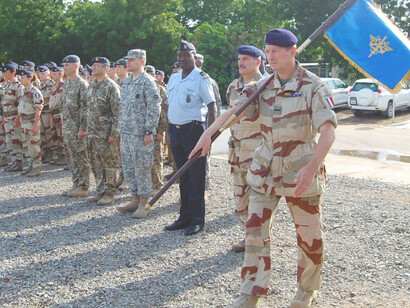
This political capital has translated into a tangible footprint on the ground. After French forces departed and the United States drew down, Russia deployed the Africa Corps, heir to the Wagner Group, in Mali and Niger. Its role is twofold: on one hand, it provides training, maintenance, and limited modernization of military equipment; on the other, it acts as combat reinforcement in high-risk operations. Symbolically, Russia has become the partner that confers military legitimacy on the juntas: Russian flags flying in Bamako, Ouagadougou, or Niamey are no spontaneous gesture but the result of a carefully crafted propaganda strategy portraying Moscow as the guarantor of African sovereignty against “Western neocolonialism.”
The Wagner effect remains. Although its structure changed after Prigozhin’s death and integration under Russia’s Ministry of Defence, the modus operandi persists: security in exchange for concessions. In Mali, companies linked to Moscow have secured gold and manganese contracts; in Niger, attention centers on uranium and the protection of critical infrastructure. Swapping natural resource access for military backing is how Russia has cemented influence and reclaimed ground that once belonged almost exclusively to Paris.
Moreover, the Africa Corps goes beyond tactical operations. It also plays a cadre-building role, training officers and NCOs in doctrines that reinforce Sahelian forces’ dependence on Russian know-how. Maintenance—ranging from helicopters to artillery systems—becomes a form of soft power: without Russian instructors, many capabilities would be inoperable.
Within this context, the AES serves as a showcase of Russian influence. As a confederation of countries ruled by sovereigntist-minded juntas, it is an ideal platform to consolidate a Moscow–Sahel axis. It is no coincidence that Russia’s official narrative emphasizes counter-terrorism and respect for African sovereignty—two core themes for leaders in Bamako, Ouagadougou, and Niamey.
Turkey: drones, pragmatism, and cultural affinity
The AES is not a Russian satellite, and its leaders have shown pragmatism in opening to other partners. Turkey has become one of the most dynamic, above all, through its ability to offer cutting-edge military technology at accessible prices. Bayraktar TB2 drones, already used in Libya, Syria, and Ukraine, have proved their worth in the Sahel. In Mali, they were key to the recapture of Kidal in November 2023, and in Burkina Faso, they are central to efforts to halt jihadist advances in northern provinces.
Ankara pairs this drone diplomacy with infrastructure investment and a narrative of solidarity among Muslim-majority countries. Its appeal lies in providing operational support without political reform conditions, contrasting with European conditionalities. Turkey thereby strengthens its profile as a pragmatic partner, willing to engage with internationally controversial regimes and to position itself as a technological alternative to the Moscow–Beijing axis.
United Arab Emirates: gold, capital, and financial legitimacy
The UAE acts more discreetly but no less effectively. Its Sahel strategy focuses on the mining and financial sectors. In Mali, Emirati funds have invested hundreds of millions of dollars to acquire gold assets, securing privileged access to a resource vital to both the local and global economy. Dubai—consolidated as a global hub for African gold—becomes the natural destination of part of Malian output, even as questions persist over traceability and fiscal controls.
For the juntas, Emirati capital is economic oxygen amid international isolation. The UAE’s presence also lends a veneer of legitimacy and plugs the AES into global financial networks. For Abu Dhabi, this is a strategic investment that ensures resources and political presence in a contested space, without directly confronting traditional powers—or Russia.
Saudi Arabia and the Gulf: diplomatic cover and energy bandwidth
Beyond the UAE, the AES is also cultivating ties with Saudi Arabia and other Gulf states. Riyadh’s interests is primarily energy and diplomacy. It seeks to consolidate its leadership in the Muslim world while diversifying its African agenda. In exchange for political support and financing, the juntas gain privileged access to international forums and a broader base of allies—reducing exclusive dependence on Moscow.
Cooperation on energy and infrastructure remains incipient but could firm up if the AES achieves greater institutional stability.
China: the patience of a strategic investor
China is the long-term player. Its presence centers on infrastructure and strategic resources. The Niger–Benin oil pipeline, operated by CNPC, has transformed Niamey’s economic profile, enabling significant oil exports to Asia. In Mali, Ganfeng Lithium began operations at the Goulamina deposit in 2024, one of West Africa’s most promising projects, cementing Beijing’s position in the global battery supply chain.
What stands out in China’s approach is its low political profile. Unlike Russia or Turkey, Beijing avoids direct security involvement and prefers to project power through finance and trade. This discretion allows it to consolidate durable influence, be less exposed to local political swings, and position itself as an indispensable partner for medium- and long-term development.
A bloc open to new alliances
The AES thus emerges as a node where global interests converge. Russia has capitalized on the vacuum left by France and the United States, but Turkey, the UAE, Saudi Arabia, and China have also found opportunities. For the juntas, opening to this spectrum of partners follows a clear logic: diversify support to reduce vulnerabilities and avoid becoming hostage to a single patron.
Ultimately, the AES is both a sovereignty project and a testing ground for the new multipolar order. How it balances Russian influence with openness to other actors will determine whether the bloc consolidates as a stable regional player—or becomes a theater of external competition that erodes, rather than strengthens, the autonomy it claims to defend.
Weaknesses of a project under construction
The AES presents itself as a bloc capable of confronting insecurity and charting a path to self-reliance, but its structural weaknesses run deep enough to threaten the project from within. The underlying problem is the contradiction between an ambitious sovereignty discourse and very limited economic, institutional, and military capacity.
Economic dependence and structural vulnerability
The economies of Mali, Burkina Faso, and Niger rely excessively on primary exports. Gold, uranium, cotton, and oil form the backbone of revenues that are highly sensitive to market swings and logistical chokepoints. The dispute between Niger and Benin over crude transit to the port of Cotonou—which paralyzed exports through the newly opened pipeline for weeks—showed just how fragile these states’ financial position is: a single diplomatic rift can choke off the hard currency needed to run government and pay salaries.
Lack of diversification worsens the picture. Agriculture—the main employer—depends on an increasingly erratic climate, marked by prolonged droughts, torrential rains, and land degradation. This vulnerability fuels food insecurity, undermines social cohesion, and limits the juntas’ ability to present themselves as guarantors of welfare.
The persistent Jihadist challenge
The most serious weakness, shaping daily life in all three countries, is the failure to contain jihadist expansion. For over a decade, the central Sahel has seen the growth of organizations linked to Al-Qaeda and the Islamic State. After the collapse of northern Mali and the fall of Libya, insurgents found propitious ground: fragile institutions, vast neglected rural zones, and porous borders.
In Burkina Faso, the situation is dramatic. At one point, over 40% of the territory lay outside effective state control, with entire provinces in the north and east where government forces scarcely ventured. Tens of thousands live under siege in isolated towns, without regular access to markets or basic services, relying on military convoys to survive. Attacks on barracks, gendarmerie posts, and villages are frequent, with violence hitting soldiers and civilians alike. For Ibrahim Traoré’s junta, the challenge is existential: without visible security improvements, legitimacy erodes month by month.
In Mali, conditions are not much better. After the UN mission (MINUSMA) withdrew in 2023, Malian forces—supported by Russian advisers and Turkish drones—launched offensives such as the recapture of Kidal. The victory carried symbolic weight, but insurgents relocated, increasing ambushes and bombings in the center and south. ISGS and JNIM (Al-Qaeda-linked) retain operational capacity and still contest control across wide rural areas.
In Niger, the junta’s rise in 2023 coincided with a spike in attacks both along the western frontier with Mali and Burkina and in the Lake Chad basin. Despite hosting US drone bases and French cooperation, Nigerien forces have not subdued insurgent cells, which exploit political turmoil to intensify operations. Agreements with Russia to replace departing Western forces have raised expectations, but results on the ground remain elusive.
Across the three states, the lesson is clear: air power alone is insufficient. Turkish drones and Russian support deliver punitive capability, but insurgents have learned to disperse, move by motorcycle, embed in communities, and exploit governance gaps. Without deep reform of ground forces, justice, and basic rural services, the insurgency will keep finding space to survive and expand.
Legitimacy conditional on results
Junta legitimacy rests on two pillars: popular rejection of French influence and the promise to restore security. The first gave them oxygen at the outset; the second is a demand they have yet to meet. In Bamako, Ouagadougou, and Niamey, public patience increasingly depends on concrete outcomes. If food prices keep rising, roads remain unsafe, and communities stay under siege, the sovereignty discourse risks ringing hollow.
Resource governance adds friction. Gold extraction in Mali and Burkina Faso—often by foreign firms working with local intermediaries—generates resentment among communities who feel they see little benefit while bearing environmental damage and insecurity. In Niger, revising uranium and oil contracts bolstered sovereigntist rhetoric but also raised concerns over transparency and managerial capacity.
An institutional architecture still embryonic
The final major weak flank is institutional. Although the AES has announced a confederation and ambitious intentions—new currency, open borders, joint force—practical advances are limited. Summits and ministerial meetings showcase unity, but there is no operational secretariat for continuous coordination nor a common budget to finance regional policies.
The joint force remains embryonic, more a political project than a tangible military capability. The common currency, while touted in speeches, faces daunting technical, financial, and logistical hurdles. Meanwhile, immediate needs—funding basic services, coordinating operations in border areas, stabilizing economies—lack a solid cooperation framework.
The risk of a bloc that cannot deliver
In short, the risk for the AES is to become more a tool of political legitimacy for the juntas than an actor capable of providing regional public goods. The contrast is stark: while insurgents sometimes offer communities a minimal form of order or protection, the state often appears distant, unable to guarantee security or development. This gap between discourse and reality threatens to undermine the bloc’s viability and turn it into a project more symbolic than functional.
Conclusions and future scenarios
The Association of Sahel States (AES) encapsulates a change of era: the retreat of Western monopoly and the rise of a variable geometry of alliances where Russia, Turkey, the Emirates, and China compete—and sometimes cooperate—according to interests. For Mali, Burkina Faso, and Niger, the AES is a vehicle for political survival and an attempt to reorder hierarchies of security, finance, and trade. The dilemma that will continue to define its trajectory is the gap between sovereign ambition and real capacities.
Scenario 1—Broadening the bloc: entry of third parties
The first prospective vector is AES enlargement to add political, economic, and logistical “critical mass.” Togo has left the door ajar: Foreign Minister Robert Dussey said in 2025 that accession is “not impossible,” aligning with relatively favorable public opinion and practical moves in logistics and customs (a window to the sea for landlocked members).
In parallel, Chad has sent political signals—at least at the spokesperson level—of sympathy for the Sahelian axis, stepping away from the French umbrella and exploring security convergence with the AES. Without a formal decision, this discursive appetite matters given Chad’s geostrategic location and regional military role.
Guinea, also under a military junta, has echoed the sovereigntist shift while prioritizing its internal agenda (constitutional referendum and transition calendar). Without declaring candidacy, its political affinity and Atlantic position make it a swing actor in any reconfiguration of the coastal façade, should the AES seek alternative port access and greater connectivity.
An expansion including Togo (ports/logistics) and tighter operational alignment with Chad (strategic depth to the east) would raise the bloc’s profile, facilitate supply corridors, and create incentives to coordinate customs, roaming, and the movement of goods and data already under bilateral discussion. The still-embryonic enlargement hypothesis would become a functional lever if monetized into lower logistics costs, labor mobility, and joint procurement power. It would also trigger diplomatic pushback from ECOWAS and strain relations with coastal capitals.
Scenario 2—Dissolution, implosion via internal shocks and resource fatigue
The second scenario is AES dissolution or hollowing-out, precipitated by a combination of domestic political shock (protests, elite splits, forced transition in one member), fiscal fatigue (hard-currency stoppages, as seen with the Niger–Benin pipeline), and insurgent learning curves that blunt the tech advantage (drones) without producing territorial consolidation. In this context, juntas would refocus on survival at home and reopen bilateral channels with external partners (Russia, Turkey, UAE, and China) outside a confederal umbrella. The AES would persist as a low-intensity brand.
Risk factors are well known: macro vulnerability (commodity dependence and chokepoints), blockages in critical infrastructure—e.g., the Niger–Benin pipeline’s dispute and stoppages before resuming—and violence that redistributes geographically whenever one hotspot is pressed (Kidal, Gourma) and another flares. In such an environment, the exit of Western security partners followed by Russian repositioning does not guarantee sustained stabilization without reforms to ground forces, local justice, and civil administration.
A political break in Bamako, Ouagadougou, or Niamey would trigger contract relocations, litigation in mining/energy, and fresh opportunities for jihadist and smuggling networks. Migration risk toward the Atlantic and Mediterranean façades would rise again, affecting Spain and the EU along the western route.
Scenario 3—Selective consolidation: minimal interoperability and the political economy of security
The third scenario is a realistic strengthening: the AES does not become a “mini-EU,” but it institutionalizes certain operational bodies and achieves basic interoperability in critical zones (Liptako-Gourma, shared border axes), leveraging common equipment and doctrine, ISR exchanges, and joint command. On this basis, the bloc absorbs costs and reduces cross-border frictions enough to improve visible services: route protection, humanitarian convoys, weekly markets, and access to basics.
Here, Russia deepens its role as security guarantor (training, matériel, fire support) after public commitments to back a ~5,000-strong joint force; China stabilizes cash flow with anchor projects (pipeline at full regime, Malian lithium), and the UAE underpins gold/finance—if mining deals consolidate—offering a liquidity cushion. Turkey, pivotal for the bloc’s “aerial capillarity” (TB2) and MRO (maintenance), multiplies its influence as a fast, politically viable provider. Collectively, the bloc would gain incremental capacity to deliver everyday security in corridors and peri-urban areas, even if it remains dependent on external partners and without fully resolving institutional fragility.
Turkey’s İmprint on the AES Horizon
Whatever trajectory materializes, one trend deserves emphasis: Turkey is deepening its footprint in the Sahel—and, by extension, its influence over the AES. Its added value is not just selling Bayraktar TB2s; it is bundling training, doctrine, and sustainment, which have shown tactical effects—see Kidal (Nov. 2023)—with a cost-effectiveness that suits austere budgets. Turkish systems are also politically compatible: Ankara avoids ideological conditionalities and projects cultural/religious affinity without explicit tutelage. If Togo facilitates logistical corridors to the sea and the AES consolidates a joint force, demand for UAVs, loitering munitions, communications, and maintenance will likely grow, expanding Ankara’s leverage within the bloc.
Implications for Spain and the EU
If the bloc broadens, Brussels and Madrid will need to work with and around the AES: facilitating legal logistics chains (humanitarian/commercial corridors), protecting infrastructure, and shaping standards (gold and critical minerals) so governance of traceability is not ceded entirely to third parties.
If it dissolves, expect renewed security crises and migration spikes along the western route; reinforced early warning and low-footprint cooperation with local and coastal actors will be essential.
If it consolidates selectively, the AES will remain an awkward actor for ECOWAS but more predictable: it will explore technical windows (borders, customs, food security) and regulatory channels (mining/energy) without demanding short-term political impossibilities.
The AES will advance—or retreat—according to its ability to deliver everyday security and tangible economic outcomes. The entry of third parties (Togo/Chad) is plausible and functional; dissolution is not unthinkable if the gap between rhetoric and service delivery persists; selective consolidation is the most pragmatic horizon. In any of the three, Turkey will likely keep gaining ground as the operational provider of reference, while Russia capitalizes on the political economy of security and China/UAE secure financial and infrastructural anchors. The Sahelian board has become transactional; understanding its specific exchanges—not just the rhetoric—will be key to anticipating what comes next.