English
 Español
 Français
 Deutsch
 Italiano
 Português
There are artists who are able to transform materials without ever betraying their intrinsic nature; artists who recognise expressive possibilities in everyday objects that escape the common eye, and who succeed in restoring to them an entirely new poetic dimension. Ruth Asawa (1926–2013) belongs to this rare category. Her work originates in an apparently simple gesture – bending, weaving and shaping a metal wire – yet develops into a formal universe of extraordinary complexity, where lightness and solidity, emptiness and fullness, geometric rigour and organic suggestion coexist in an ever-shifting equilibrium.
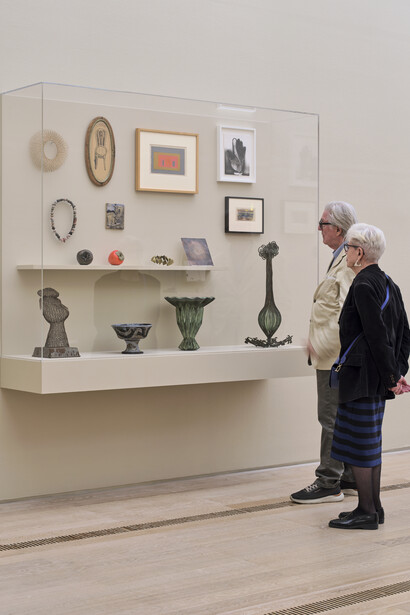
It is precisely this ability to transcend the traditional boundaries of sculpture that lies at the heart of the major retrospective devoted to the Japanese-American artist by the Fondation Beyeler. The first major European retrospective dedicated to her work, the exhibition offers an opportunity to engage with a practice spanning more than six decades and encompassing wire and bronze sculptures, drawings, prints, paintings and public commissions. Its purpose is not merely to retrace the career of an extraordinarily versatile artist, but to recognise the underlying coherence of an artistic investigation in which every medium serves the same fundamental principle: observing the world, understanding its structures and restoring its vitality through the creative act.
The retrospective is the result of a collaboration between the San Francisco Museum of Modern Art and the Museum of Modern Art in New York, with a presentation specially developed by the Fondation Beyeler. The project brings into focus the complexity of an artist whose work, although widely recognised in the United States, has received comparatively less attention in Europe, despite its significance for the history of art in the second half of the twentieth century.
Born in Norwalk, California, in 1926 to Japanese immigrant parents, Ruth Aiko Asawa grew up in a family of farmers. Her formative years were marked by a painful historical experience. In 1942, during the Second World War, she and her family were forcibly relocated to internment camps for Japanese Americans, following the discriminatory policies introduced by the US government in the aftermath of the attack on Pearl Harbor.
In 1946, Asawa enrolled at Black Mountain College in North Carolina, one of the most important experimental institutions of the American avant-garde. There she met Josef Albers, whose teaching, grounded in direct engagement with materials, perception and experimentation, would have a decisive influence on her artistic development. The College's interdisciplinary environment also brought her into contact with figures such as Richard Buckminster Fuller and Merce Cunningham, within a context in which visual art, architecture, dance and scientific thought were not regarded as separate fields, but as different ways of exploring reality.
Her experience at Black Mountain College helped consolidate an approach that would remain central to her practice: rather than imposing a predetermined shape upon a material, she sought to discover what it might reveal through manipulation and observation. Material became an interlocutor, an opportunity for knowledge, a means of investigating the relationships between space, structure and perception.
In 1949, Asawa moved to San Francisco. It was there that the distinctive visual language for which she would become internationally renowned began to take shape.
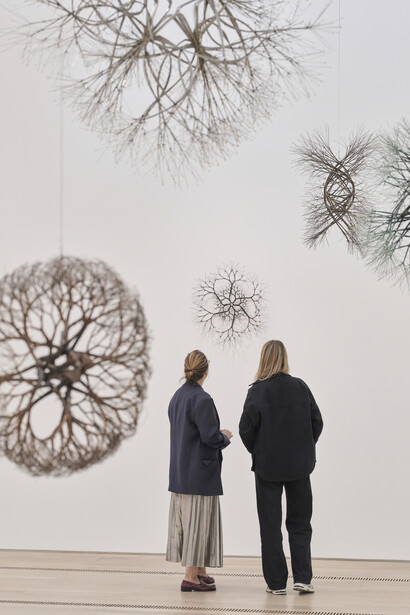
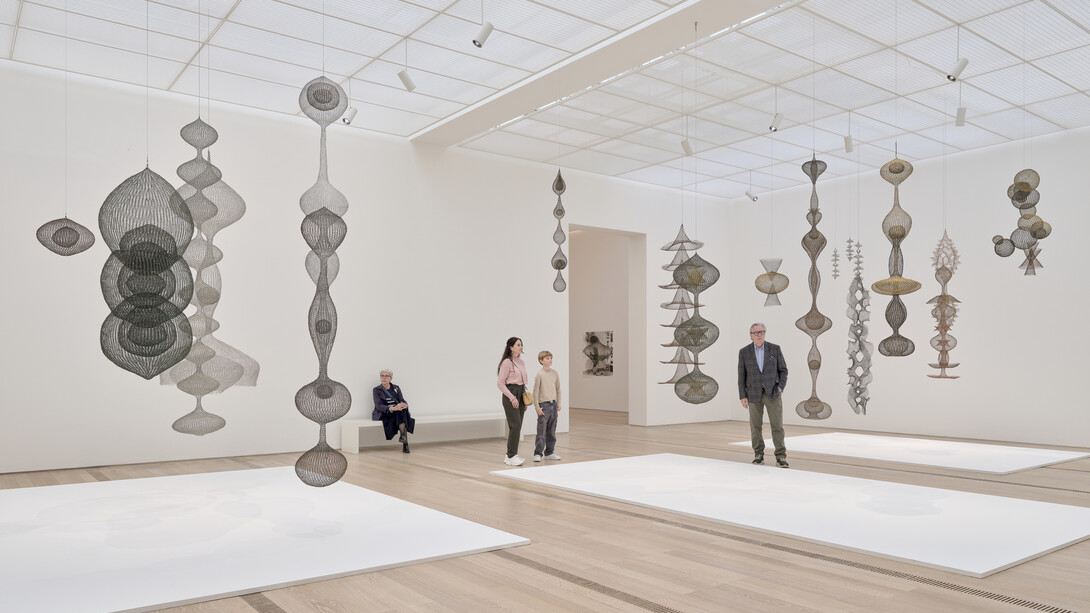
Her celebrated suspended wire sculptures represent one of the most original innovations in post-war American sculpture. Using a continuous looping technique, Asawa creates three-dimensional forms that appear to emerge from a single, uninterrupted movement of the hand. The thin yet resilient wire is worked into successive loops, generating concentric volumes, cavities, interconnected surfaces and structures that seem to expand organically into space.
At first glance, these works may evoke marine organisms, seeds, pods, flowers, nests or cellular architectures. This is no coincidence: nature was one of the artist's primary sources of inspiration. She observed its processes of growth, recurring geometries and invisible structures. Yet it would be reductive to interpret her sculptures as mere representations of natural forms. Asawa does not imitate nature; she investigates its underlying principles, translating them into an abstract visual language.
The result is a form of sculpture that cannot be reduced to its material presence. Its open structure allows light to pass through, casting shadows that become an integral part of the work itself. Emptiness is no longer a residual space, something left between one surface and another, but an active presence endowed with its own sculptural quality.
This relationship is precisely what makes Asawa's works so compelling. Viewed from different angles, their configuration seems to shift constantly: what initially appears solid becomes transparent, while what seemed to be a closed volume reveals a succession of inner spaces. Sculpture is no longer an object to be contemplated from the front, but a perceptual experience requiring movement, attention and time.
From this perspective, the distinctions between form and space, fullness and emptiness, interior and exterior gradually lose their meaning. The work behaves like an open organism, in continuous dialogue with its surrounding environment.
One of the most fascinating aspects of the retrospective is the opportunity it provides to appreciate the breadth of Asawa's artistic investigation, and to recognise how limiting it would be to identify her exclusively with her wire sculptures.
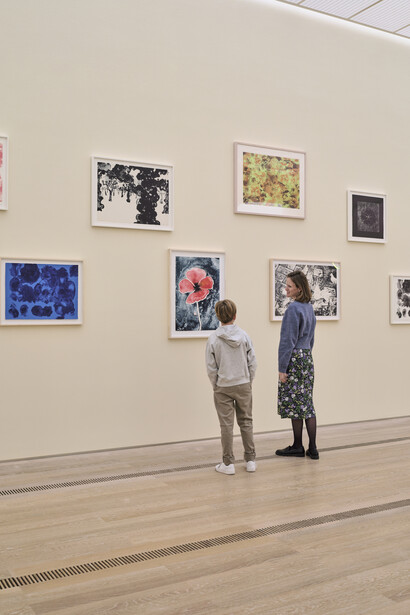
Drawing, in particular, constitutes a fundamental chapter of her production. Her works on paper, often characterised by fluid marks, repetitions, intricate patterns and organic configurations, are not simply preparatory studies for her sculptures. They possess an expressive autonomy of their own, revealing an approach to observation grounded in the continuity between gesture, rhythm and structure.
At times, the graphic mark seems to reproduce the very movement of the wire, while on other occasions it acquires an almost calligraphic quality. The relationship between line and surface becomes a field of experimentation in which the two-dimensionality of the paper is not a limitation, but a different realm of possibilities.
Alongside her suspended sculptures, Asawa also developed works using techniques of wire tying and weaving, in which forms take on an even more explicitly organic character. Roots, branches, plant systems and branching structures suggest a continuity between the natural world and the environments constructed by human beings.
Her experimentation also extended to bronze casting, painting, printmaking and works created through the folding of paper. Moving from one material to another never represented a rupture in her artistic research. Rather, it allowed her to explore how the same underlying principle could generate different outcomes.
Material, therefore, is never merely a support. It is the place where thought takes shape.
Perhaps the most significant dimension of Ruth Asawa's work emerges when we consider the relationship between her artistic practice and the social context in which it developed.
From the late 1960s onwards, she created numerous works for public spaces, including fountains, murals, monuments and commissions intended to become an integral part of everyday community life. At the same time, her interest in art education developed into a concrete commitment to widening access to artistic learning and promoting creativity as an essential component of both individual and collective growth.
Asawa did not conceive of the artist as an isolated figure, detached from society and ordinary life. On the contrary, she regarded creative experience as a possibility available to everyone, present in everyday gestures and the simplest activities. This conviction was also reflected in her devotion to her family and in her ability to integrate her artistic practice with the many responsibilities that shaped her life.
Her home and garden in San Francisco became places of experimentation and encounter, environments in which art, nature, education and personal relationships coexisted. Creativity was not confined to the studio, nor was it subordinated to the production of objects destined for museum collections. It was an attitude towards the world.
From this perspective, her public works acquire a particular significance. Sculpture leaves the protected environment of the gallery and enters everyday life, becoming an opportunity for encounter and participation. Art does not necessarily demand to be recognised as such: it can simply accompany people's lives, transforming the way they perceive the spaces around them.
The Fondation Beyeler retrospective allows us to appreciate the extraordinary relevance of an artistic investigation that, although rooted in the context of post-war American art, continues to engage with some of the fundamental questions of contemporary sensibility.
At a time when artistic production often seems driven by spectacle, monumental scale and the multiplication of visual languages, Asawa brings us back to essentials. A piece of wire, a sheet of paper, a surface to be folded or a material to be shaped can become the means of constructing an entire universe. There is no need to radically transform matter: one simply needs to learn to look at it differently.
Her work also invites reflection on the relationship between tradition and innovation. The technique of weaving, historically associated with craftsmanship and decorative practices, is freed from established disciplinary hierarchies and transformed into an autonomous sculptural language. Asawa does not seek to erase the distinction between art and craft through theoretical statements; she transcends it through the work itself, demonstrating that artistic value does not depend on the nobility of a material or the conventional status of a technique, but on the quality of one's vision and the depth of one's enquiry.
Her personal history, too, invites a broader interpretation. The experience of wartime internment, discrimination and the difficulties she encountered throughout her education belong to a biographical narrative that cannot be separated from the historical and cultural context of America. Yet it would be equally reductive to interpret her entire body of work through the lens of suffering. Her art is not simply a response to the injustices she endured; above all, it is an affirmation of freedom, curiosity and possibility.
In this sense, the lightness of her sculptures should never be mistaken for fragility. It is a lightness achieved through an intimate understanding of material, the precision of gesture and the patience of repetition. Each loop of wire depends upon the one before it and prepares the way for the next; every element contributes to the stability of the whole without losing its individual identity.
The Fondation Beyeler thus offers a valuable opportunity to rediscover an artist whose significance extends far beyond the acclaim surrounding her celebrated suspended sculptures. Through the diversity of materials and techniques, the exhibition presents the portrait of a woman who made creativity a form of knowledge and art a way of inhabiting the world.
Perhaps this is where the enduring quality of her work ultimately resides: in its ability to remind us that beauty is not necessarily something to be added to reality, but something to be recognised within it. All it takes is a moment to pause, to look attentively and to discover, in a simple piece of woven wire, the complexity of an entire universe.