English
 Español
 Français
 Deutsch
 Italiano
 Português
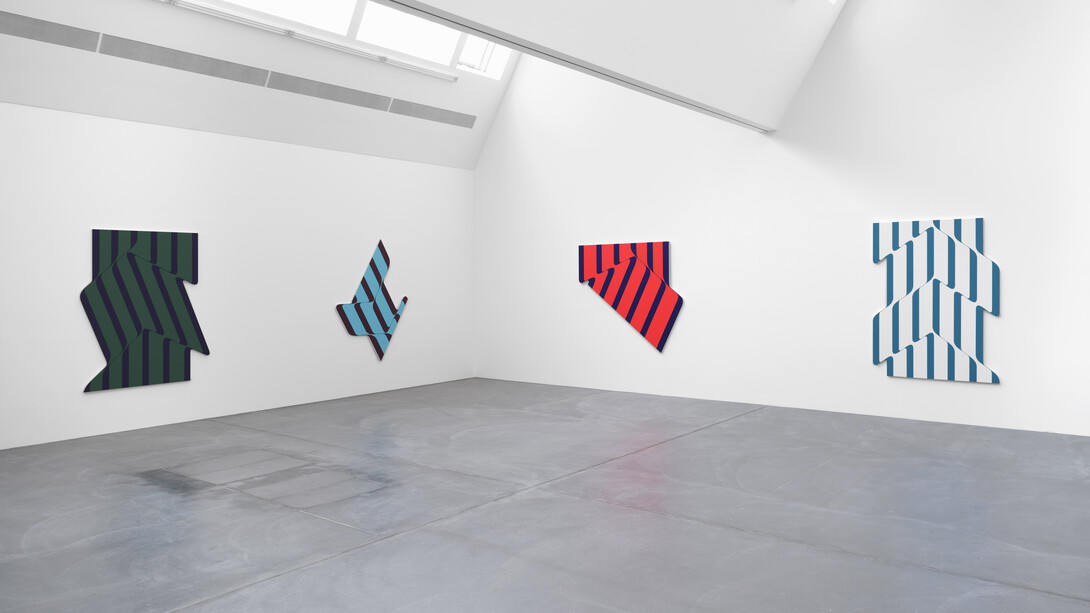
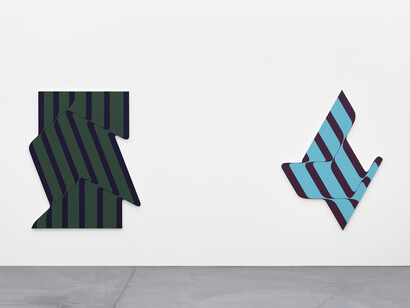
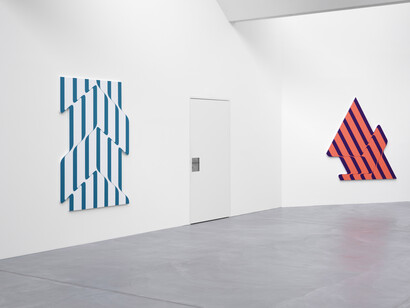
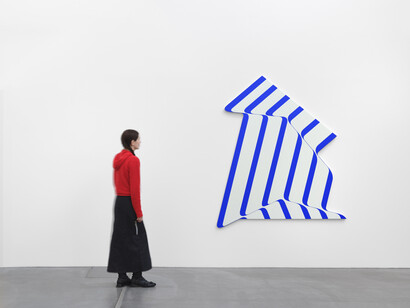
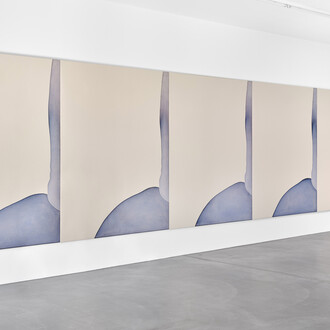
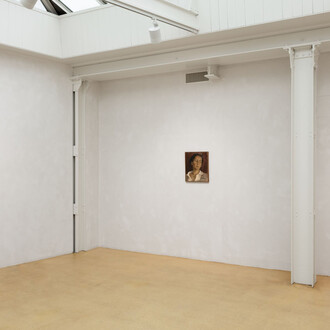
For his current exhibition, Headroom, Haggerty presents new works on shaped canvases in calibrated color combinations. Conditioned by the walls that hold them, the paintings respond in situ to the surrounding architecture, echoing its angles, interrupting its lines, and compressing into its formats.
Haggerty’s reduction has a lineage. Hard-edge abstraction has long treated simplicity not as withholding but as a proposal: a shape, a color, a line stated plainly enough that it stops describing anything else and starts operating on its own terms. That tradition often begins with forms observed in the world, such as a shadow, a gap between buildings, or a curve read off an ordinary object, abstracted until the source falls away and only the relationship of form to form remains.
Haggerty’s paintings work in a related register. The vocabulary is narrow, no more than six lines and two hues, but that narrowness is what keeps the paintings open.
Because so little is fixed in the image, nothing forces a single reading. A line spaced to recede can also read as advancing; a shape can be taken as an object, a gesture, or a frame, depending on where the eye enters and how long it stays. A line might be a contour or a fold, an edge held flat against the canvas or a form pulling free of it, thickening toward something almost sculptural before flattening back out. It isn’t always clear what a given line is doing or where it goes: whether it’s describing a shape or cutting through one, staying on the surface or leaving it. This is what keeps the work abstract rather than illustrative, not vague but genuinely underdetermined, offering enough structure to hold attention and just little enough information that the viewer has to finish the thought. That restraint leaves room for a painting to mean more than one thing at once, in a pared-back visual language where shape and color exert an immediate, physical force.