English
 Español
 Français
 Deutsch
 Italiano
 Português
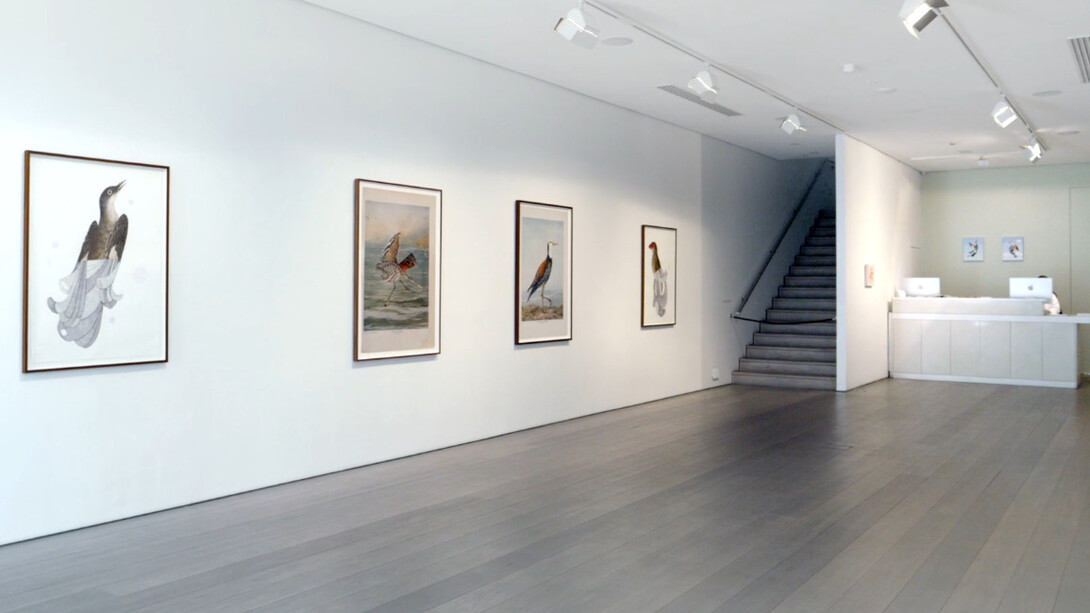
To collect, to dissect, to reassemble.
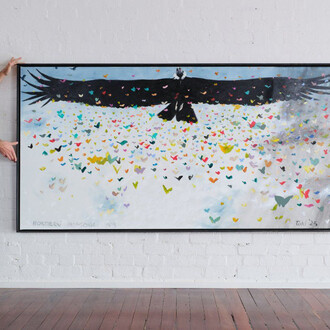
In the early years of the 20th century two movements were born. Collage as an art form in its own right, and birdwatching as a pastime rather than a bloodsport. Both are concerned with collecting and chance encounter, and both have been used to challenge existing norms.
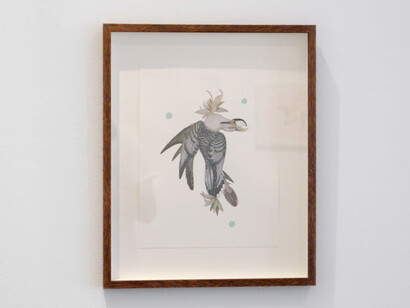
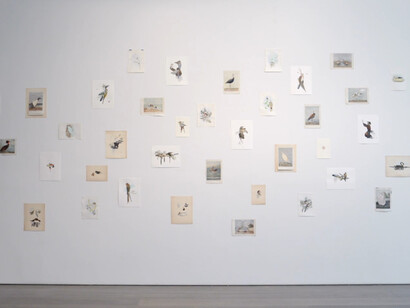
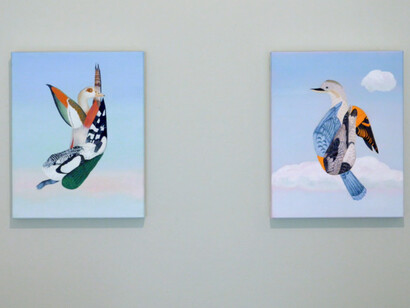
Work for the exhibition Anni’s birds began in 2025 during a two-month residency to the Josef and Anni Albers Foundation in Connecticut, USA. I knew before I went that I wanted to make collages that combined birds of North America with ones from Australia, a way of contrasting where I had come from with where I found myself. I just wasn’t sure how.
On our first day at the foundation, my partner, artist Peter Sharp, went exploring a local book barn while I remained behind, needing a little downtime to regroup. I asked him to see if he could find any books on American and Australian birds and he returned with two gems; American nature writer Neltje Blanchan’s 1898 publication Birds that hunt and are hunted, and Abram Rutgers 1967 publication Birds of Australia that features watercolour illustrations incorrectly attributed to John Gould; it was his wife Elizabeth who painted most of them.
The Gould’s original work was first published between 1840 and 1848 at a time when hunting birds and collecting their skins was considered a normal part of ornithological research. The beautiful colour and attention to detail in the illustrations so much admired can surely only be attributed to this practice. As the 20th century dawned though, sentiment began to change and the advent of the camera meant that bird enthusiasts, both amateur and professional, could ‘hunt’ birds with a lens rather than a gun.
This change in sentiment is reflected in the work of Neltje Blanchan whose book Birds that hunt and are Hunted is a poetic treatise on the ecological importance of the birds of North America. Her work celebrates their beauty and diversity and argues for the importance of preserving birds in the wild, rather than hunting them for sport.
‘Collage artists are, for the most part, collectors. They also tend to be sensitive to serendipity and consider the happenstance of stumbling onto material a driving factor for creation’.1 I allowed this to be my guiding principle, and working solely with the material that my partner had found for me, I set about tearing and cutting out the pages from both vintage books and removing each illustrated bird with surgical precision. It felt subversive. In fact, ‘subversion is at the core of collage. Collecting images, stripping them of their initial context, and pasting them into new compositions is [itself] an act of subversion.’2
While making the collages it dawned on me that the notion of taking something from one context and inserting it into another had correlations to the works of the Albers, who, as former Bauhaus artists and teachers, introduced radical and subversive ideas about art and art making to a new generation of American artists in the post-war years. It was not lost on me that the forming collages enacted a visual metaphor for notions of migration, the transmission of ideas, and the way new meaning is constructed from disparate sources.
The collages in this exhibition challenge you to consider whether what you think you know is the same as what you see. Collage creates a tension between its original and altered states, a frisson between known and unknown; like something on the tip of your tongue.
(Text by Michelle Cawthorn, September 2026)
Notes
1 Noelia Hobeika, ‘Collecting echoes: the poetic power of collage’, The art of collage vol. 2, Gestalten, Berlin, 2013, pp. 2-3.
2 ibid, p.2.