English
 Español
 Français
 Deutsch
 Italiano
 Português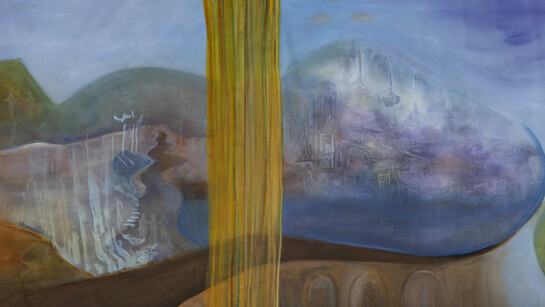
I was on the Manning River at the bottom swimming hole at the farm. There was this huge fallen tree structure about 60m tall. It was very grey. … we climbed over the top. On the other side was a huge bowl thing for skating and all these skaters at some point I felt it was dangerous to be there so I climbed back over. My friend stayed in the halfpipe and then this enormous tsunami came crashing down the centre of the pipe it was so loud and I could see all the water and I knew no one would have survived. The dreams along the river continued. I can’t remember what exactly but I remember walking up and down the river.
(Babette’s dream diary, March 15, 2026)
It’s been raining all week in Sydney. I am dodging pools of muddy water on my morning walk as I leave a response to Babette’s recent voice message. Despite the time difference in Paris, Babette immediately responds. It is 2.45am and she is still in her studio. She sends me a selfie with her visiting mum, Belinda, who is keeping her upright with avocado Ryvitas. I know Belinda. We met by accident in Perth, when Qantas cancelled our flights while in-transit to Paris. Ours is a friendship forged in the crucible of transit purgatory. In the transfer cab to the airport, we realised that I’d taught her daughter Babette art history at the National Art School. Over beers in Singapore airport, she rewarded me with several games of “Bush Rummy”, now a favourite card game that I will forever associate with that memory.
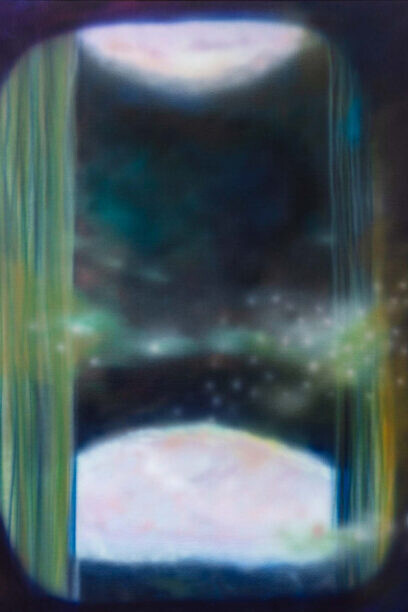
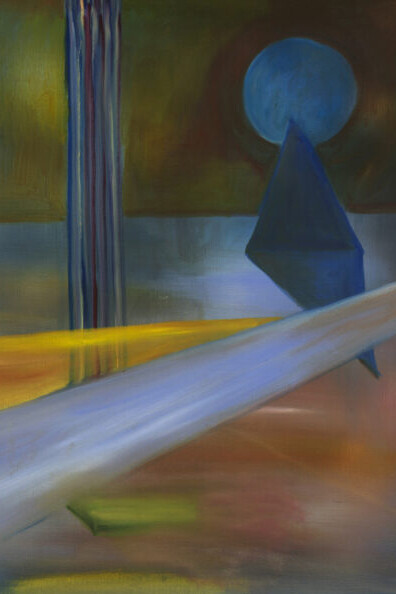
Babette’s dreamscapes are ethereal and earthly. They are interiors and exteriors. They are then and now and in-between. They are stylistically slippery, aesthetically hazy, subjectively porous. Forms that resonate with familiarity are stubbornly ambiguous. Obscured details require patient, forensic examination. The explicit dream symbolism and crisp illusionism associated with surrealist painters such as Magritte or Dali is completely ignored. In reality, dreams are more sensation than a film projected onto the back of one’s eyelids. Anyone who has dreamt of falling knows this intuitively, and yet dream spaces hold qualities that seem intrinsic. In “…the space of our dreams”, Foucault writes, “…there is a light, ethereal, transparent space, or again a dark, rough, encumbered space; a space from above, of summits, or on the contrary a space from below, of mud; or again a space that can be flowing like sparkling water, or a space that is fixed, congealed, like stone or crystal.”1
Recurring motifs in Babette’s dreams include waterfalls, caves, and carparks. These are cool, damp places full of shadows, and sometimes foreboding. The surrealists often cited caves and labyrinths as a reminder of the importance of myth and primitive instinct. Babette paints the atmospheres of these dreams at human scale, in portrait format, rather than landscape. The effect is immersive and the address is intimate. Waterfalls, caves, and carparks all evoke the vertical axes of terrestrial space, echoing Freud’s renowned iceberg model of the mind, as well as the passage of dream, from the dark recesses of the unconscious to waking life. For Babette, who is living in the slippage between Australia and France, and dream and waking life, the waterfall, which unifies two distinct planes through the language of water, is a particularly poignant emblem.
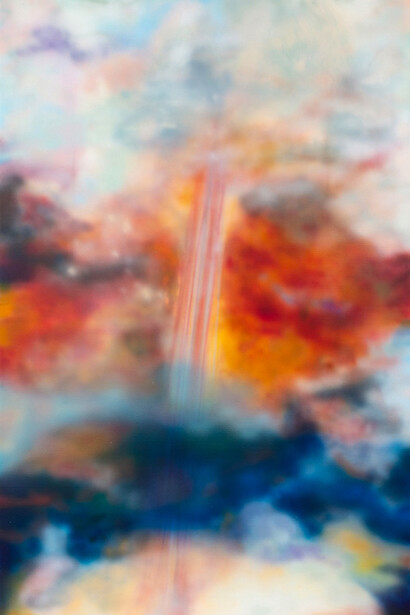
“The dreams along the river continued.” Water unifies the exhibition. The title “And her hallway moves like the ocean” is a lyric borrowed from Flood I, a favourite studio jam by The Sisters of Mercy. The song continues, “At the head of the river, At the source of the sea… Dream of the flood.” Leonora Carrington’s painting Elements (1946), which merges the four classic elements (earth, air, fire, water) with alchemy, cosmology and mythology, is the inspiration behind Babette’s monumental diptych, I pulled out the vials of paints… (2026). It mirrors Carrington’s mystical landscape, in which mountains, forests, caverns and sea are interlaced across the canvas in the impossible contiguity made famous by Flemish Renaissance painters such as Bosch and Bruegel. Of the elements, the philosopher Gaston Bachelard writes in Water and dreams (1941) that, “Water is truly the transitory element. It is the essential, ontological metamorphosis between fire and earth.
A being dedicated to water is a being in flux. One cannot bathe twice in the same river because already, in his inmost recesses, the human being shares the destiny of water.”2 Babette dreams of the river because the river weaves Burrel Creek, Lismore, and Paris together. The river is always changing as she is always changing. At an atomic and cosmological level, she is never in the same place more than once.
This morning/night, awake/asleep, here/there, Babette is with her mother. In Civilization and its discontents (1929) Freud wrote about ‘oceanic feeling’, a primitive trace of infantile consciousness, prior to entry into language and culture. It is a nostalgia for the symbiosis that binds a mother and child through the womb. It is a profound sense of cosmic oneness; it is an extreme form of homesickness.
(Text by Jaime Tsai)
Notes
1 Michel Foucault, ‘Of other spaces,’ trans. Jay Miskowiec, Diacritics 16, No. 1 (Spring, 1986) 23.
2 Bachelard, Gaston. Water and dreams: an essay on the imagination of matter. Dallas: Pegasus Foundation, 1983. 6.