English
 Español
 Français
 Deutsch
 Italiano
 Português
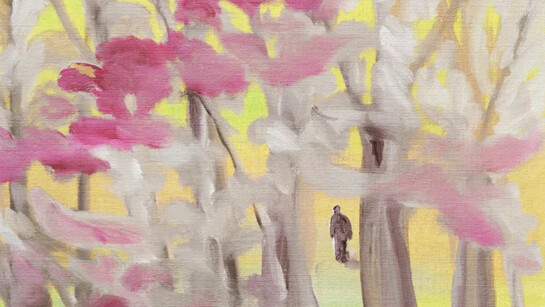
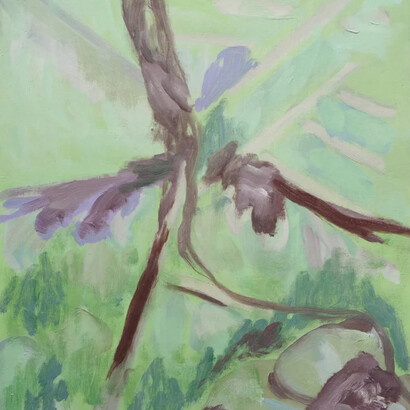
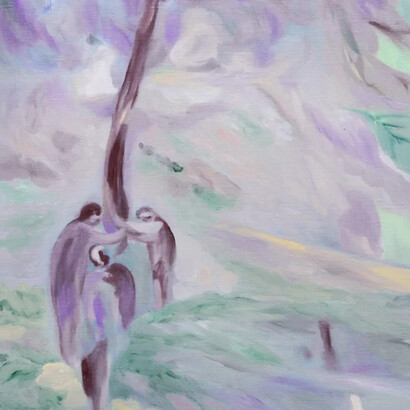
I am often asked about a drawing or a painting: where is this landscape from? Is it of some particular place I have travelled to, or somewhere I have walked? And there is never an answer to this question. One thing I like about a drawing is that it is never about a place, even when it looks like a landscape.
Then I have to answer that this is not a drawing of a particular place – even though I love moving through a landscape, and looking at landscapes while on the move always affects the way you think and what you make. It leaves traces in your mind. So, is this an imagined place? Yes, of course. And I would have to add – all landscapes are imagined. That’s why they are very real. Imagination is the movement of mind.
In her essay On imagination, the poet Mary Ruefle writes about a conversation with the poet Michael Burkard, who says that he likes to think of imagination “as ‘spooky behavior over long distances,’ which is how scientists describe those electrons that respond to each other though far apart. […] You can feel its presence.”
Imagination is happening to everyone – if you let it in. And out – then it gets a form and goes on existing in someone else’s mind. It doesn’t belong to anyone; you cannot own it or cage it. And at the same time, it is me, but also you, and anyone else. It circulates through everything.
There are moments when I can feel it as something almost physical, even before it becomes a work. A work does not begin with a sudden happening. What reveals itself in it, call it imagination, or thought, or presence, circulates through my whole body and mind, responds to something inside and outside of me, and takes a form in its own time.
This inward and outward movement is never-ending. There is something in my hands that’s connected to that presence in and outside of my mind; the imagination, the substance of thought, is moving, responding to the material I’m working with and to my hands, and revealing itself. That’s what it is.
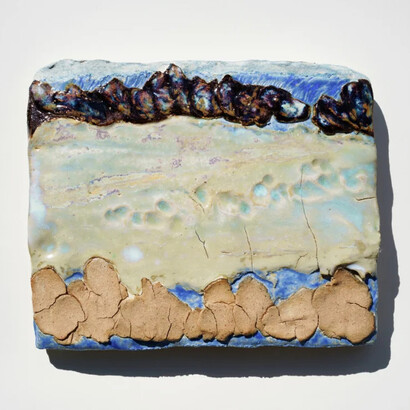
Some drawings appear in a few minutes; some can remain there for days, beside the painting I’m working on, and I add to them, and at some point – that’s it. A ceramic sculpture or relief can emerge in a few movements, or it can move and change, one into another, until something emerges and stays. But even then, in my mind, it still keeps moving.
About seven years ago, I stayed in the mountains overnight, in a tent by a wetland. It was in May. And then, in the dark, the air was filled with those sounds, surrounding me and everything. It sounded like some peculiar electronic music, or that’s how thousands of little alien spacecraft might sound when talking to each other. They were frogs, of course. I went out to walk a bit along the water, and there, in the distance, was a little tent twinkling in the dark – as if responding to these sounds. A little star or a planet, shining thousands of light years from me; we were both in open space.
It came to my mind, that little tent shining in the dark of the mountain wetland, when I was reading “The Summer Book” by Tove Jansson again. There is a story in it, titled “The Tent,” in which Sofia, a little girl living on a little island with her grandmother and father, goes out to spend the night in a tent, all by herself. Surrounded by the trees, and the sea, and all the birds and creatures out in the wild. This time, reading the story, it came to me – that’s it, that’s what imagination is. It is this tent, through which all the sounds, close and distant, come and go, surround and move through. I am inside this tent, and outside of it. And you become the “everything” that surrounds you, the presence – indivisible.
(Text by Elena Tutatchikova)