English
 Español
 Français
 Deutsch
 Italiano
 Português
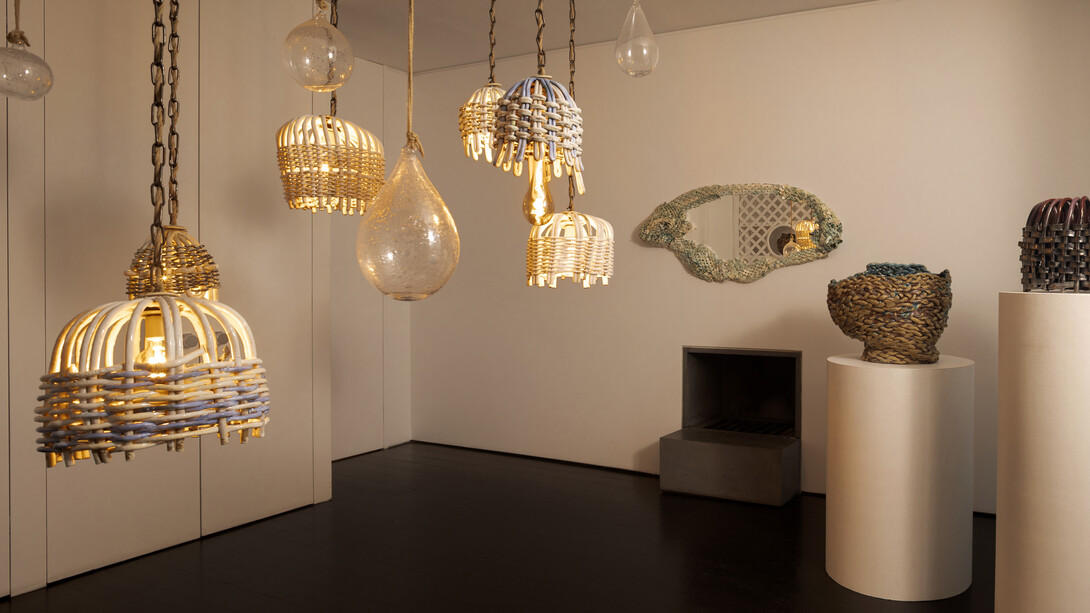
The Future Perfect presents Lasting radiance by Anina Major at the gallery’s West Village townhouse, opening November 3, 2026. The artist’s first solo presentation in New York City, the exhibition extends Major’s language of plaiting into collectible design, bringing together functional and sculptural works that illuminate, reflect, and occupy a domestic interior while keeping the hand at the center of her practice. Lasting radiance argues that brilliance persists even when it is briefly obscured: radiance can be reflected or eclipsed, but never diminished.
The exhibition opens weeks after Anina Major: the sacred mangrove at Pérez Art Museum Miami (PAMM), her most significant institutional presentation in the United States to date, on view through August 1, 2027. It also follows Soon come home, her solo exhibition with Tern in Nassau (on view through October 26, 2026) and coincides with the gallery's presentation of her work at Art Basel Miami Beach (December 2 - 6, 2026). Where the PAMM installation expands Major’s tower forms into an immersive landscape, and Soon Come Home turns Tern’s gallery into a living archive, Lasting radiance turns to the scale of the domestic interior.
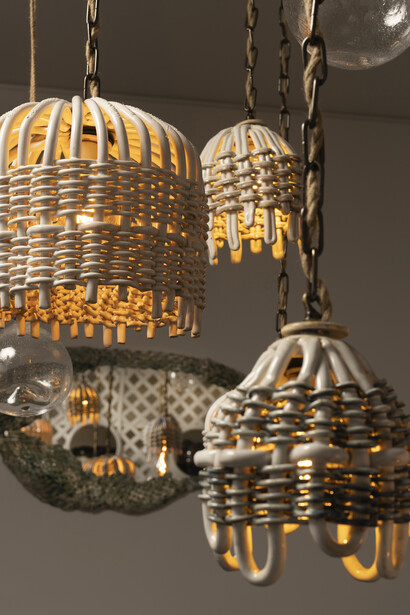
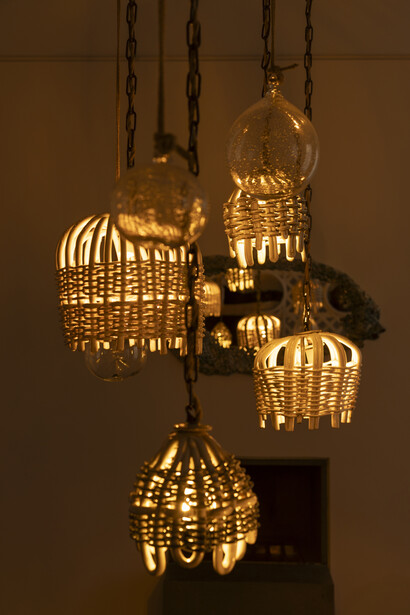
At the center of the exhibition is Tears of a light catcher, a large-scale suspended constellation of six woven ceramic light structures accompanied by hand-blown glass drops. Constructed from glazed and stained stoneware incorporating melted sea glass, the work recalls the crowded ceilings of Caribbean tourist marketplaces, where handcrafted objects gather overhead. Light passes through the woven structures and reflects across the bubbled, teardrop-shaped glass, casting an interplay of illumination and shadow. The work brings luminosity and vulnerability into conversation, suggesting that fragility and brilliance are not opposing conditions.
Positioned above the townhouse fireplace, Seen is a sculptural mirror whose glazed stoneware frame loosely follows the outline of New Providence, the Bahamian island where Major was born. The island’s contours also suggest the shape of an eye, bringing geography into dialogue with perception. While the eye directs the gaze outward, the mirror returns it, allowing the viewer to become both observer and subject. Within the contours of the island, the act of seeing oneself becomes inseparable from the question of where one sees from. The piece blurs the line between viewer and subject, and turns the everyday act of looking in a mirror into an act of appreciation.
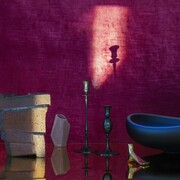
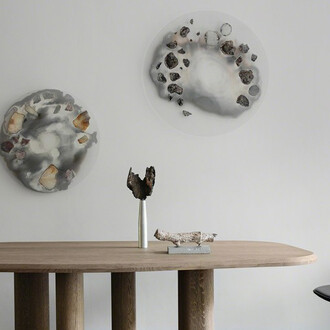
Along the shelving, sculptures sit within individual alcoves, including Salt water tears, Poured at the root, Black sun, and Wounds into silver. Arranged as a connected sequence, the works draw upon poetic imagery of tears, celestial bodies, transformation, and renewal. Their presentation invites viewers to encounter each sculpture individually while discovering relationships across the larger composition.
Major also cites Salvador Dalí’s Mae west room as a reference for the exhibition’s playful relationship between sculpture and domestic space. Rather than treating the interior as a neutral setting, Lasting radiance allows individual objects to enter into dialogue, creating an environment in which the boundaries between artwork, furnishing, and architecture become increasingly fluid.
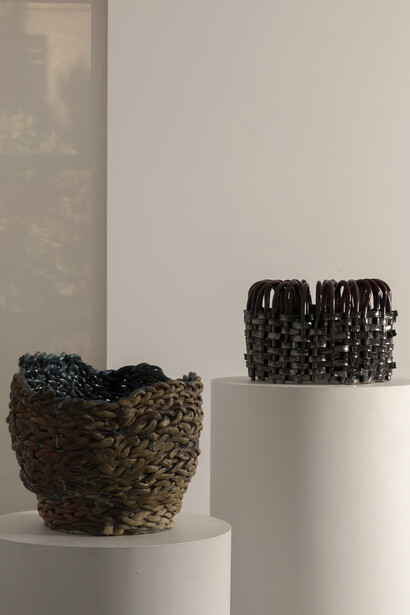
Rooted in the Bahamian tradition of palm-leaf plaiting, a practice Major learned from her grandmother, straw weaver Saphora Newbold, her work translates inherited gestures into enduring sculptural forms. Through clay, glass, and light, Lasting radiance carries this material language into new relationships with function. The exhibition proposes that objects need not relinquish their sculptural or conceptual significance to become part of everyday life. Instead, their proximity offers new possibilities for intimacy, recognition, and appreciation.
“I've always been interested in the relationship between what we make, what we value, and what we choose to live with. My grandmother's weaving was both useful and beautiful, and that understanding continues to inform my practice. With Lasting radiance, I'm exploring how sculpture can become part of our everyday encounters with light, reflection, and ourselves. There's something powerful about creating objects that not only occupy a space but change how we experience ourselves amongst them,” said Anina Major.
"Anina's work carries the hands and histories behind it, you can feel generations of craft in every piece, even when the material is clay and glass rather than palm leaf. Showing it in this townhouse, in rooms with a fireplace and shelving rather than white walls, lets people experience what her collectors already know: these pieces aren't meant to be admired from a distance. They're meant to be lived with, touched, used, and returned to every day," said Laura Young, Managing Director of The Future Perfect.