English
 Español
 Français
 Deutsch
 Italiano
 Português
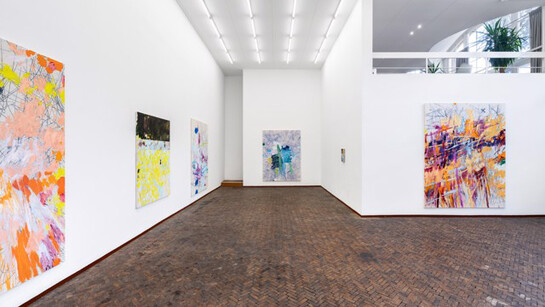
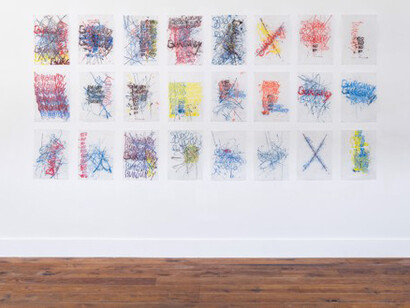
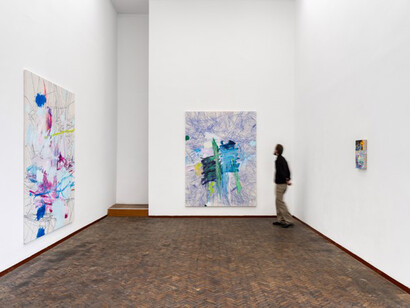
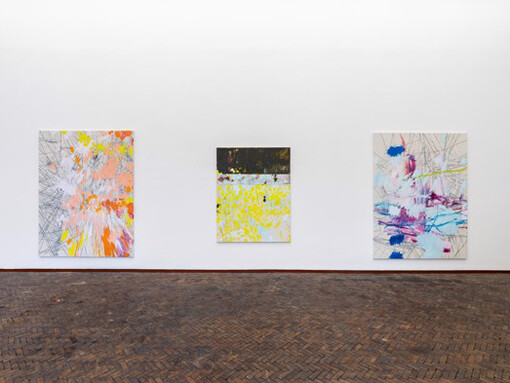
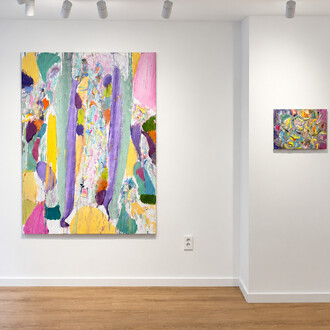
Energy – the first thing that comes to mind when looking at Lotte Wieringa’s paintings is energy. Explosive energy, simmering energy, emotional energy: something clearly wants to burst out. Wieringa usually begins her canvases with an underlayer of intense blue scratches, over which she applies bold, abstract brushstrokes in various colours. Her style is sometimes described as ‘mark-making’, a term that suggests leaving traces or, figuratively, making one’s mark. As a viewer, you sense – you know – that for Wieringa, these marks are the expression of deeply felt emotions. At the same time, the source of those emotions remains out of sight – and it does not matter anyway. Precisely because Wieringa limits her compositions to energy and colour – sometimes deep red, at other times vibrant orange or soothing soft blue – there is ample room for viewers to make that energy their own. To share energy.
It is for this very reason that Staying with the Trouble is such an apt title for Wieringa’s first solo exhibition at Gerhard Hofland. The phrase refers to a book by the philosopher Donna Haraway, in which she argues that we must move away from the so-called Anthropocene and the worldview that places humanity at the centre of everything. According to Haraway, this idea is responsible for much of the evil we see today and we should instead look further afield: at the ways in which humans can forge the deepest connections with the surrounding world – with nature, with non-humans, with the universe, with the Earth. At the heart of Haraway’s argument is the idea that we and all other organisms on the planet are part of the same creation – and that, consequently, we have no choice: there is no alternative but to allow ourselves to be immersed as fully as possible in the power of that entire creation. It is a book written ‘with love and rage’, as someone once put it.
This same ‘love and rage’ can be seen in Wieringa’s canvases. Her previous series was dominated by deep red, as if the canvases had been pulled from within her body. The works at Gerhard Hofland are lighter, more outward-looking. It is no coincidence that Claude Monet’s late Giverny canvases, in which he explored the connections between art, nature and humanity, were a major source of inspiration for Wieringa’s series. Like Monet, Wieringa seeks to sweep viewers up in the sheer intensity of the moment through a combination of colour and nature and composition. For Wieringa, these paintings are not an escape, but rather a deeper, more intense experience of the here and now. It is precisely by refusing to deny the ‘trouble’ and instead looking it straight in the face that we open up space for intense colours, shimmering light and new perspectives. New energy. For Wieringa herself, but also for the viewer.
(Text by Hans den Hartog Jager)