English
 Español
 Français
 Deutsch
 Italiano
 Português
As I write these lines, I have no idea what to expect from Lionel Estève’s exhibition at Guillaume’s (Stems Gallery). Since his first exhibition with me in 1999 (we have done 10 together, counting only the solo shows), he has questioned his work with each new exhibition, and each one has come as a surprise to the viewer. Few artists are willing to take the risk of constantly reinventing themselves.
I am not a critic and I am not going to analyse his work…others will do that. But is it importan to stress that Lionel Estève is a visual artist in the fullest sense of the term, working with an extraordinary range of materials and media: stickers, plastic balloons, slides, stones, pebbles, guitar strings, glass gold leaf from Provence and Tuscany, paper, etc. This constant movement between painting and sculpture is what makes him such an original and distinctive artist.
It is also worth pointing out that Lionel Estève, a well-known artist of a certain age who has exhibited with galleries of a certain generation, is taking a risk by showing in a young gallery alongside young artists. The gallery is taking a risk too, stepping outside its usual image to take on the challenge.
(Albert Baronian)
The recollective quality of Albert Baronian’s commemorative tribute to the extensive oeuvre of Lionel Estève appears remarkably fitting to the artist’s debut solo exhibition at Stems in Brussels (BE) considering Souvenirs de Bruxelles pays homage to his sentimental affinity with the capital, manifesting as a phantasmagoric apparatus examining the reminiscence garnered by his frequent departure.
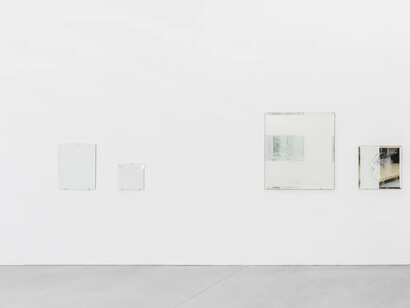
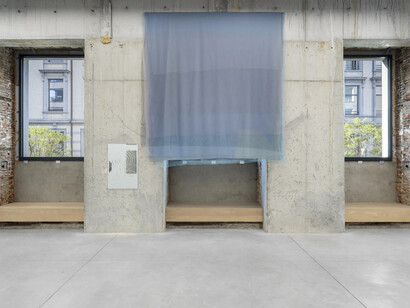
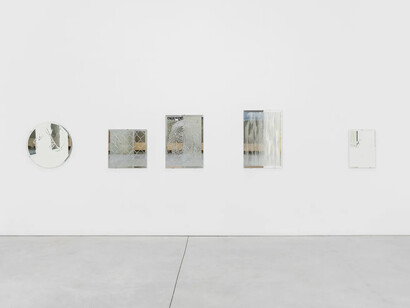
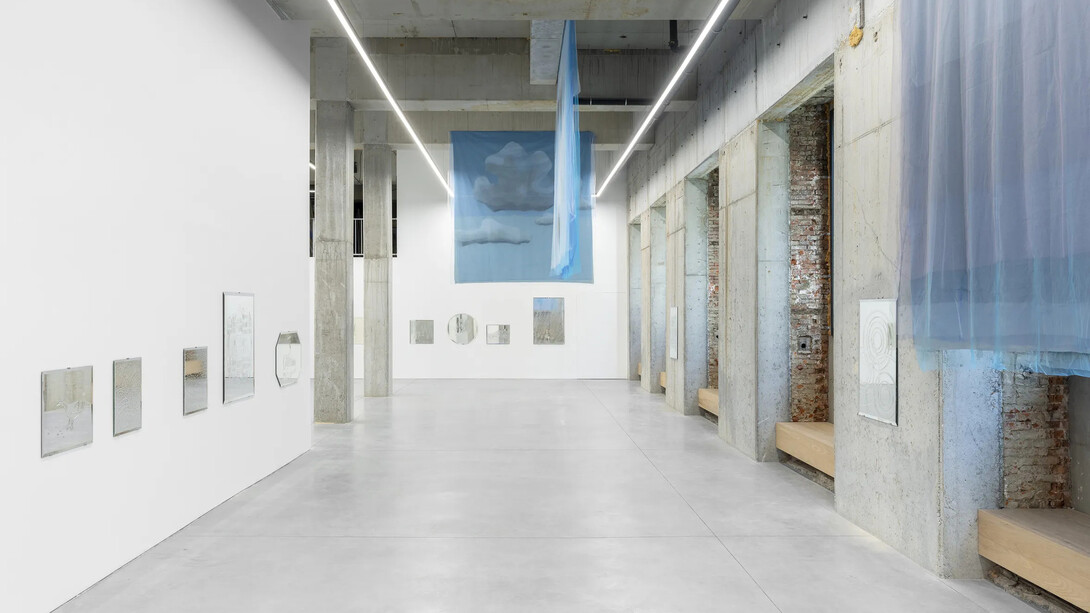
Together with layered swathes of blue hued tulle netting cast in a spectrum of gradients adorning the upper architecture of the gallery, evoking the illusion of a descending watercolour painting and the particular fragility inherent to the city’s ever changing but usually wet meteorological terrain, the exhibition is comprised by a linear sequence of 34 mirrors whose surfaces embossed with quotidian images and those associated with the iconography of the Belgian capital, provide a tangible landscape for the atmospheric mood initiated above.
Neutrally aligning disparate motifs where universal sightings such as Voiture (car) and Chien (dog) are synonymous with images eminently affiliated with Belgian identity in Grand-place, Estève extends this consummation by wryly democratising the tyrannical King Leopold with Pigeon (pigeon) and Danse (dance), whose illustration in charmingly Belgian comic strip fashion serves to parallel the diverse, satirical and unpretentious appeal Brussels conjures.
Spelling a constellation of associations that recall the arbitrary nature of how our memories assign images to a particular place, the variety of bevelled mirrors of distinct character and design afforded to those traded at the beloved Jeu de Balle market in Marolles: a cultural micro climate atypical of Bruxellois “souvenirs” themselves, reinforce this playfulness by accumulating a rhythm consequence of their collective alignment to depict a skyline or musical score.
If the cadence of Souvenirs de Bruxelles is constituted by a tempo that pulsates the viewer into an immersive emporium of reflections, emitting segments of drawings in neighbouring mirrors, partial sightings of visitors and glimpses of architecture that has itself been intercepted by meters of hanging tulle, conjointly intervening, contributing and defining the characterisation of experience, then the beat of the exhibition, summating a montage of fragments in flux that objectively captures how consciousness is perpetually constructed and reinstated, indicates that the structure of that rhythm unfolds by way of Mallarmé’s “Un Coup de Dés jamais n’abolira le hasard”; a revolutionary work of avant-garde literature whose words cascade irregularly like a cerebral musical score across double paged spreads in multiple typefaces, faithfully demonstrates how mental activity proceeds.
Simulating the movement of waves that abstractly narrates the event of a shipwreck, the poem is generated by liberal amounts of white space Marcel Broodthaers effectively describes as “modern space” by design to simulate silence and isolate thought, an aesthetic disposition that can be felt across the vast gallery walls separating the melodramatic tones of tulle that emulate an incoming storm and the chanced encounters of motifs and reflections encapsulated by the mirrors, notably Vent, Pluie moyenne and Ronds dans l’eau suggesting that if Mallarmé declares, “a throw of the dice will never abolish chance”, Estève believes a throw of the dice will never abolish the chance of rain in Brussels.
Aptly referenced in Un coup de dès, noted on a page torn from a Tin Tin-esque writing pad, which in the context of consciousness brings forth the ancient manuscript of the Freudian palimpsest, transcended by the omnipresent layers of lightweight open mesh netting and the effect of the technique by which the drawings are applied; appearing organically forged by rainwater, the images collectively evoke the memory of a time that hasn’t yet passed, held in reserve of their not happening or retained in the approach route of their potential to take place, sobering the modest wit of their style to an ethereal mark making of soft apprehension.
Serving as an enquiry into how impressions permeate the subconscious and manifest retroactively to shape our notion of habitat and sense of belonging, Souvenirs de Bruxelles prevails in the porous realm of transit, a theme prominently professed by Dick Annegarn, whose wistfully melancholic, folk-blues anthem “Bruxelles”, conjuring a grasping to a fading nostalgia of the city, delivers a superlative melody to the gentle formation of reminiscence Lionel’s Estève’s exhibition encompasses.
(Text by Charlotte Norwood)