English
 Español
 Français
 Deutsch
 Italiano
 Português
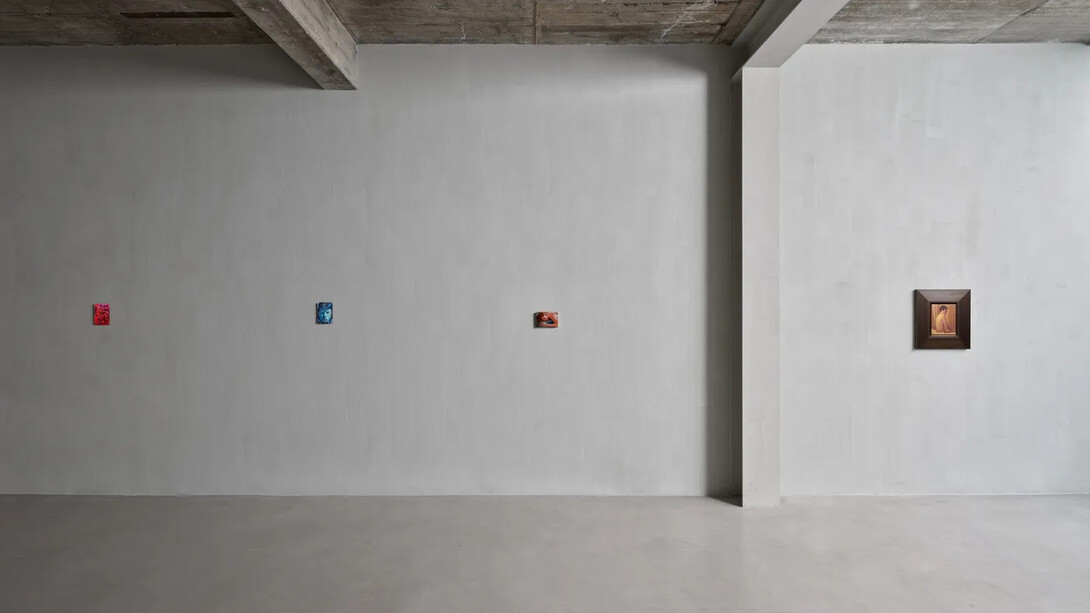
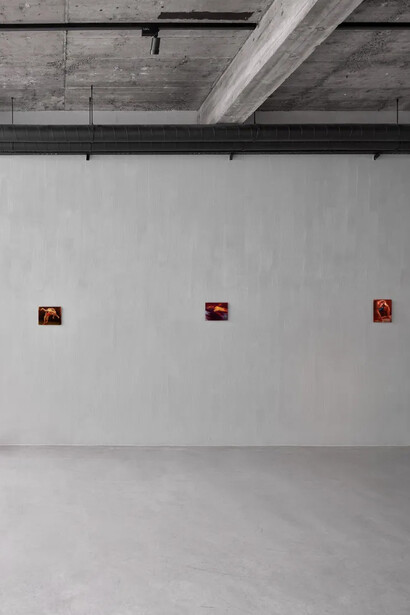
Light does not simply fall upon Caleb Hahne Quintana’s newest paintings; it appears to emanate from within them. Across the small copper supports at the centre of Don’t get lost in heaven, passages of exposed metal flicker through layers of umber, ochre, violet, and earthen red, producing a luminosity that seems to sit somewhere between surface and image. Copper becomes more than a support: its glow complicates what we see, making the material itself continually perceptible beneath the illusion of painting. Like memory, it remains present even where it has been covered over.
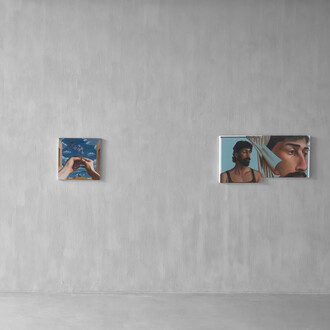
Newchild is pleased to present Don’t get lost in heaven, Quintana’s first solo exhibition with the gallery. Moving between portraiture, landscape, still life, and scenes of collective experience, the exhibition considers youth as a state of suspension—a period in which vulnerability can coexist with a profound sense of invincibility. Its figures swim, smoke, gather, wait, and move through landscapes that oscillate between the familiar and the uncanny. They belong to a world of adolescence and early adulthood in which consequence can still feel distant, and where the boundaries between freedom, recklessness, desire, and danger have not yet fully settled.
In American spirit, a young figure fills almost the entire copper plate. A cigarette hangs from the mouth beneath a narrow band encircling the forehead, while the face emerges in cool blue-green tones from an otherwise darkened field. The title invokes both a brand of cigarettes and a wider mythology of American independence, counterculture, and self-invention. Quintana draws from a wide range of source material, including images of youth subcultures, rock music, hippie culture, and Vietnam-era protest, as well as candid photographs he takes of strangers encountered in everyday life. These images often emerge from fleeting, unguarded moments that, through painting, acquire a poetic charge. In American spirit, that broader cultural history is compressed into an intensely private portrait, where collective ideas of youth and rebellion are filtered through the intimacy of a single face.
The precariousness of this period recurs throughout the exhibition. In Rapture, a swimmer is suspended within reddish water, the body illuminated by fiery orange and violet reflections that travel across the surface. An ordinary physical act becomes strangely unmoored. The swimmer appears simultaneously immersed and weightless, held somewhere between propulsion and surrender. The work carries something of the exhibition’s central proposition: the exhilaration of believing oneself impervious to consequence, alongside the latent knowledge that such states cannot be sustained. The title Don’t get lost in heaven similarly resists a singular reading. Heaven might suggest transcendence or ecstasy, but also disappearance—a state of elevation from which, like Icarus approaching the sun, one risks not returning.
Elsewhere, suspension becomes quieter. In I do not know the difference between expectation and waiting (Twins), two long-haired figures sit with their backs to the viewer, leaning into one another before an open field. Their bodies merge into an amber atmosphere in which hair, landscape, and the exposed warmth of the copper seem almost continuous. The distinction proposed by the title—between expectation and waiting—is never resolved. Instead, the painting lingers within that uncertainty, describing a moment whose significance may only become apparent retrospectively.
Such psychologically ambiguous images emerge from Quintana’s broader engagement with memory. His practice frequently begins with drawing, which he has described as an extension of language and a way of reacting to and reflecting upon the world. His visual vocabulary draws upon personal experience alongside his upbringing in Colorado, his Mexican heritage, and his family’s histories of migration and assimilation. Rather than treating these histories as stable narratives, Quintana works through their gaps and inconsistencies: memory becomes a mutable space in which lived experience, inherited stories, imagination, and recollection continually overlap.
This uncertainty is particularly evident in Where this is I am, wherever I am this is. A seated young man is partially obscured by a vase of flowers that occupies the painting’s foreground. Portrait and still life are given nearly equal weight: the figure retreats into shadow as flowers press forward into the viewer’s space. The work refuses a clear hierarchy between subject and surroundings, suggesting instead how objects, interiors, and incidental details can become inseparable from the memories attached to them. Quintana has repeatedly elevated such quiet, everyday moments within his work, using intimacy and observation as a means of approaching broader questions of place and belonging.
Material is central to this new body of work. Quintana prepares the copper through sanding and the application of garlic before establishing his initial layers of paint, engaging methods with historical precedents in painting on metal. The support’s smooth, non-absorbent surface permits both precision and saturation, yet Quintana does not attempt to disguise it completely. Copper is allowed to shine through hair, flesh, sky, and water, at times seeming to illuminate an image from behind. The resulting paintings remain insistently physical objects: the viewer moves between looking at the copper and looking into the world painted upon it.
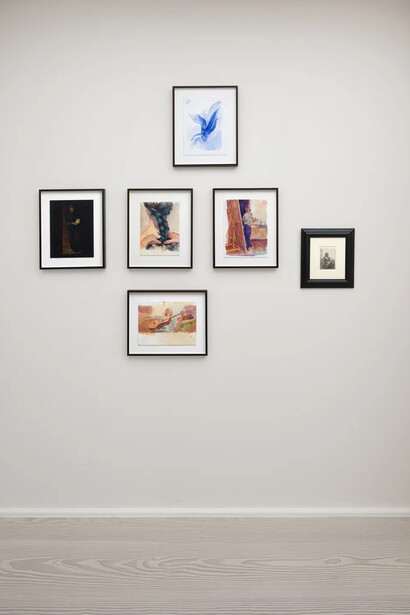
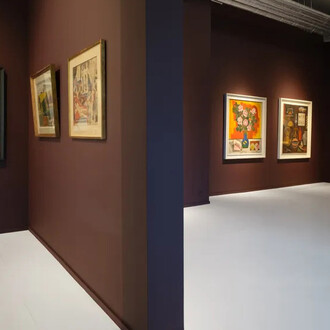
This attention to material history is extended through the presentation of Quintana’s paintings alongside a small group of Old Master works by Rembrandt van Rijn, David Teniers, and Frans Francken I. The pairing is not intended to establish direct equivalences, but rather to make visible the persistence of certain pictorial concerns across time: luminosity and darkness, compressed psychological space, the expressive potential of small scale, and the ways in which a support can determine the character of an image.
Among them is Rembrandt’s Saint Jerome kneeling in prayer, looking down (1635), a first-state etching in which the saint appears in contemplation with the lion traditionally associated with him just behind. Unlike representations that emphasise Jerome’s identity as a scholar, Rembrandt presents an austere, inward figure absorbed in a private psychological and spiritual state. Installed in proximity to Quintana’s paintings, the small etching offers a historical counterpoint to their own moments of interiority.
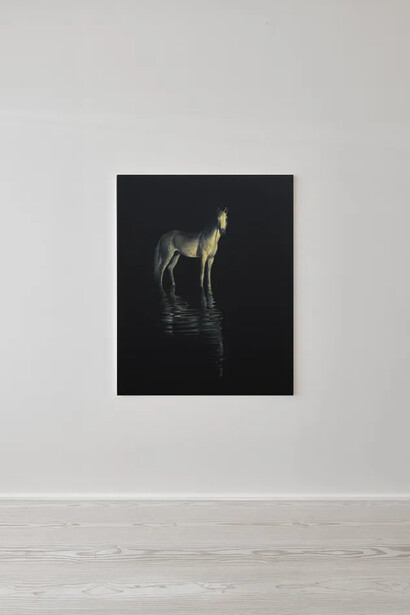
In A man named equus, a near-naked figure moves across a dark body of water, illuminated only partially as his reflection trembles beneath him. The surrounding field approaches near-total blackness, leaving body, water, and reflected light as the painting’s few points of orientation. Like the figures throughout Don’t get lost in heaven, he appears caught in passage—neither fully arriving nor departing.
Across the exhibition, Quintana returns to these unstable intervals: between adolescence and adulthood, recollection and invention, intimacy and estrangement, immersion and flight. His subjects rarely announce what has happened immediately before or what will follow. Instead, they occupy the charged moment in between. Copper glows beneath them as both matter and metaphor—a persistent light underneath the image, much as the past persists beneath the experience of the present.