English
 Español
 Français
 Deutsch
 Italiano
 Português
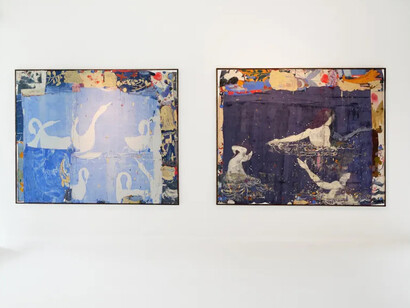
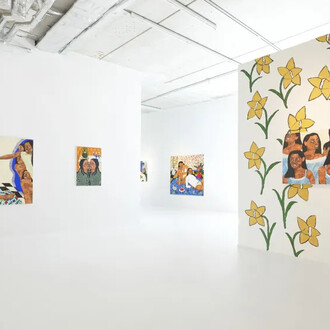
In Then and again, Gommaar Gilliams explores how meaning can emerge through repetition. Certain figures, motifs and symbols appear again and again throughout his work: birds, swans, stars, boats, bathers, horse riders and fish. For Gilliams, this repetition is closely connected to the way stories and cultures develop. For centuries, images and symbols have been passed down and reinterpreted in an attempt to better understand the world and ourselves. From myths, fables and allegories to astrology and heraldry, images gather meaning through repetition and become part of our collective memory. This idea relates to what art historian Aby Warburg described as the survival of images: the way certain motifs continue to appear across different periods and cultures, taking on new meanings each time.
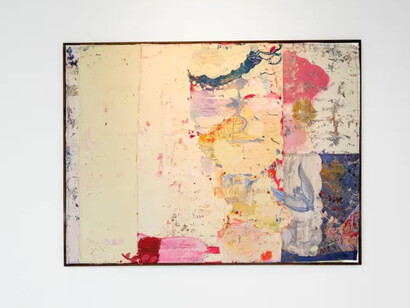
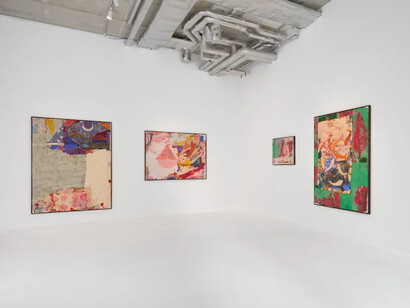
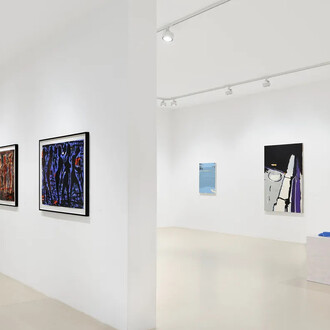
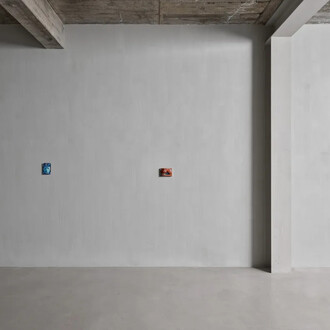
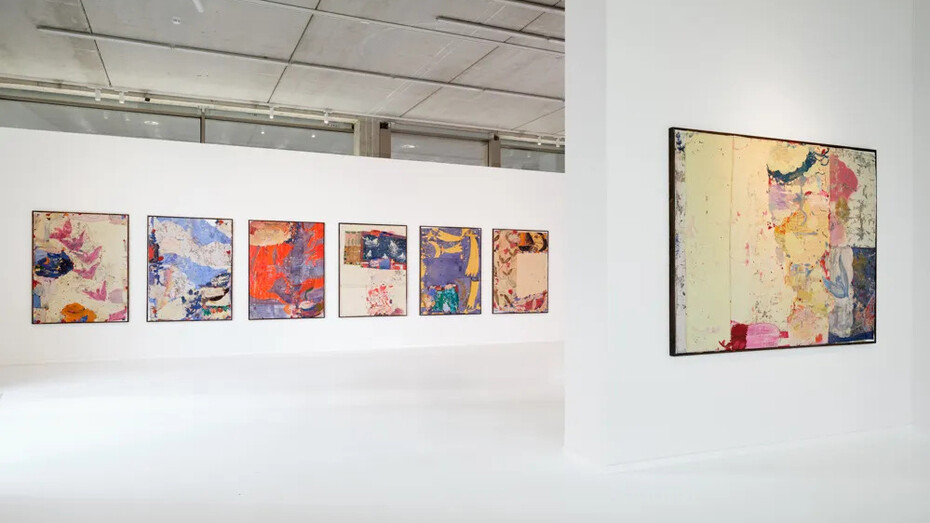
Drawing on this visual memory, Gilliams builds his own visual world. His references range from medieval Italian painting and miniatures to the visual traditions of Persia, India and Central Asia, as well as the cultural exchanges that took place along the historic Silk Road. He does not tell clearly defined stories, but rather refers to the idea of storytelling itself. His recurring motifs form something close to a personal visual alphabet, in which recognisable symbols refer to a much larger history of images. Connections can be found with artists such as Joaquín Torres-García, who sought to create a universal visual language through simple symbols, and Cy Twombly, whose work brings together signs, mythology and personal associations. A boat remains a boat and a bird remains a bird, but their meaning changes depending on the context in which they appear and what we, as viewers, bring to them. In this new series, Gilliams takes this visual language further. Large, sometimes almost monochrome areas of colour are given more space, without ever being truly empty. Seams, changes in colour and traces of paint remain visible, giving the surface a presence of its own. Alongside these areas, smaller scenes appear, showing night skies, bathers, horse riders, boats and landscapes filled with plants and flowers. Sometimes they resemble small windows within a larger composition, while elsewhere a single figure remains barely visible against an open expanse of colour. Gilliams seems to be exploring not only which symbols can return, but also how little is needed for a story to emerge.
Colour also plays an increasingly important role. Deep cadmium yellow and bright green can cover large parts of the canvas, while cerulean blue, carmine red or wine-red tones create sharp contrasts. Here, colour does more than describe: it creates tension within the painting. Through contrast, a small accent of colour can have just as strong a presence as an area covering almost the entire canvas. The same freedom can be seen in his approach to painting. Gilliams works on different pieces of fabric that are stitched together, building up his paintings layer by layer. In some areas, paint is applied thickly, giving it an almost physical presence. Elsewhere, it is removed again or the surface is barely touched. Forms appear, disappear and are built up once more. Repetition is therefore present not only in the images he chooses, but also in the process of making the work itself. Each painting carries traces of what came before, without those earlier stages ever disappearing completely.
The title Then and again captures precisely this movement between what already existed and what can begin again. The works retain the poetic and melancholic atmosphere that characterises Gilliams’ practice, but in this series they seem to move closer to our own reality. The distant, almost idealised Arcadia that sometimes appears in his work feels less out of reach here, as though it has come down into our world. His paintings can also be read as poetry. Not as stories with a fixed beginning and end, but as images in which associations, memories and meanings continuously flow into one another. Then and again is therefore not only about returning, but also about what changes through that return. How an image gathers new meanings through repetition, how something familiar can become strange again, and how every new encounter can add something to what was already there. The strength of Gilliams’ symbols lies not in a universal meaning that remains the same everywhere and at all times, but precisely in their ability to take on new meanings again and again. These are images we have recognised for centuries, yet they continue to offer us new ways of seeing and new stories to discover.