English
 Español
 Français
 Deutsch
 Italiano
 Português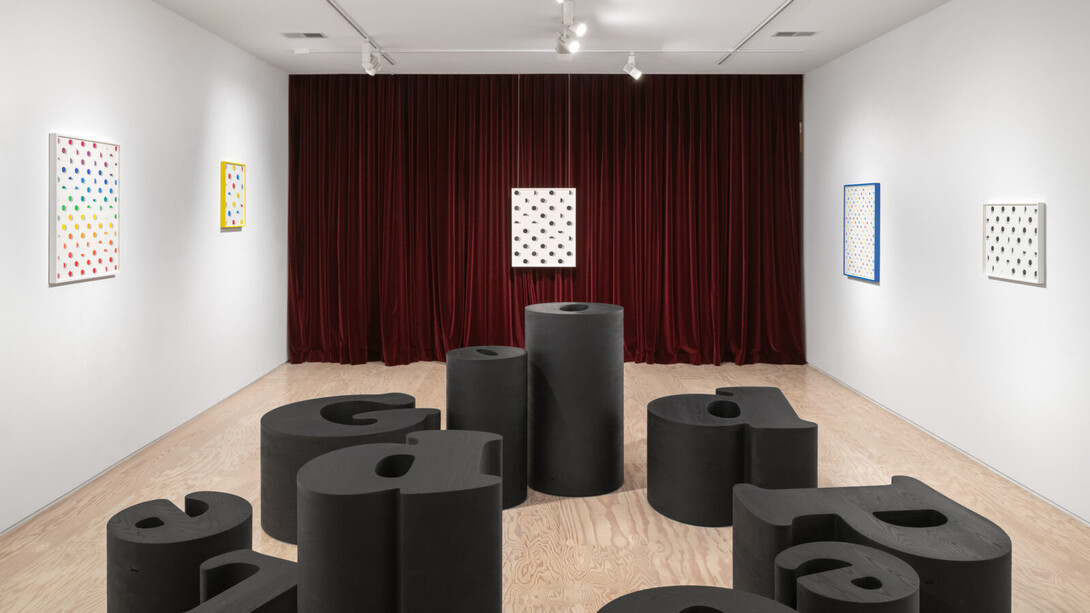
Jessica Silverman is pleased to present Sadie Barnette‘s second solo exhibition with the gallery titled 28 as it is the 28th solo exhibition of the artist’s career to date. On view September 10 through October 24, the show features new colored-pencil drawings and a new installation in ash and poplar wood that asks questions about perspective and legibility. Throughout the show, Barnette explores the history of abstraction, the social life of language, and the unconscious insights of the mundane. The work in 28 is as intellectual as it is embodied, revealing the significance of a single mark, and the multiple meanings of an ordinary phrase.
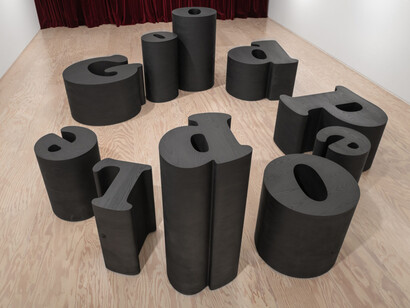
Good people (Decaptych) (2026), is an eleven-foot-long, three-dimensional rendition of the phrase “good people” in Cooper Black typeface. While her 2-D text works invite reflection and interpretation, Good people (Decaptych) also calls the body forward. Arranged around an open center, the sculpture turns the familiar phrase into a communal structure.
For over a decade, Barnette has turned recognizable symbols and expressions into recurring motifs. Repeated mark-making and text-based abstractions materialize the unacknowledged weight of familiar sensations and experiences. Barnette’s practice is rooted in family legacy and personal exploration. In 28, the artist extends questions of recognition and legibility through elemental forms and the phrase “good people.” Her painstaking, pristine drawings achieve an almost print-like precision, despite being made entirely by hand, while her carefully crafted sculptures make unconventional use of their materials. Through repetition, labor, and material transformation, Barnette gives form to the associations carried by even the simplest marks and phrases.
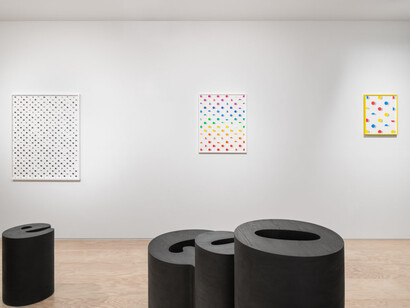
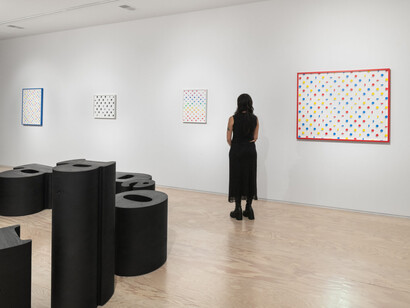
28 also debuts a group of colored-pencil drawings from her new Dots series. Here the artist designs a pattern that is translated into a translucent vinyl stencil, building up color through tight, systematic layers. Each work follows one of three predetermined palettes—primary colors, rainbow, or black-and-white—and is further shaped by position and size. The process recalls the Conceptualist legacy of artists such as Sol LeWitt, who used written instructions to generate their compositions. Cool-gray shadows give the dots an illusion of depth, making them appear to hover above the paper, while some dots break into half-moon shapes. At a larger scale, the primary-colored circles recall John Baldessari’s use of disks to thwart the gaze, while their repetition evokes Howardena Pindell’s punched-paper compositions. Barnette engages in this art-historical conversation and reasserts the hand into forms associated with mechanical reproduction.
In 28, Barnette recasts the language of postwar American abstraction, challenging the presumed neutrality of its elemental forms. Familiar signs shift in scale, substance, and meaning. In Barnette’s hands, the ordinary becomes open and expansive.