English
 Español
 Français
 Deutsch
 Italiano
 Português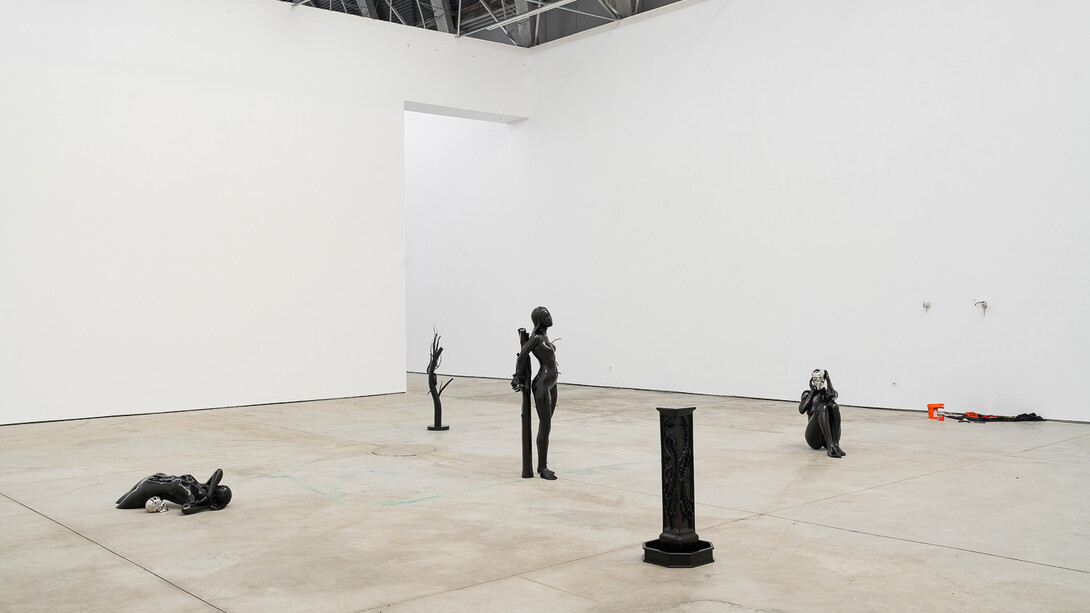
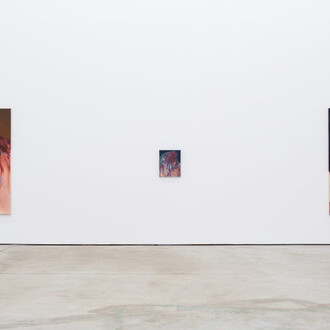
Galeria Nicodim, Bucharest is pleased to present Seven of cups, the inaugural large-scale solo exhibition of emerging Italian-Romanian artist Marta Mattioli. The exhibition marks her debut with the gallery and coincides with a celebratory milestone - the 20-year anniversary of Nicodim Gallery’s founding in Los Angeles. For Mihai Nicodim, the founder and owner of the gallery, returning to frame Mattioli’s monumental debut in Bucharest, represents a deeply symbiotic homecoming, bridging the gallery's two decades of championing raw, transformative contemporary practices in Los Angeles, New York and Bucharest. Adding a layer of institutional continuity, the accompanying exhibition essay is penned by Romanian-American writer and curator Luana Hildebrandt, the gallery's former director who helped establish Nicodim's original space in Los Angeles.
Marta Mattioli investigates the intersection of classical archetypes, bodily fragmentations, and industrial materialism. Splitting her formative years and artistic development between Romania and Italy, she draws heavily from the disparate visual landscapes of her dual heritage, merging high gloss, post industrial installations with classical environments. Her earlier studio practice gained recognition for its intimate focus on anatomical structures in stainless steel and silver, examining how the skeletal frame records internal resonance. Seven of cups, her debut exhibition at Galeria Nicodim, Bucharest marks a pivotal point in her practice, scaling up her vocabulary from isolated, decontextualized fragments to sprawling, human-sized environments.
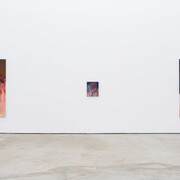
Set within the space that once operated as an industrial workshop for producing monumental public sculpture, the exhibition Seven of Cups, spanning both gallery rooms, unfolds from an art historical lineage of rupture, reproduction, and material transmutation. The venue itself functions as a repository, holding the indexical, phantom imprint of forms no longer physically present to chart an evocative trajectory between physical wreckage and the internal form of memory.
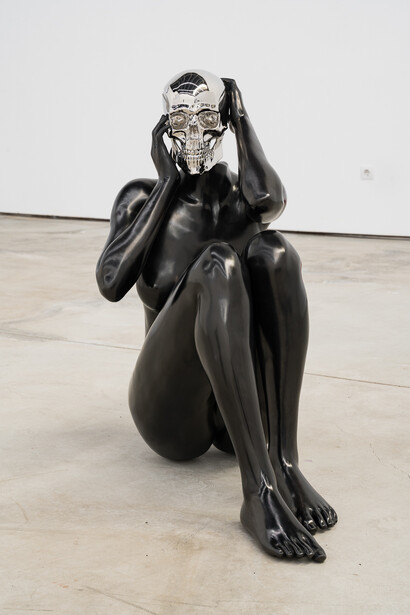
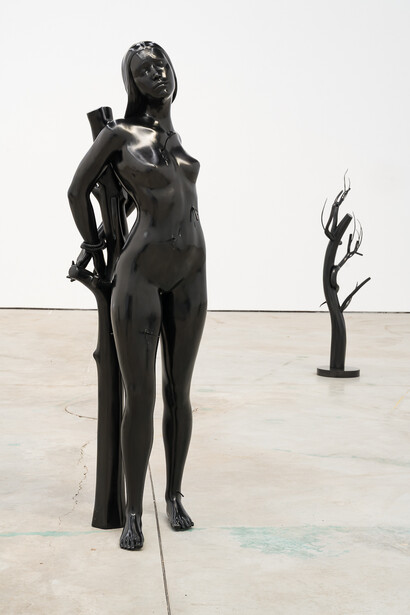
In the first room of the exhibition, a female figure surrenders to the architecture in three distinct positions—the penitente, martire, and memento mori—that survive precisely through historical repetition, given new bodies to resist absolute erasure. Defined equally by their symbolic weight and their raw material presence, these human-sized sculptures, channeling archetypes from Mattioli’s Italian heritage and childhood memory, inhabit the space to establish an intimate, confrontational relationship with the spectator's body. At the same time, they execute a dialectical subversion of the weight, authority, and permanence traditionally used to extend institutional power beyond the flesh and preserve presence past death. Here, architectural permanence is deeply unsettled; monumentality is stripped of its distant, classicist stance and reduced to the fragile proportions of the human frame, shifting from an assertion of power toward an evocative meditation on embodiment.
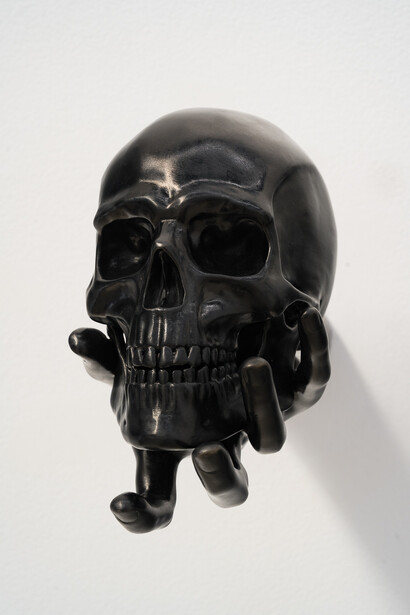
Flanking these figures is a monolithic fontanella endlessly cycling water until it ceases to flow. Its four panels, reimagined as vanitas, place creation alongside disappearance. Stainless-steel anatomical fragments like the Atlas vertebra and Adam’s apple are hanging decontextualized on the wall. Encapsulating the inward turn of Hegel's "Romantic" stage of art, these anatomical pieces function as physical ruins where structural stability is undone, suspended between the body they once supported and the object they have become.
This processual dissolution of the aesthetic object navigates a sharp tension between light absorbing black patinas and highly reflective chrome surfaces. The deep black surfaces act as pure material negativity, pulling the objective specificities of the sculptures inward toward total anonymity and concealing specific identities. Conversely, the mirrored steel surfaces act as structural interruptions within the gallery that completely break the static objectivity of the artwork. Because the reflective surface constantly mutates according to the physical position of the observer, it forces a transition into an active, subjective reception—the viewer cannot look at the object without being returned to their own presence, anchoring the aesthetic experience in immediate, self-reflective awareness.
This trajectory ultimately culminates in a silent second room dominated by a solitary, partially submerged ceremonial table. Reinterpreting the ritual of the feast through desire and consumption, the installation engages the Tarot’s Seven of cups as the ultimate emblem of earthly illusion, human ego, and the crisis of choice. Where the traditional tarot card presents a seeker with seven floating chalices overflowing with worldly temptations—wealth, glory, power, and desire—warning that these pursuits are mere projections of the ego, the exhibition masterfully merges this iconography with the Renaissance memento mori tradition to expose the spiritual aftermath of those cravings.
Through her manipulation of polished surfaces, emotional tension—channeled through the archetypes of the penitente and the martire—and anatomical fragments, Mattioli’s practice echoes Berlinde De Bruyckere’s visceral subversions of classical form, aligning with a rich art historical legacy of utilizing fractured anatomical ruins to archive human impermanence. Simultaneously, her translation of fluid, virtual renderings into rigid, hand-cast metals directly alludes to the "Post-Digital Baroque," an aesthetic framework that updates the hyper-visceral, theatrical sensibilities of 17th-century counter-reformation sculpture for an era dominated by screens and interfaces.
(Text by Luana Hildebrandt)