English
 Español
 Français
 Deutsch
 Italiano
 Português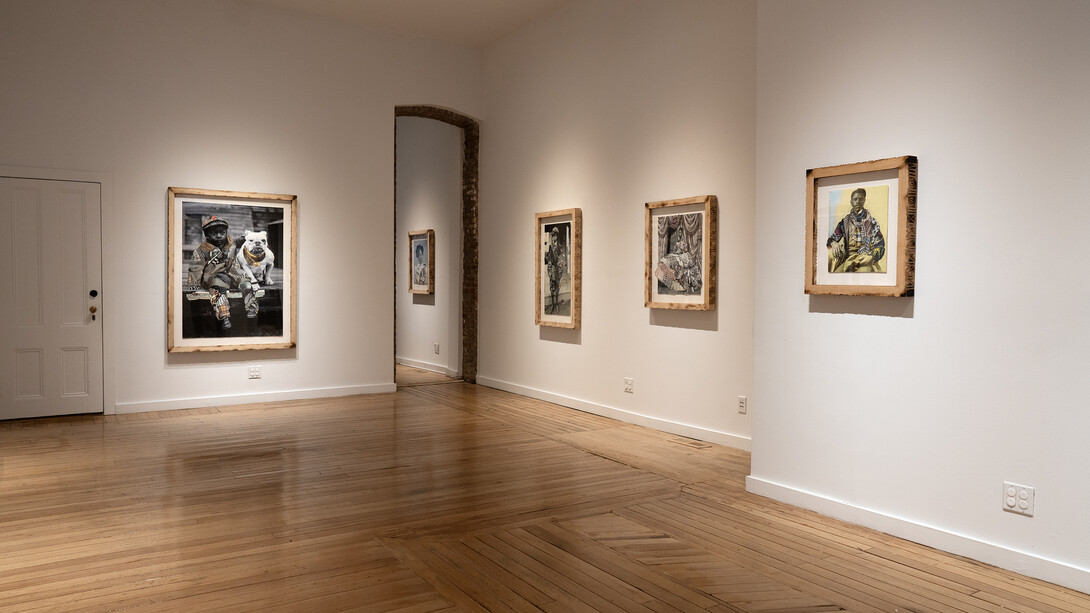
Claire Oliver Gallery is delighted to open our season with The weight of grace, a new solo exhibition by multidisciplinary artist Stan Squirewell. “This body of work is my love letter to the people who came before me,” states Squirewell. “I keep going back — five generations, six — because I want to know who was standing there so that I could eventually stand here. History rarely gave them credit, so I wanted to build them a throne instead of a footnote. Every frame in this show is an altar to an ancestor, named or unnamed, real or reimagined. At the end of the day, this whole body of work is about one thing: celebrating life in all its majesty.”
Comprised of 14 new mixed-media works, soft sculptures, and installation, the exhibition is a tribute to the consequence of connection across generations via material culture. Using the metaphor of a river, a traditional life source that carries cross pollination through space and time, Squirewell wrestles with the concept of family, what is seen and unseen, inherited and imagined and how lineage and folklore impact and evolve over generations. Squirewell’s point of departure is his own matrilineal heritage, offering the viewer a fresh exploration of broader Black identity through memory, material and folklore. The weight of grace is on view September 4 - October 31, 2026.
For Squirewell, the river is the central metaphor for how culture travels through space and time: As people move, their traditions are brought with them, weaving those histories into the new places they settle. Like water, culture is always flowing forward, depositing new silt on old banks. What survives is never purely the source and never purely the delta, but a third entity altogether, remade with every generation that propels it forward.
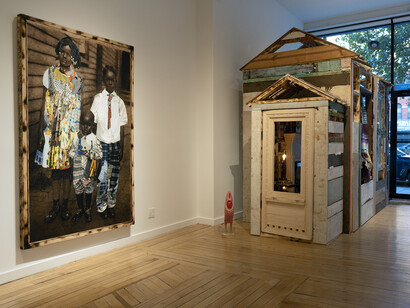
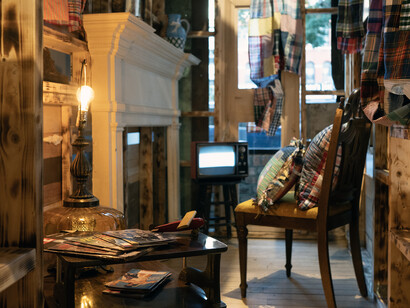
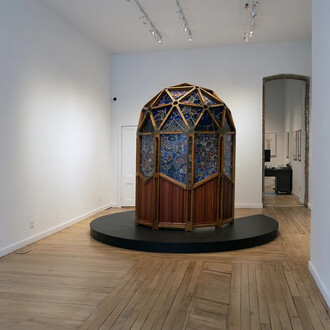
Anchoring the exhibition is a monumental new sculptural installation, a ten-foot long house built entirely from reclaimed and salvaged wood, taking its form from the shotgun house, a vernacular dwelling central to Black life in the American South. Assembled from weathered clapboard, painted trim, and found architectural fragments, this structure widens the lens of Squirewell’s known two dimensional works. By creating a fully inhabitable environment, the artist works to share knowledge of those that have come before. Inside, Squirewell has placed a photograph of his fifth-generation grandfather, a Civil War veteran, the oldest photograph Squirewell owns of any ancestor, honoring him and the many other unnamed relatives who came before. By connecting this shotgun house to the traditional longhouse found in civilizations around the world, he traces a shared history of cultural movements along waterways and a common thread of human resourcefulness in home-building.
Squirewell’s practice of layering is inherent to the artists’ life. Growing up among the row houses of Washington, DC, he recognized an architectural cousin to the shotgun form: morphing as it moves from place to place, absorbing local conditions without foregoing its original anatomy. As a young man he walked through the shotgun houses of New Orleans, homes that had absorbed and reflected wave after wave of migration into and out of the city, each arrival leaving its own imprint on the architecture. When Hurricane Katrina destroyed many of these houses, Squirewell watched a physical record of that inherited, moving culture disappear, impressing on him how fragile the vessels of memory can be. The house installation that is central to this exhibition is his answer to that loss: a structure that holds five generations of his own family, through DC, Harlem, and Louisville, each one contributing its own layer, the old continually remade by the new, made richer by carrying the past forward.
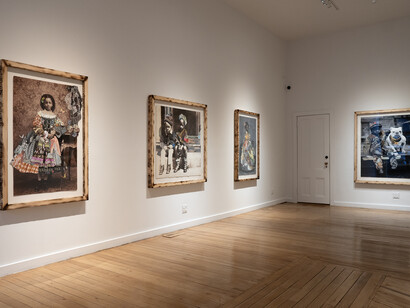
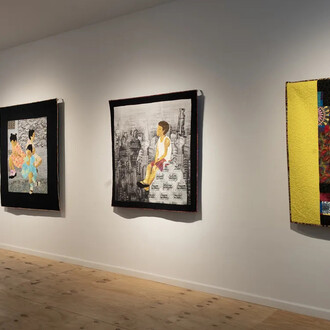
Continuing his practice of reclaiming identity from historical anonymity, Squirewell draws from the Smithsonian Institution's anonymous photo archives alongside personal family photographs, sourcing images of relatives across generations: parents, grandparents, great-grandparents, and beyond. Working in his signature layered process, which the artist likens to a DJ's remix, Squirewell photographs fabrics and adornments he collects and owns, then collages them onto his subjects, weaving vibrant patterns and status-branding elements that confer dignity and legacy onto figures once left unnamed. Each work is set within a hand-carved frame, inscribed with text drawn from Langston Hughes' poetry alongside binary code, Indigenous American symbols, and glyphs from a long-forgotten African language, then finished in the Japanese shou sugi ban technique of fire-blackening wood. Through this technique, Squirewell transforms each frame into a reliquary for the ancestor it holds.
The new body of work builds on the concept explored in Squirewell's previous exhibition Robitussin, hotcombs and grease, which likewise traced the influence of stories from the past, events of the present, and projections toward the future. Where that earlier show incorporated work by other artists who shaped Squirewell's own thinking, this new exhibition turns the lens inward, comprised solely of his own work—a continuation of the same trinity of past, present, and future, now focused entirely on his own memory, lineage, and ingenuity.
The presentation arrives on the heels of significant institutional recognition for Squirewell. Threads of influence, his solo museum exhibition organized by the KMAC Contemporary Art Museum in Louisville, KY, where the artist has lived and worked since relocating from Harlem, has been on view to wide acclaim and will travel to the Hunter Museum of American Art in Chattanooga, Tennessee from September 24, 2027 through January 10, 2028.