English
 Español
 Français
 Deutsch
 Italiano
 Português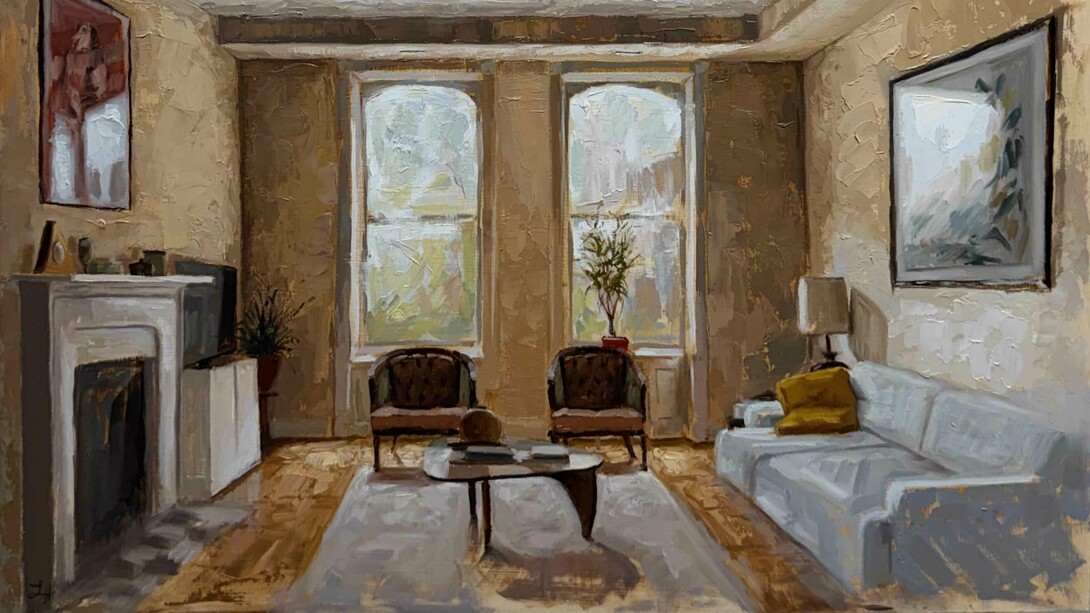
Jackson Junge Gallery is pleased to present their fourth solo exhibition of the year, Lingering stardust, featuring the artwork of Chicago oil painter, Laura Haberer. This expressive collection sheds light on interiors across Chicago and in doing so constructs a portrait of our shared lives. By omitting human subjects, the viewer is made to consider the influence of humanity on the mutual spaces we occupy. The essence of the architecture we exist within is imbued with the stories of each passing face, their light a refraction which reverberates through the ages, all the way back to the stars from which we all came.
Haberer’s calling to begin a career as a painter was born of her desire to find connection and belonging within a contemporary world that felt disoriented in the wake of the pandemic. While quarantine caused a shift in all our interpersonal relationships, Haberer was uniquely impacted as a professional psychotherapist. Having to alter her practice to limit face-to-face interaction, she felt that those relationships which were so crucial to her personal and professional worlds were farther away than ever before. This feeling of distance caused her to consider ways that she could bring herself closer to the world around her. In doing so, only six years ago, she began to paint. Since that time, Haberer has taken to a range of subject matter, from landscapes to portraiture, but finds that interiors have a unique ability to tell stories. After gaining the confidence to take her practice out into urban environments beyond her own home, she felt called to paint places and objects which hold a depth of communal history. “I find home with people, that first was represented for me in my own living room,” she says of her previous work depicting interiors. “I think as I started to look around more, I realized that home exists wherever we are.”
Lingering stardust is a continuation of Haberer’s unending goal to express our connected lives, zooming outward beyond the individual’s environment to include transient areas. Cafes, cultural centers, antique stores, and open houses are communal spaces which feel the activity of so many unique lives every day. The significance of these spaces as a connective force cannot be overlooked in an urban environment whose infrastructure is increasingly tailored to individualism. In divorcing these spaces from any of the people that would typically inhabit them, a mutual past emerges which ties together all their occupants across time.
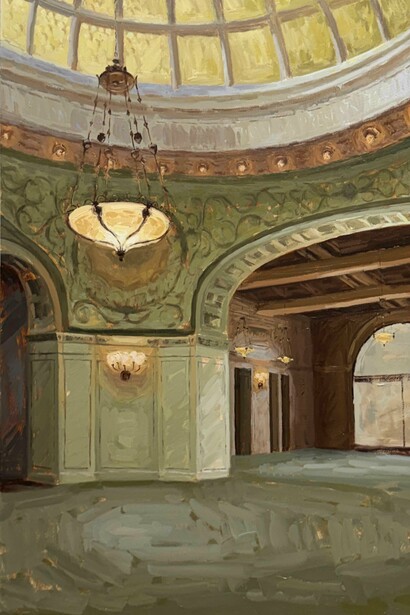
There is a feeling of quiet wisdom that resonates throughout architecture that has been a historical meeting place for generations. In Haberer’s depiction of the Chicago Cultural Center, Elysian light, this sentiment is expressed with great intricacy. The specificity of such ornate decorative architecture as the Preston Bradley Hall Tiffany Dome is not lost on her brush. She lovingly captures the mosaics which have adorned the walls since the Cultural Center’s opening to the public in 1897, originally as the first Chicago Public Library, with great detail. These subtleties cause her audience to consider the lives of those who spent their time building that architecture, and how many have experienced that handiwork during its 129-year lifespan. In the same stroke, the gentleness and warmth she introduces to the space allows the viewer to see a site softened by time, basking in the wonder of all who have travelled through.
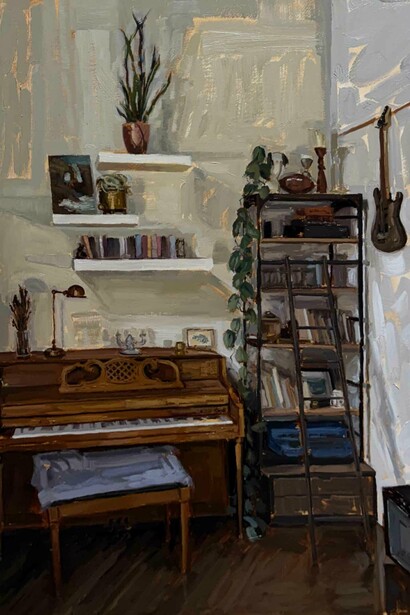
The reverence that Haberer’s audience feels while viewing these works is inherent in the subject matter she chooses to paint. She finds that soft light in combination with antique objects reveals an emotional quality that draws her toward painting these spaces. “It [light] encircles everything inside the room. And all those things inside the room are symbols of lives lived. All the nooks and crannies are as complicated as the humans they represent.” This sentiment is evident in the piece Walls tell stories, a depiction of her childhood friend’s home as it is being shown for sale. While the light dancing on its centerpiece, a piano, feels representative of that family’s connection from father to young son through music, it also feels as if it is waiting for the arrival of a new tenant to build a different kind of sanctuary in the space, as many families had before them. This exercise in observing the intimate details that make a place feel like home is contrasted by its sister piece, To leave a place, which also uses an apartment on the market as reference. With its heavily staged furniture and distant composition, the audience is made to feel as though the signifiers of home are packed up in boxes, while the surrounding walls remain steeped in the warm afterglow of loving memories.
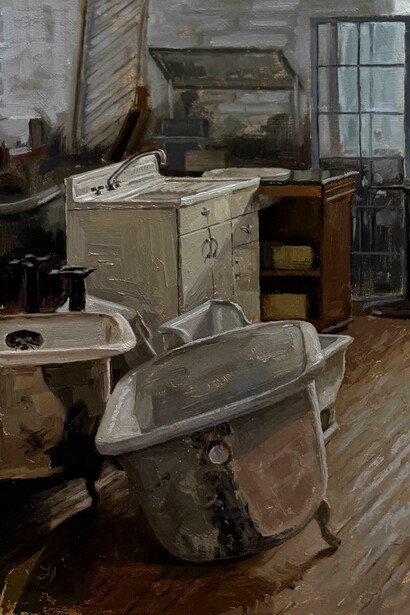
In Haberer’s eyes, the spaces and the objects in them are separable from each other, but inseparable from the influence that humans have on them. Since becoming a new mother, she empathizes with how generations of familial interaction are internalized by everyday domestic objects, even as they are separated from homes. The way that light refracts off rust, cracks, and weathered enamel is illustrated with just as much glory as intentional decoration. “I couldn’t help but think of all the children bathed in those bathtubs and all of the mothers bathing those children in those bathtubs...” she says of painting Nostalgia, whose subject is defunct bathroom fixtures found at Salvage One, an architectural salvage shop in West Town. “That experience of bathing your child is no different than it was 500 years ago, than it was 50,000 years ago.”
Laura Haberer offers a similar treatment to the atmosphere of each piece in the Lingering stardust collection. Through visually softening each space she depicts, dappling light across each interior, she diffuses those edges that form physical boundaries and highlights the intricacies of each space simultaneously. In doing so, she can show us a microcosm of the ever-evolving character of our world. “My understanding of human nature is that it is incredibly complex. Not black and white. The only universality to it is that everyone is complicated. What I’m trying to evoke is that nothing is concrete.” The softness expressed across Haberer’s body of work is a facet of that same philosophy, that despite the unique qualities of every individual, the separation between each of us is lesser than we often perceive. “Those lines are blurred if we let them be.”