English
 Español
 Français
 Deutsch
 Italiano
 Português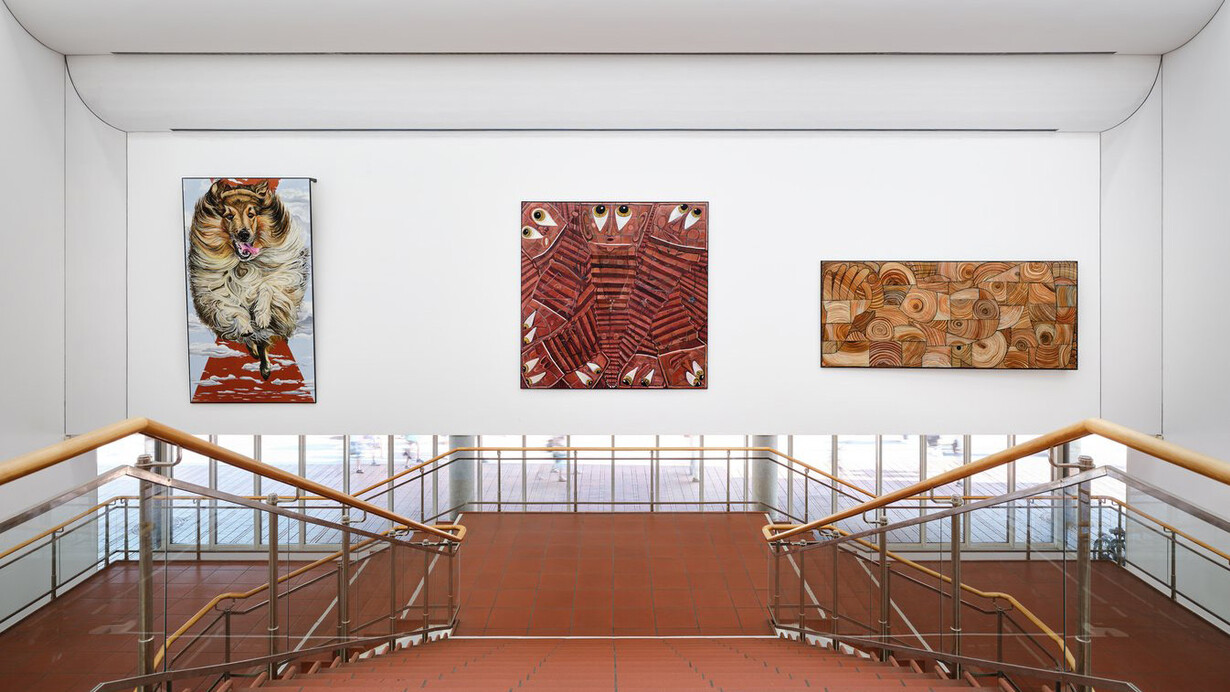
Every two to three years, an artist is invited to create a new work for the Museum Ludwig’s largest wall, located in front of the main staircase. Schultze Projects pays homage to artist couple Bernard Schultze and Ursula (Schultze-Bluhm), whose artistic estates are managed by the Museum Ludwig and commemorated with this series, which was initiated in 2017.
For the fifth edition of Schultze projects, Jana Euler (born 1982 in Friedberg) has developed a new work, Triptych – image viewer connections, that deals with specific ways of seeing and perceiving art, and with the interaction between work and audience.
The museum is one of the few places where seeing itself becomes an activity. Unlike in the cinema, where the gaze is guided and fixed in time, the museum experience is marked by movement: we walk, linger, talk, and discuss what we have seen. In contrast to the fast, fragmented movement of scrolling on screens, we take more time and are more concentrated, defining the duration, distance and sequence of our looking. We often view artworks slowly, comparing them from different angles. The museum offers many perspectives and the chance to give our eyes free rein.
Euler’s work vividly and humorously addresses this process of finding a viewpoint, making use of the specific spatial situation that allows the wall to be seen from three different levels, and while going up or down the stairs. The individual pictures have different formats and use a mixture of styles and techniques. The top and sides of the huge wall on which they hang is covered with a mural that realistically replicates the museum’s saw-tooth roof including climate-control and side walls.
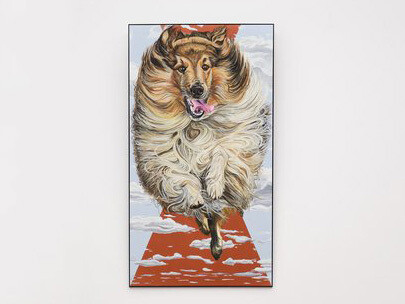
The left-hand picture, One on one, is a largely naturalistic rendering in oils of a long-haired collie, painted from photographs. The picture leans out from the wall, reinforcing the impression that the dog is hurtling towards the visitors and that there can be no escape.
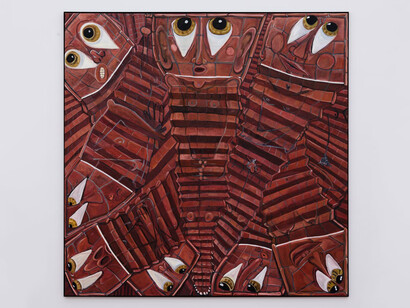
The reddish-brown of the middle picture, Nude stairs staring back, quotes the floor tiles at the Museum Ludwig. At first, it looks like an abstract, cubist composition. On closer inspection, various body parts emerge – eyes, mouths, breasts and genitals. “The motif of naked, anthropomorphized stairs that occupies the whole of the canvas seeks to make eye contact with every position from which the wall and the picture can be seen. The eyes slide to the edge of the frame, looking out at the various heights and platforms where viewers might be standing.” (Jana Euler)
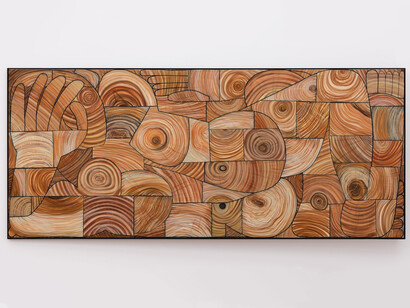
The third picture, Reclining nude, is done in acrylics sprayed onto canvas. It is based on the colors and structure of the wooden floors at the Museum Ludwig. Like the left-hand picture, it protrudes slightly from the wall. In what initially appears to be an entirely abstract composition, the viewer discovers the five fingers of a hand supporting a head. With a little imagination, it is possible to make out the rest of a reclining body that is turned away, knees bent. “The human figure and the picture are one, and there’s no eye contact because the figure is lying pensively with its back to the staircase. I think being seemingly ignored in this way allows viewers to identify with by the figure, as well as recognizing the floor on which they have been walking around the museum.” (Jana Euler)
The trompe-l’oeil effect of the mural surrounding the three works only works from a single viewpoint on the staircase. It makes the entire surface appear smaller, and the already large canvases even larger. This again underlines the importance of the perspective from which something is seen. No less important here is the connection between the viewer and the object of their gaze. Realizing that this applies both specifically to Jana Euler’s contribution to Schultze projects and in more general terms is one of the many experiences offered by this work.