English
 Español
 Français
 Deutsch
 Italiano
 Português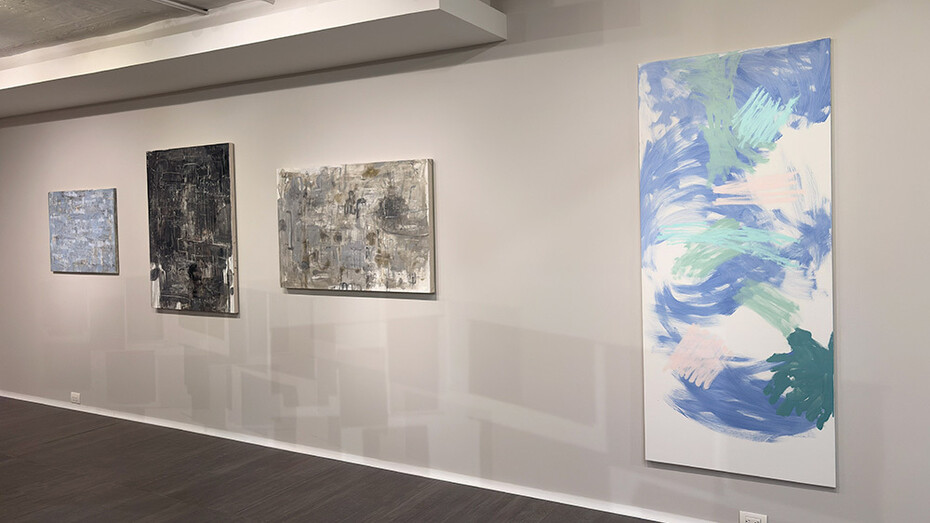
What is a landscape made of?
Not only of mountains, trees, or rivers. A landscape is, above all, an accumulation of smaller things: the humidity that comes before the rain, a reflection that lasts a second on the water, the dryness of cracked earth, the cold that changes the color of the sky, the light of an hour that never repeats itself quite the same way. We recognize a landscape long before we name it. We feel it in fragments, and only afterward, if at all, do we gather it into a word: mountain, river, field.
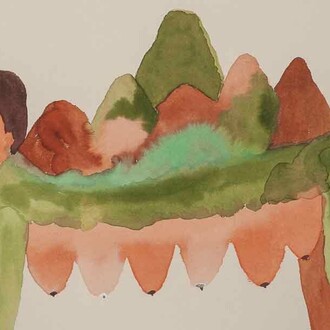
Imagination doesn't always work with what we see. Sometimes it works with the substance of things themselves — their weight, their temperature, their density. Some matter is heavy and resistant, like dry earth; other matter can barely be touched, like air or moving water. We identify earth by its dryness or its dampness, before its shape. Air can barely be felt passing by. Natalia Mendieta and Lorenza Panero begin exactly there: not from sight, but from matter. Rather than depict landscapes, they evoke them through their most elemental qualities.
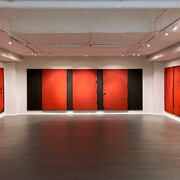
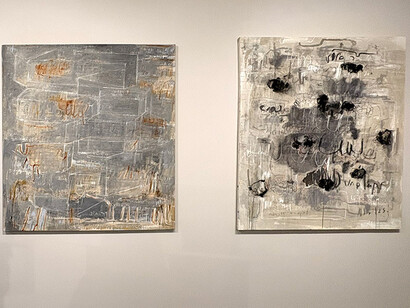
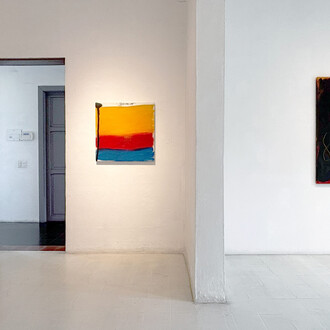
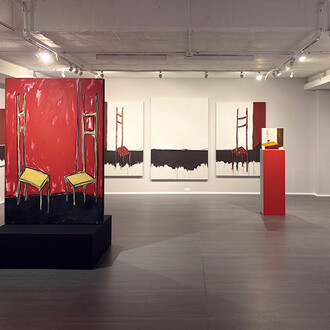
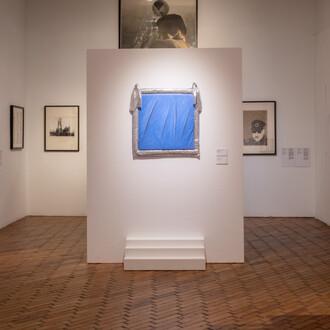
For Natalia, that matter has a concrete name: the tapia, or rammed-earth wall — a way of thinking about the ground that receives a mark: the color of the earth, the craft of building, the trace someone leaves behind when raising a wall to live inside. This reflection runs through canvases, rice paper, and ceramics, and condenses into a poem of her own, Una tapia es una tapia (A Wall Is a Wall), where a single thing unfolds into everything it can be at once:
"A wall is a wall, / it's a house, / it's the wall itself. / It's mountain, it's vestige, / it's the block, / it's boundary."
That same word — tapia — reappears in the paintings, transformed: its silhouette is present in every piece, though it's no longer recognizable as a word. It has become stroke, gesture, calligraphy that gestures toward meaning without fully declaring it.
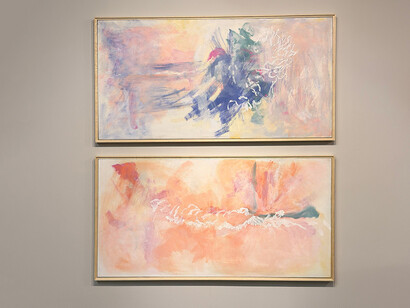
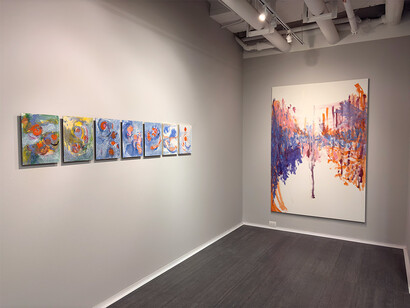
Lorenza moves in the opposite direction: she works with what can barely be held in the hands. Her painting and work on paper live in an ethereal terrain, closer to air or water than to earth — everything tends to dissolve, to lose its edge, to become atmosphere before form. Painter David Manzur noted this in her work years ago: there is something "oneiric, magical, and mysterious" in these images, closer to a state of mind than a specific place. Her images don't tell a story; they let each viewer build their own in front of them. The light of an hour of the day, the sense of being near or far from something that never quite comes into focus — that's what remains. Here, there is something felt before it can be described.
Earth and wall, light and air: the materials change, but the trust is the same — that the viewer completes what the work only suggests. No image in this show is fully resolved. The exhibition unfolds almost like a poem: meaning doesn't rest in a single piece, but in the relationship between them, in what resonates from one work to the next, in the silences between one wall and the following.
We don't see a landscape, but qualities. Those qualities summon elements, and the elements, in turn, awaken the imagination. The rest is done by the viewer: it is that imagination that finally reassembles the landscape.
(Text by Ana Lucía Arbeláez)